

Audio By Carbonatix
President John Mahama has outlined a bold plan to transform Ghana’s mining industry, saying that the country must move beyond exporting raw minerals and instead build a strong, technology-driven and locally owned sector.
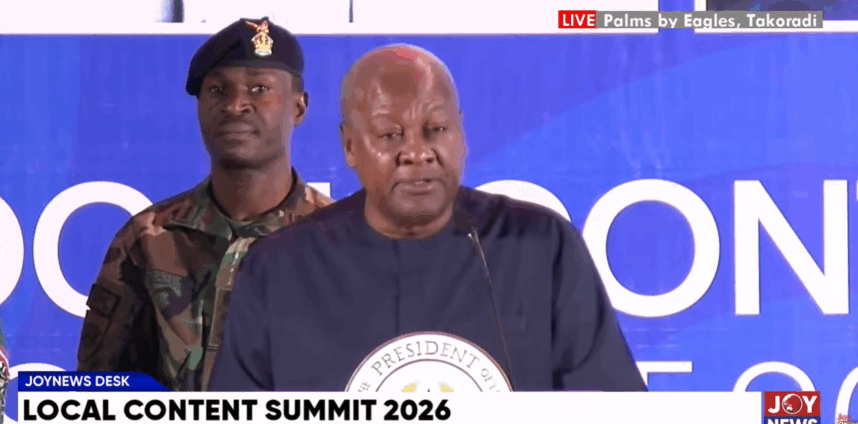
Speaking at the 2026 Local Content Summit in Takoradi, the President said his government’s approach would be guided by six strategic pillars designed to deepen local participation and ensure long-term national benefit from Ghana’s mineral wealth.
“Today, I wish to outline six strategic pillars that will guide our approach to local content,” he said.
The first pillar, he said, is to shift local content from simple transactions to real partnerships. “Local content must evolve from transactional procurement to transformational partnerships,” he stated.
President Mahama said government is reviewing mining laws and regulatory frameworks to help Ghanaian companies move higher up the mining value chain.
“Government is reviewing and refining our mining legislation and regulatory frameworks to ensure that Ghanaian enterprises move up the mining value chain,” he said.
He said that Ghanaian firms must grow from “suppliers of consumables to manufacturers of critical components, from service providers to innovators.” He added that mining firms would be encouraged to build local capacity rather than merely purchase goods locally.
“Equity participation, technology transfer, and knowledge sharing must become standard practice and not the exception,” he said.
The second pillar focuses on value addition. The President said it is no longer acceptable for Ghana to export raw minerals while importing finished products.
“It is no longer acceptable for Ghana to continue to export raw ores and import finished products. We must aim to eliminate raw ore exports within the next five years,” he said.
He called for the establishment of refineries and bullion infrastructure, the promotion of mineral-based industrial clusters, and increased downstream processing of bauxite, manganese and lithium.
“Our mineral wealth must power Ghana’s industrialisation, not merely sustain export dependence,” he said, adding that Ghana’s mining strategy must align with the global green energy transition.
The third pillar centres on human capital development. According to President Mahama, no mining sector can compete globally without a skilled workforce.
“We will strengthen institutions such as UMAT and our technical universities,” he said, referring to the University of Mines and Technology. He added that apprenticeship programmes would be expanded in collaboration with the mining industry.
Priority skills areas will include automation and robotics, drone and modern exploration technologies, data analytics, environmental sustainability and renewable energy integration.
“We must train not only miners, but also mining technologists, engineers, and innovators,” he said.
The fourth pillar looks to the future of mining. “The future of mining is digital, sustainable and technology-driven,” the President said.
He announced plans to position Ghana as a hub for AI-assisted exploration, IoT-enabled asset management and blockchain-based supply chain transparency.
He also revealed that government would explore establishing a national mining innovation and research hub to support knowledge sharing and technology adaptation.
“This summit must mark the beginning of a structured ecosystem and not a one-off event,” he said.
The fifth pillar focuses on expanding indigenous Ghanaian ownership in the mining sector. President Mahama said government would support local companies to scale up from subcontracting roles to full ownership of major mining projects.
He cited the Black Volta gold project being developed by Engineers & Planners Limited as a landmark example.
“This is the first mining project of such scale being undertaken by a wholly owned Ghanaian company,” he said.
When operational, the project is expected to produce about 170,000 ounces of gold a year over a mine life of more than 15 years.
The sixth pillar emphasises responsible mining and community protection. “Local content cannot be separated from responsible mining,” the President noted.
He said development agreements and community engagement would be strengthened under a revised minerals and mining framework, with traditional authorities and Metropolitan, Municipal and District Chief Executives playing key monitoring roles.
“Mining must leave our communities better than it found them,” he said.
The President also pledged continued action against illegal mining and renewed efforts to clean polluted water bodies and reclaim degraded lands. He said government would work to formalise the artisanal and small-scale mining sector.
President Mahama said that government alone cannot deliver the transformation. “This is a shared responsibility. The government cannot achieve this transformation alone,” he said.
He challenged Ghanaian entrepreneurs to rise to the occasion. “The bar for quality and innovation is high. But the opportunity is unprecedented. You must prepare, you must build partnerships, and you must compete.”
To international investors, he offered assurance but also clear expectations. “Ghana offers you stability, policy clarity, and long-term partnerships. But we expect genuine collaboration that embeds capacity within our economy,” he said.
He also urged regulators to ensure fairness and transparency in enforcement.
In a reflective moment, the President asked: “What will be the legacy of our mineral wealth 100 years from now?”
“If we get this right, our greatest export will not be raw gold, raw bauxite, raw manganese ores, or lithium. Our greatest exports will be Ghanaian talent, Ghanaian technology, Ghanaian enterprise, and a resilient and competitive mining economy,” he said.
He urged stakeholders to move beyond declarations. “This mining local content summit must deliver more than just declarations and must deliver a binding commitment, a shared national pact that makes our mining industry thrive. The work begins now,” he said.
Latest Stories
-
Power restoration fault suspected in Kumasi Central Market fire
2 hours -
The 7-foot giant of Ngleshie Amanfro: Seven-foot Ghanaian Ephraim Saawa dreams of joining the national basketball team
3 hours -
Government promises support for Kumasi Central Market fire victims
3 hours -
Vibes The Movie: Big Ghun’s Ghanaian film earns five nominations at 2026 REFFA
3 hours -
MamaCare CEO warns unresolved conflicts among health workers could undermine maternal and neonatal care
4 hours -
Health professionals urged to translate medical knowledge into practice to save mothers
4 hours -
Conflicts among care providers linked to maternal, neonatal deaths – Expert
6 hours -
GIS marks 10th TIME conference, champions improved teaching practices
6 hours -
BRICS Or Balance? What Ghana’s bid really means
6 hours -
GPRTU wants full TRAFFITECH-GH implementation to start in 2027
6 hours -
Mahama announces plans to import electric wheelchairs for PWDs
6 hours -
KGL U17 Colts 2026: Western beat Prempeh Elite Academy to set up final final with Greater Accra Region
7 hours -
Late Solanke strike salvages 10-man Spurs draw at Man United
7 hours -
Gender Ministry to monitor welfare of Nana Akua Addo’s children amid domestic violence case
7 hours -
Benedict Okyere Yeboah: Ghana’s football problem goes beyond sacking a coach
7 hours