

Audio By Carbonatix
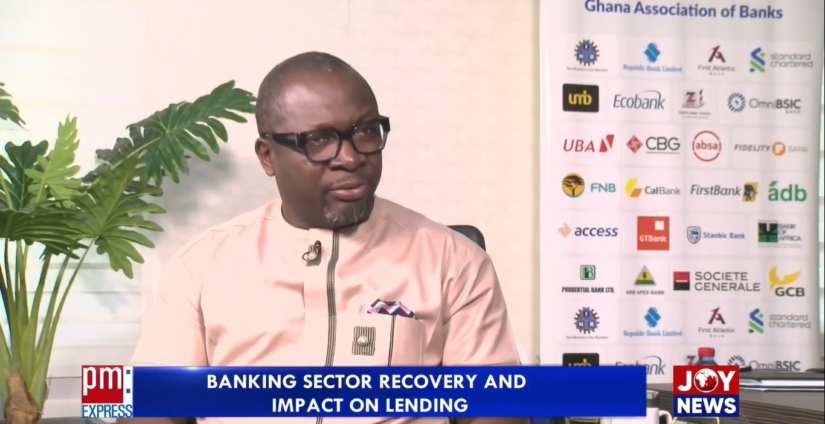
The Chief Executive Officer of the Ghana Association of Banks, John Awuah, has highlighted the pivotal role of the banking sector clean-up in weathering the challenges posed by the Covid-19 pandemic and the subsequent economic crisis.
Speaking on JoyNews' PM Express on Thursday, Mr Awuah said the exercise was a proactive measure in safeguarding the stability and functionality of the financial industry.
He emphasised the significant contribution of the banking sector to Ghana's successful negotiation of an IMF-assisted programme during these trying times, an action he believes would have been impossible if the sector was not resilient enough.
Reflecting on the resilience of the banking industry, Mr Awuah pointed out that the massive clean-up of the banking sector in 2017 served as a crucial shock absorber.
This clean-up, he stated, played a pivotal role in mitigating the negative effects on the banking industry, ultimately enabling it to navigate the complexities of the economic downturn and the pandemic.
"The banking sector clean-up provided a shock absorber for the industry, and that perhaps is the key enabling force that helped the banks to come through these difficult periods that we’ve had," he told the host, George Wiafe.
Banking sector clean-up
Former Finance Minister, Ken Ofori-Atta supervised the banking sector clean-up from mid-2017 to January 2020 in a bid to restore confidence in the banking and specialised deposit-taking sector.
The government said the action was one of the contributory factors for the country’s high debt stock.
The clean-up saw a reduction in the number of banks from 34 to 23, whilst 347 microfinance institutions, 15 savings and loans, and eight finance houses had their licences revoked.
While some of the commercial banks were merged to form the Consolidated Bank Ghana Limited, state-owned GCB was allowed to swallow others.
The Securities and Exchange Commission (SEC) also announced the revocation of the licenses of 53 Fund Management Companies.
A number of these institutions were found to have varying degrees of corporate governance lapses.
The total estimated cost of the state’s fiscal intervention, excluding interest payments, from 2017 to 2019 was pegged at GH¢16.4 billion.
Vice President, Dr. Mahamudu Bawumia in 2020 claimed that the government spent about GH¢21 billion on the banking clean-up exercise.
Nonetheless, the clean-up faced massive criticisms with the opposition party suggesting that the closure of some of the banks were purely political, and has caused massive job losses.
The argument has been that, government could have spent less in saving the banks instead of spending more to close them down.
Some of the affected financial institutions also sued the government for the action.
Latest Stories
-
China reaffirms unwavering ties with Ghana as Ambassador presents credentials
10 minutes -
Wrongful teacher postings undermine early childhood education in Upper East
15 minutes -
Five new envoys present Letters of Credence to Mahama
20 minutes -
BoG Governor says building buffers and lowering credit costs go together
26 minutes -
Fuel shock looms as petrol nears GH¢15.19, diesel GH¢17.85 from April 1
33 minutes -
From May to December, nothing works – Tomato traders reveal harsh reality for farmers
46 minutes -
Ghanaian farmer can’t grow tomatoes because of lack of irrigation – Tomato Importers Association president
1 hour -
Social media firms must better enforce Australia under-16 ban, watchdog says
1 hour -
King Charles should meet Epstein victims, US lawmaker says
2 hours -
Belgian ex-diplomat appeals order to stand trial in Congo’s Lumumba murder
2 hours -
Cholera aid for African countries stalled by Iran conflict
2 hours -
The Oscars are leaving Hollywood
2 hours -
Too watery, too risky – Why Ghanaian traders prefer Burkina tomatoes
2 hours -
We buy from Burkina because ours rot fast – Tomato traders defend import dependence
3 hours -
Nigeria’s giant oil refinery fails to prevent record gasoline prices
3 hours