

Audio By Carbonatix
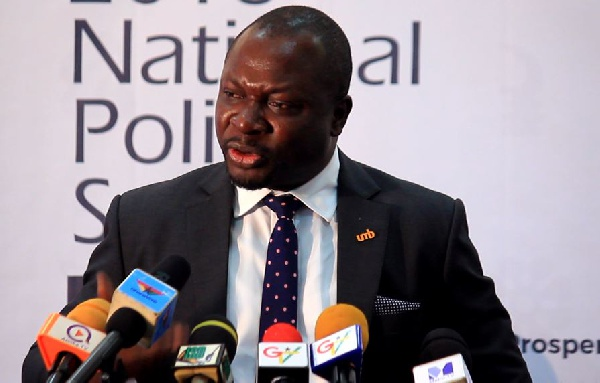
CEO of the Ghana Association of Banks (GAB), John Awuah, says the challenges in Ghana’s lending system reflect the character of the country and deep structural deficiencies that extend far beyond the banks themselves.
Speaking on JoyNews’ PM Express on November 12, he said that comparing Ghana’s lending rates to those in Côte d’Ivoire exposes systemic problems that have nothing to do with banking discipline alone.
He pointed out that many of the banks operating in Ghana also operate in Côte d’Ivoire, yet they lend at much lower rates there.
“Half of the banks operating in Ghana are also operating in Côte d’Ivoire — talk of the Ecobanks, Access Bank and the likes. How is it that in Côte d’Ivoire, the same bank is able to lend at the rate we are talking about?” he asked.
According to him, the difference is not simply about risk or management. It is about the broader systems that support financial operations.
“It’s a character of a country and the structural deficiencies that we have in this country,” he said.
He explained that processes within key state institutions affect how banks function and how credit risk is assessed.
“We have a lot of structural bottlenecks — from the Lands Commission to the court system to credit culture,” he noted.
Mr. Awuah said the absence of a unified credit reporting system makes it difficult for banks to properly assess loan applicants.
“If Mr Joseph Obeng [GUTA president who was also on the show] approaches a bank to borrow, let’s say ¢100,000, all the bank could do is say, Oh, where else do you have exposure? It is word of mouth. There is no mechanism for having a 360 view of the customer,” he explained.
He said borrowers often withhold information about other debts, making it impossible for banks to assess their true financial exposure.
“Whether he has a supplier’s credit, he won’t disclose to the bank. Whether he has taken a loan from the landlord of the property where he rents, whether he is even in arrears, he won’t disclose to the bank,” Mr Awuah said.
This lack of transparency, he warned, distorts lending decisions and increases the risk of loan defaults.
“So the bank gives ¢100,000, thinking it is going to maybe bring goods from China to sell, make money, and pay back the loan.
"Half of it goes to pay the supplier, another half goes to pay rent and salary in arrears. By the time you realise, what you funded is gone. Where is he going to get the money to pay you back?” he said.
Mr Awuah insisted that Ghana’s lending environment cannot be fixed by focusing on banks alone.
The weaknesses, he said, lie in the national systems that define how information flows, how property is verified, and how the courts enforce credit agreements.
“The system that gives the bank a 360 view of the customer is non-existent,” he emphasised.
Latest Stories
-
GTA sensitises taxi drivers in ‘Know Ghana’ tourism campaign
56 minutes -
Archbishop Agyinasare calls for responsible speech amid growing social media abuse
1 hour -
‘It will be inexcusable for gov’t not to honour payment of teachers’ arrears by 30th October’ – Haruna Iddrisu
1 hour -
Forbes’ World’s Best Employers 2026: No Ghanaian firm ranked among 900 companies
1 hour -
Electronic processing of teachers’ data: ‘The decision is the Controller’s’ – GES boss
1 hour -
Teachers’ Strike: Haruna Iddrisu questions paper-based processing of promoted teachers’ data
1 hour -
Savannah Region: Kunfusi bridge collapses again, leaving nearly 4,000 residents cut off
2 hours -
Teachers’ strike: GES targets Monday deadline to submit promotion data to Controller
2 hours -
Inflation to average 11.3% in 2027 – Fitch Solutions
2 hours -
I didn’t campaign for NDC to come and do this nonsense – Kpebu on EOCO
2 hours -
Fitch Solutions maintains policy rate forecast of 14% by December 2026
2 hours -
Diaspora Nasara Caucus congratulates Mohammed Ali Suraj, new NPP executives
4 hours -
Dr Antwi-Boasiako’s cybersecurity book showcased at UN crime prevention congress
4 hours -
We will empower the grassroots and protect every vote – NPP’s 1st Vice Chair Kojo Bamba
4 hours -
I do not see myself as better than anyone – NPP’s 1st Vice Chair Kojo Bamba
5 hours