

Audio By Carbonatix
The short-lived coup in Benin left “casualties on both sides” of the government forces and the mutinous soldiers, authorities said Monday, as security forces intensified the search for the coup leader who was on the run.
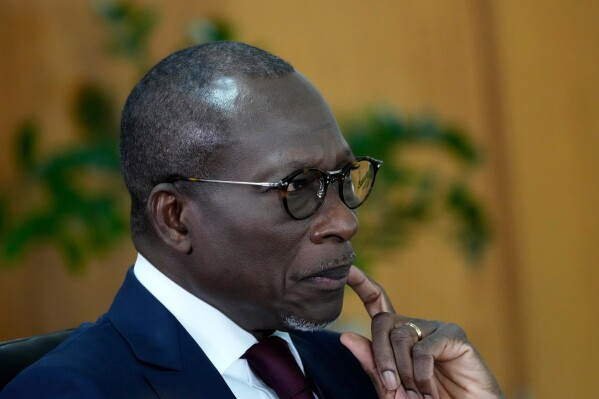
The military takeover attempting to overthrow President Patrice Talon, which lasted a few hours before authorities announced it had been foiled, was the latest in a series of recent coups across Africa — most following a similar pattern of disputed elections, constitutional upheaval, security crises and youth discontent.
In a statement detailing Sunday’s events, Government Secretary Edouard Ouin-Ouro said the mutinous soldiers attacked Talon around 5 a.m. before being “overwhelmed by the fierce resistance of the loyal soldiers.”
The government confirmed the involvement of Nigerian and Ivorian troops in helping to thwart the coup, saying the Nigerian military had “(used) its military aircraft, which immobilised some of the armoured vehicles.”
Authorities said that although several arrests have been made over the coup, its apparent leader remained on the run and was being hunted. Two senior military officers held hostage by those carrying out the coup had also been released, officials said. Authorities did not specify the number of casualties.
An ongoing investigation into the coup will “identify all the perpetrators and their sponsors, whoever they may be” and will assess the damage in the aftermath, Ouin-Ouro said in the statement issued after a high-level cabinet meeting chaired by the Benin leader.
How the coup unfolded
A group of soldiers calling themselves the Committee for Refoundation stormed the national television station on Sunday morning to announce the coup.
Led by Lt. Col. Pascal Tigri, eight soldiers appeared in a broadcast announcing the removal of Talon, the dissolution of the government and the suspension of state institutions.
Before the coup, Tigri was a member of Talon’s protection detail. As an artillery officer, he commanded a National Guard battalion between 2023 and 2025.
By Sunday afternoon, the coup was foiled by Benin’s military, supported by Nigerian air and ground forces, which launched attacks against fleeing coup participants.
Calm on Monday returned to Cotonou, Benin’s administrative centre, with soldiers on the streets.
Talon described the coup late Sunday as a “senseless adventure,” and said the situation was under control. He vowed to punish mutineers and ensure the safety of hostages, including some believed to be senior military officers. He didn’t disclose their identities, and it wasn’t clear how many were held.
The Economic Community of West African States, or ECOWAS, said Sunday that it had deployed a standby force to Benin to help preserve democracy. The troops included personnel from Nigeria, Ghana, the Ivory Coast and Sierra Leone. The size of the force was unclear.
A Nigerian government spokesperson said in a statement that Talon had requested Nigeria’s help. It wasn’t clear how many personnel or how much equipment had been deployed.
Regional challenge
Nigeria and the ECOWAS regional bloc hadn’t intervened in a member state since 2017, when it sent troops to Gambia to force then-President Yahya Jammeh to vacate power following his election loss.
The bloc, led by Nigeria, tried to intervene in Niger after the country’s 2023 coup. At that time, Nigerian President Bola Tinubu led the bloc. His threat to intervene if the junta didn’t restore the ousted democratic government resulted in a standoff between the bloc and three junta-led countries, and they later left the bloc.
Analysts say Nigeria has a strategic interest in defending its borders — which it shares with Benin, Niger, Chad and Cameroon — especially now, while it experiences a severe security crisis.
“The coup in Benin is one too many. Nigeria cannot afford to be encircled by hostile governments,” Oluwole Ojewale, a senior security researcher at Dakar-based Institute for Security Studies, told The Associated Press.
As West Africa battles a surge in coups, analysts say ECOWAS lacks consistency in its response. In Gabon and Guinea-Bissau, the bloc was less assertive, and it has watched some other leaders stay in office via constitutional changes.
“You can make the argument that Tinubu needed to show some strength in preserving democracy, but this now speaks to ECOWAS’ double standard,” said Cheta Nwanze, a partner at the Lagos-based SBM Intelligence geopolitical consultancy firm.
Despite a history of coups following its independence from France in 1960, Benin has enjoyed relative calm in the past two decades. The country is set to elect a new president in April, because Talon is set to leave office after a decade in power.
Latest Stories
-
Edmond Boateng takes up secretary role at Honorary Consular Corps of Ghana
3 minutes -
Gambia appoints British barrister to prosecute gruesome Jammeh-era crimes
19 minutes -
Girl group Flo on entering into their ‘bombastic, confident, strong’ era
29 minutes -
Germany suspends military approval for long stays abroad for men under 45
45 minutes -
Liverpool face uphill Champions League task after PSG thrashing in Paris
46 minutes -
‘Ketamine Queen’ sentenced to 15 years in Matthew Perry overdose death
56 minutes -
Nigeria begins mass trial of 500 terrorism suspects
1 hour -
Atletico Madrid stun 10-man Barcelona to seize Champions League semi-final advantage
2 hours -
Black Stars coach to be announced by next week – Sports Minister
2 hours -
Chiefs, queen mothers and principal elders of Odau group denounce ‘rebellious Etweresohene’, pledges allegiance to Okyenhene
2 hours -
KNUST library dress code sparks online backlash over strict rules
2 hours -
Cultural Diplomacy in Action: Ghanaian youth leaders present symbolic smock to U.S. Chargé d’Affaires
2 hours -
Ghana Card payment activation under review – NIA breaks silence on financial integration
2 hours -
Ofori-Atta’s ICE release on bail positive; he poses no risk – Amanda Clinton
2 hours -
Ken Ofori-Atta’s passport seized after bail, set to reappear in US Court on April 27
2 hours