

Audio By Carbonatix
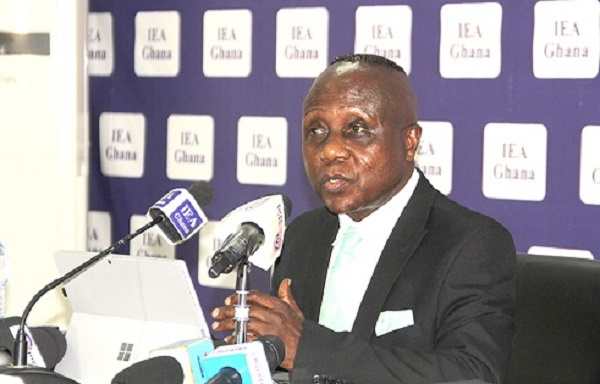
The Director of Research at the Institute of Economic Affairs, Dr. John Kwakye, has indicated that the record GH¢61 billion loss by the Bank of Ghana (BoG) would force the regulator of the banking industry to cut back on some of its important operations so as to save costs.
According to him, the Central Bank’s balance sheet has been severely impacted as a result of the Domestic Debt Exchange Programme (DDEP), and is therefore surprised that the Minister of Finance, Ken Ofori-Atta and the Governor, Dr. Ernest Addison, seem to have played down the loss as only a “technical loss”.
He was reacting to the Vice President, Dr. Bwumia’s defense of the Bank of Ghana for saving the economy from collapse.
“As government debt to BoG was also discounted under the DDEP, the bank made a whopping loss of GH¢61 billion and a record negative equity of GH¢54 billion in 2022. Both the Minister and the Governor seem to have played down the loss as only a “technical loss.” However, the fact is that the Bank’s (BoG) balance sheet has been severely impacted, and this would force it to cut back on some of its important operations so as to save costs”.
Dr. Kwakye added that it is no wonder inflation peaked at 54.1% in 2022 and depreciation of the cedi ballooned to 54.2% in November 2022.
“It is the magnitude of the advance—over 50% of the previous year’s revenue—that is disturbing. It is no wonder inflation peaked at 54.1% in 2022—and depreciation ballooned to 54.2% in November 2022, before falling bank to 30.0% in December 2022”.
Dr. Bawumia strongly defended BoG for heavily monetising the fiscal deficit, especially in 2022. He commended the Central Bank for saving the economy from collapse at a time when Ghana had lost access to international capital markets.
He also said BoG’s action was responsible and that it was temporary as the Central Bank had advanced money to the government in only two of the past seven years.
The Minister of Finance had expressed similar sentiments in the past, but Dr. Kwakye said it was not surprising because government was the direct beneficiary of the monetary financing.
“However, as central bankers, we know that the most inflationary source of financing the budget is high-powered money coming directly from the central bank vault. It is not the fact that BoG advanced money to government that is the issue, for the Bank’s Act provides for such advances up to 5% of the previous year’s revenue”, he mentioned.
Latest Stories
-
Real-Time VAT on cross-border digital services – not a new tax and does not violate double taxation principle
25 minutes -
Digitalisation, AI key to Ghana’s tourism transformation – GHATOF
37 minutes -
Stronger GTA-private sector partnership needed to grow tourism – GHATOF
47 minutes -
Amazon eyes Ghana for broadband expansion after talks with Mahama
2 hours -
National Investment Quiz 2026: Six schools qualify for quarter-finals
2 hours -
‘Do not let Russia pay for its madness with lives of your people’ – Zelensky to Ghana, 46 other countries
2 hours -
6,079 promotion cases fully processed and paid – CAGD says amid nationwide teachers’ strike
2 hours -
Teacher unions to meet government Monday over nationwide strike
3 hours -
Photo story: Republic Bank-JoyNews Habitat Fair clinic wraps up after three days of housing solutions, expert engagement
3 hours -
National Peace Council urges investment in youth to sustain Ghana’s peace
3 hours -
Afenyo-Markin urges youth to speak up against injustice
3 hours -
CAF annuls Edo Queens victory, orders WAFU B final to resume from extra time
4 hours -
Interior Minister urges traditional authorities to enforce anti-bushfire bye-laws
4 hours -
3rd Republic Bank-JoyNews Habitat Fair Clinic ends on a high note after three days of strong patronage
4 hours -
Ten climbers missing after avalanche hits Himalayan base camp
4 hours