

Audio By Carbonatix
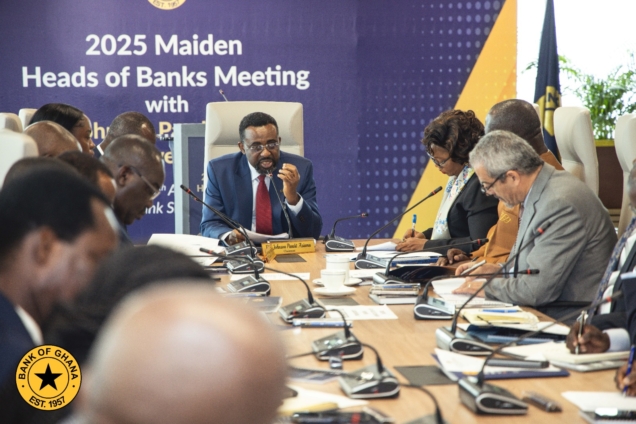
The Bank of Ghana Governor Dr. Johnson Asiama has revealed that the central bank is moving towards risk-sensitive regulation and a system award model for regulating the banking sector.
According to him, this is not just about enforcing compliance but rather “shaping a banking system, that is agile, accountable, and prepared for the future”.
The Governor announced this at a meeting with Heads of Commercial Banks at the Bank Square. This is part of a strategy to engage heads of commercial banks after every Monetary Policy Committee meeting.
In attendance were chief executives or representatives of regulated banks in Ghana and officials of the Bank of Ghana, including the 1st Deputy Governor, Dr. Zakari Mumuni.
Key Focus Areas for Regulation
The Bank of Ghana Governor noted that the first step will be risk identification and mitigation.
According to him, this will focus on the use of data analytics and early warning indicators to identify emerging risk.
The 2024 Fraud Report revealed a 5.0% increase in fraud cases and a 13.0% rise in value at risk.
According to the Governor, this will need “reinforcing the urgency of stronger internal controls and oversight”.
The central bank will also focus on building digital resilience as part of regulating the banks.
Dr. Asiama advised banks to assume greater responsibility for the safety of their systems, product integrity, and customer protection, adding that “banks must invest significantly in product security features, expand public financial education”
Another area the Governor highlighted is governance and compliance.
Dr. Asiama revealed that the Bank of Ghana will be depending on its supervision in the area of “board effectiveness, compliance culture, and accountability across all levels of institutions.”
He added that “Compulsory Basel III & IV Training for all Bank Directors to enhance regulatory knowledge and governance among bank directors, is under consideration”.
The rest of the areas that will be critical for the Bank of Ghana include enhancing collaboration, which the Governor believes “should be done by co-creating solutions and not merely enforcing rules”.
The rest are building capacity for future challenges and prioritising sustainable oversight, especially credit risk and reputational exposure.
Latest Stories
-
Only 14% of the world’s cities breathed safe air in 2025, new global report finds
1 hour -
Ghana’s air quality improves for the first time since 2021; country places 11th in Africa – IQAir 2025 report
1 hour -
Ghana’s £32 million debt to UK universities halts government-sponsored education
1 hour -
Chad, DR Congo have dirtiest air in Africa; Réunion, Canary Islands cleanest, IQAir 2025 report
2 hours -
Divine Mission Academy advances to finals of 2026 Luv FM VitaMilk Primary Schools Quiz
2 hours -
University of Ghana beat UENR to reach 2026 Honda Football Championship final
3 hours -
President Mahama urges international partners to respect Ghana’s position on LGBTQ issues
3 hours -
UDS edge UBIDS to reach 2026 Honda Football Championship final
3 hours -
Gender Minister holds first quarter ministerial advisory board meeting
3 hours -
Yirenkyi, Adjetey score lowest as Ayew tops ratings in Austria annihilation
3 hours -
Mahama courts diaspora support, highlights $7.8bn contribution to Ghana’s economy
3 hours -
President Mahama honoured with International Statesperson Award in US
4 hours -
Biggest winners from Ghana’s defeat to Austria
4 hours -
Gov’t working to address salary arrears of 2024 teachers – Education Minister assures
4 hours -
‘Democracy Is Not for Sale’ forum ends with strong calls to tackle vote buying, reform political financing
4 hours