

Audio By Carbonatix
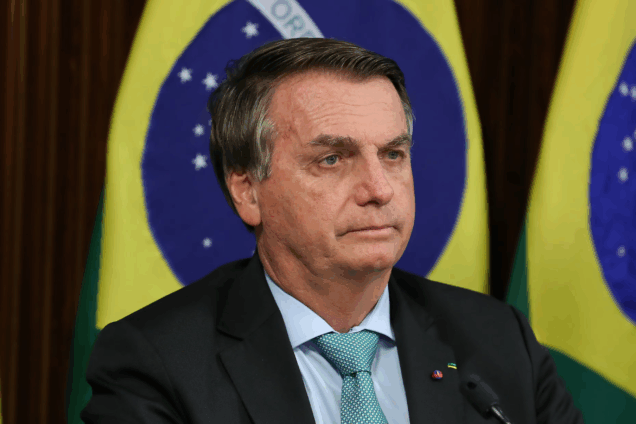
The former president of Brazil, Jair Bolsonaro, has been sentenced to 27 years and three months in prison after being found guilty of plotting a military coup.
A panel of five Supreme Court justices handed down the sentence just hours after they had convicted the former leader.
They ruled he was guilty of leading a conspiracy aimed at keeping him in power after he lost the 2022 election to his left-wing rival, Luiz Inácio Lula da Silva.
Four of the justices found him guilty while one voted to acquit him. Bolsonaro's lawyers have called the sentence "absurdly excessive" and said that they would file "the appropriate appeals".
The Supreme Court panel also barred him from running for public office until 2033.
Bolsonaro, who was put under house arrest after being deemed a flight risk, did not attend this final phase of the trial in person.
But he has in the past said it was designed to prevent him from running in the 2026 presidential election - even though he had already been barred from public office on separate charges. He has also called it a "witch hunt".
His words have previously been echoed by US President, Donald Trump, who imposed 50% tariffs on Brazilian goods, framing them as retaliation for Bolsonaro's prosecution.
Reacting to the guilty verdict, Trump said he found it "very surprising" and compared it to his own experience: "That's very much like they tried to do with me. But they didn't get away with it at all."
US Secretary of State Marco Rubio said that Brazil's Supreme Court had "unjustly ruled to imprison former President Jair Bolsonaro" and threatened to "respond accordingly to this witch hunt".
Brazil's foreign ministry reacted swiftly, posting on X that "threats like the one made today by US Secretary of State Marco Rubio, in a statement that attacks a Brazilian authority and ignores the facts and the compelling evidence on record, will not intimidate our democracy".
Bolsonaro, who is 70, now faces the prospect of spending the rest of his life in prison.
His lawyers are expected to argue that he should be kept under house arrest instead of being sent to jail - as well as plead for a lower sentence.
They have also said that they will appeal against his conviction but legal experts have said this may prove difficult, as this is normally only possible if two out of the five justices have voted to acquit.
Bolsonaro was found guilty of five charges, all relating to his attempt to cling to power after he was beaten in the 2022 election.
But prosecutors said he had started to plot to stay in power long before, proposing a coup to military commanders and sowing unfounded doubts about the electoral system.
They also said that Bolsonaro knew of a plan to assassinate Lula and his vice-presidential running mate, as well as a Supreme Court Justice.
The justices found he had led a conspiracy and also convicted seven of his co-conspirators, including senior military officers. Among them are two former defence ministers, a former spy chief and former security minster.
While the plot failed to enlist enough support from the military to go ahead, it did culminate in the storming of government buildings by Bolsonaro's supporters on 8 January 2023, the justices found.
Order was quickly restored and more than 1,500 people were arrested.
But, according to Alexandre de Moraes - the justice who oversaw the trial - Brazil had come close to descending into authoritarianism.
"We are slowly forgetting that Brazil almost returned to its 20-year dictatorship because a criminal organisation, comprised of a political group, doesn't know how to lose elections," he said before casting his guilty vote.
Brazil's recent history and the decades it spent under military rule were also invoked by Justice Cármen Lúcia, who cast the decisive third "guilty" vote on Thursday.
She compared the attempted coup to a "virus", which, if left to fester, can kill the society in which it has taken hold in.
The sole dissenting voice on the five-member panel was Luiz Fux, who argued in an 11-hour speech on Wednesday that the accusations against Jair Bolsonaro were unfounded and voted for him to be acquitted.
But on Thursday, Cármen Lúcia, the only woman on the panel, insisted that Brazil's democratic order had been at risk and warned that "there was no immunity to authoritarianism".
Latest Stories
-
NYA partners iYES 2026 to inspire youth towards transgenerational impact
20 seconds -
Nkoranza Secondary High Technical wins 2026 Cowbell-GES Independence Day Debate
22 minutes -
South African Tourism blends sport, diplomacy and destination marketing at Accra Polo Independence Match
27 minutes -
Fidelity Bank bridges market gap for young entrepreneurs with expanded Orange Market
29 minutes -
South African Tourism strengthens elite business and lifestyle ties at Accra Polo Independence Match
38 minutes -
Police seek A-G advice in GH¢7.5m robbery case
43 minutes -
25,000 youth failed to attend security support programme interviews – Interior Minister
49 minutes -
Driver granted bail over auto fraud
53 minutes -
Ketu North MP Scholarship Scheme to honour second cohort of beneficiaries
58 minutes -
Minority seeks answers over Mahama’s use of chartered jet for foreign trips
1 hour -
Lands Ministry rolls out reforms
1 hour -
CDD, NCCE forum reviews Ghana’s draft political finance law
1 hour -
Gov’t to enforce airport Terminal Two completion timeline
1 hour -
Let’s create structures that empower future generations of women – Nana Oye advocates
1 hour -
EU, Ghana sign security partnership pact
1 hour