

Audio By Carbonatix
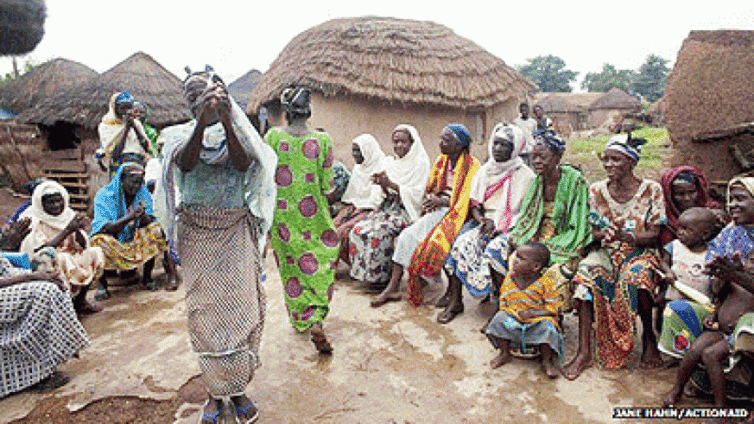
The Sanneh Institute is asking for signatures on a petition to help women who were ostracised into alleged ‘witch camps’ to safely return home.
In May 2021, the Sanneh Institute conducted research at five alleged witch camps in Northern Ghana. Executive Director, Prof. John Azumah visited and interacted with those involved in the camps.
Belief in witchcraft is widespread across Africa and the report says that accusations disproportionately affect women typically in their mid-50s to late-70s.
Those accused of witchcraft often come to these camps to flee the communities that ostracized them.
“The moment an accusation is made, those accused are literally on their own. Even spouses and grown-up biological children are afraid to come to their defence,” the report says.
Those who come to these alleged witch camps are barred from returning home because of gatekeepers such as traditional priests and shrines who oversee the camps
According to the report, many of the camps don’t allow people to visit on their own. Gatekeepers are present during visits which can prevent the victims from talking candidly about their experiences at the camp.
Traditional priests at the camps often need to perform final rituals before allowing anyone to leave but these rituals typically come with a cost.
Food supplies are also “virtually non-existent” according to the report. Some people even have to pick grains from the ground just to survive.
The report claims that the traditional priests and the aid from NGOs have a stake in these camps so there are no plans to shut them down.
This is despite the abuse at the camps that include rape, monetary exploitation, verbal and emotional abuse, and forced labor without pay.
The report revealed that the majority of victims do not want to be in the camps. It says “Others would be happy to relocate to other communities but lack the means to do so and also cannot pay for the final rituals.”
Recommendations for the safe return of the accused
The Sanneh Institute has come up with four recommendations to help the accused be able to safely relocate or return to their communities.
- Relief should be provided to the accused by targeting the victims who are able to safely return home or relocate.
- Educating communities against witchcraft accusations in places like churches and mosques can protect the accused from further abuse.
- Legislation should be used as a deterrent and protect people from future accusations. The Sanneh Institute says that the Parliament of Ghana should pass a law against witchcraft accusations.
- Reintegrating victims into their communities and allow them to return home safely.
Latest Stories
-
Port crises loom as 11,000 drivers threaten four-day strike
1 hour -
A source of excellence across generations – Vice President Opoku-Agyemang lauds Mfantsipim
2 hours -
(Photos) Mfantsipim School launches historic 150th anniversary
2 hours -
Knights and Ladies of Marshall group backs Catholic Bishops’ stance on anti-LGBTQ+
3 hours -
Bright Simons writes: All the Filla in the Ibrahim Mahama/E&P – Gold Fields Saga
4 hours -
Monetise Idiocy In Ghana
4 hours -
ECG kicks off Phase Two of transformer upgrades at Lashibi; brief outages expected
5 hours -
The Ghanaian prophet and the mysterious death of his scottish wife Charmain Speirs
5 hours -
Nearly 400 sentenced in Nigeria for links to militant Islamists
5 hours -
Ghana’s recovery supported by gold strength despite global oil price pressures – Standard Bank Research
5 hours -
Methodist Church hails Mfantsipim@150; calls for “fresh consecration” to excellence
5 hours -
‘Excellence is our inheritance’ – Nana Sam Brew-Butler hails Mfantsipim’s 150-year reign in leadership
6 hours -
Kwaku Azar writes: A-G vs OSP
6 hours -
Mfantsipim–Adisadel rivalry built excellence, not division – Sam Jonah
6 hours -
Vice President launches Mfantsipim’s 150 years of shaping Ghana’s greatest mind
6 hours