

Audio By Carbonatix
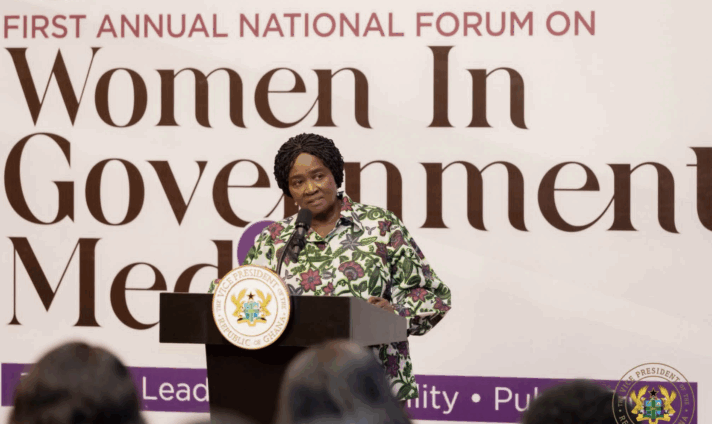
Vice President Professor Jane Naana Opoku-Agyemang on Thursday urged women not to allow themselves to be intimidated or belittled because of their gender.
She made the call at the First Annual National Forum on Women in Government and Media, held at the Banquet Hall of the Presidency in Accra, on the theme: “Leadership, Visibility, Public Trust”.
The high‑level forum brought together distinguished women leaders, policymakers and media professionals to foster strategic collaboration, enhance representation and strengthen public confidence in leadership and governance.
It reflected a strong national commitment to inclusive leadership, institutional credibility and the advancement of women in public service and the media.
“We must refuse to be belittled. We must refuse to be intimidated. We must refuse to be shaped in other people’s images,” the Vice President said.
“We must have faith in ourselves. We must refuse for anyone to talk us down simply because we are women. We are proud of being women.”
Prof Opoku-Agyemang noted that women in leadership often work under heightened pressure and scrutiny. Yet, she said, national development required women to help shape Ghana’s direction—whether in Cabinet, Parliament, boardrooms, newsrooms, production studios or communities across the country.
She observed that visibility helps expand opportunities and normalize women’s authority, but said this must be supported by credibility, which is sustained by public trust.
According to her, trust was strengthened through accountability, clear communication and competence.
The Vice President noted that when media reporting was contextual rather than sensational, public trust is reinforced.
Therefore, the relationship between women in government and women in the media “must not be accidental; it must be strategic,” she stressed, because media shapes perception and perception influences confidence.
She cautioned that when gender issues are reduced to clickbait or when stories about women focus on superficial matters such as appearance rather than intellect, competence and outcomes, the space for women in public life becomes limited or insignificant.
Prof Opoku-Agyemang said women journalists and editors carry particular responsibility—not because women were morally superior, but because their presence brings perspective.
Women in editorial spaces, she said, are able to question framing, challenge assumptions and insist on depth.
“For many, the media is a classroom for governance, economics, health, public policy and more,” she added.
Women in media leadership, she said, help clarify complex issues, elevate credible expertise and expose harmful practices, thereby contributing to national development.
She also acknowledged the challenges of the digital age, where speed and controversy tend to be rewarded more than nuance, but insisted that standards must guide editorial decisions.
Emphasising that inclusive leadership was a developmental imperative, the Vice President said nations that integrate women meaningfully into decision‑making build stronger institutions, foster more civil governance and promote inclusive growth. “Women are not only beneficiaries of development; we are among its drivers,” she said.
Prof Opoku-Agyemang stressed that expanding representation does not equate to lowering standards.
She encouraged women in government and public institutions to lead with integrity, communicate transparently and mentor younger women.
“Let’s guide them. Let’s restore trust and let them know that we have their back,” she said.
She added that visibility should go beyond self‑promotion to include clear explanations of one’s work, enabling citizens to judge performance on substance rather than speculation.
To young women entering public life and journalism, she said their work would shape public understanding of power and potential.
She urged them to interrogate every story and decision with clarity and open‑mindedness.
“Ask yourself: Whatever I’m reporting, does it clarify? Does it provoke? Does it inform? Does it inflame? And to what end?”
The Vice President emphasized that democratic governance depended on informed citizens, and informed citizens depended on credible journalism and credible leadership.
She therefore called for a deliberate relationship between women in governance and women in media to strengthen democratic accountability.
“Let us commit to leadership that is visible, credible and compassionate. Let us build institutions that earn trust through words and actions. Let us shape national narratives responsibly and ensure that the story of Ghana’s development is told accurately, fairly and with confidence in Ghana’s women,” she said.
Latest Stories
-
Libya’s military seizes narcotics after firefight with smugglers
2 hours -
At least 139 migrants dead, including some children, after boat from Djibouti to Yemen capsizes, UN agency says
2 hours -
“US Embassy introduced TRIBE Culture Fest to NSA, GTA” – Kofi Adams
2 hours -
“NSA did not tell us of any embassy arrangement” – Kofi Adams
3 hours -
Kumasi records third commercial fire in three days
4 hours -
Trump faces growing backlash over plans to import diesel from Russia
4 hours -
AI is less regulated than milk, says Microsoft president
4 hours -
Boots sold in £7bn deal to Canadian billionaire family
4 hours -
Glasner suffers loss on Selhurst return as Palace beat Forest
4 hours -
WAFU B U17: ‘We won but I expected more from my boys’ – Kassim Ocansey
4 hours -
Royal Mail plans to cut 2,500 jobs
4 hours -
Man City cruise to statement win over 10-man Liverpool
4 hours -
Citroen revives the 2CV for an electric age
4 hours -
Blind guide dog owner says quiet EVs put lives at risk
5 hours -
Hamilton apologises to Ferrari as Antonelli moves to brink of title
5 hours