

Audio By Carbonatix
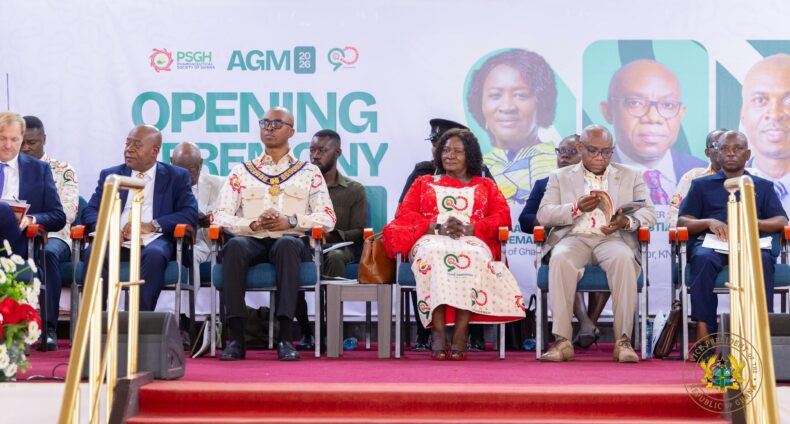
Vice President Professor Naana Jane Opoku-Agyemang has called for stronger local pharmaceutical production as Ghana seeks to reduce its reliance on imported medicines and improve access to essential drugs.
She said expanding the capacity of Ghanaian pharmaceutical manufacturers would strengthen the health system and help the country respond more effectively to changing healthcare needs.
The Vice President was speaking in Accra at the opening of the 90th Anniversary Annual General Meeting and Scientific Conference of the Pharmaceutical Society of Ghana.
She noted that local manufacturers were already building capacity to produce a wider range of essential medicines and pharmaceutical products.
“Local manufacturers are developing capacity to produce infusions, injectables, ophthalmic products and anaesthetics,” she said.
Professor Opoku-Agyemang said increasing local production would not only strengthen the pharmaceutical industry but also improve access to essential medicines.
The government is pursuing a five-year strategy to increase the proportion of medicines manufactured locally from 30% to 70%.
Pharmaceutical Society calls for funding
President of the Pharmaceutical Society of Ghana, Pharm. Paul Owusu Donkor, welcomed the 70% target but said achieving it would require sustained government support.
“We therefore ask the government of Ghana to turn its five-year strategy into a funded delivery program,” he said.
He called for predictable public procurement of quality-assured medicines manufactured in Ghana, timely payment of suppliers and access to affordable long-term financing for pharmaceutical manufacturers.
According to him, these measures would give local producers greater certainty to invest in production capacity and contribute to the government’s target.
Focus on changing health needs
Beyond pharmaceutical manufacturing, Professor Opoku-Agyemang urged pharmacists to play a greater role in addressing Ghana’s growing burden of chronic and non-communicable diseases.
She also called for regulation to keep pace with technological changes affecting healthcare, including artificial intelligence, digital prescribing and evolving medicine supply chains.
The Vice President said Ghana’s changing health needs require a health system capable of detecting diseases early, managing conditions effectively and preventing avoidable complications.
The conference is being held under the theme “Science. Impact. Legacy: 90 Years of Pharmaceutical Excellence.”
The 90th anniversary event is providing a platform for discussions on the future of Ghana’s pharmaceutical sector, access to medicines and measures to build greater resilience within the health system.
Latest Stories
-
Demand and savings deposits decreased in August 2026, but currency outside banks increased by 4%
4 minutes -
Fiscal policy implementation poses downside risk to inflation – BoG
38 minutes -
Organised Labour should seek fair adjustment, not excessive pay rise – Labour consultant
42 minutes -
BoG maintains medium-term inflation target of 8 ± 2%
49 minutes -
Sammi Awuku urges NPP Germany to unite ahead of 2028 elections
1 hour -
The Inconvenient Truth: We cannot pray for the cure while protecting the disease
2 hours -
MTN Ghana trains civil society organisations on artificial intelligence
3 hours -
GoldBod FX framework aims to make dollar supply predictable – Acheampong
3 hours -
How does a Ghanaian team make it to the BAL?
3 hours -
Ghana’s investment climate presents opportunities for industrial growth and job creation.
3 hours -
‘I paid thousands to a company for jobs that never came’
4 hours -
SSNIT intensifies informal sector enrolment drive with Techiman float
4 hours -
Ghana seeks long-term mining investments that benefit local communities – Armah-Kofi Buah
4 hours -
GHATOF demands compensation for 85 businesses affected by La Pleasure Beach demolition
4 hours -
Bono Regional Minister calls for investor education to drive economic growth
4 hours