

Audio By Carbonatix
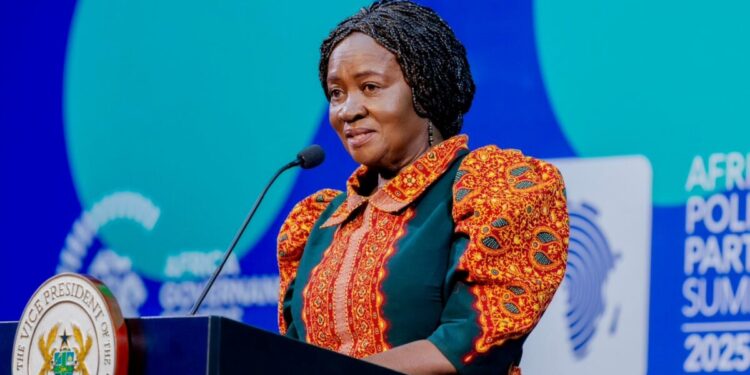
Vice President Professor Naana Jane Opoku-Agyemang has called for a major rethink of how the history of the transatlantic slave trade is taught, insisting that young people must understand both the devastation it caused and the resistance of Africans.
She said that the history must be accurately reflected in education systems and linked to the broader international conversation on reparatory justice.
“This history should be reflected accurately in our knowledge systems and encourage countries to integrate reparatory justice into their education broadly conceived in all its different forms,” Prof. Opoku-Agyemang said.
She was speaking at a ceremony in Cape Coast following the adoption of UN General Assembly Resolution 82/50, which recognised the trafficking and enslavement of Africans as the gravest crime against humanity.
The Vice President said education has become an important part of the responsibility created by the historic UN recognition.
“Our young people,” she said, “should understand how the trade operated, how it shaped societies on both sides of the Atlantic and why its consequences remain part of international discussion today.”
She said teaching the history accurately also requires a deliberate effort to recognise African agency.
Prof. Opoku-Agyemang rejected a narrative that presents Africans solely as victims of enslavement.
“Africans were more than the people to whom enslavement happened,” she said.
She explained that African communities resisted capture, defended their territories, escaped and organised to preserve their freedom.
“We remember suffering, but we also remember agency, resistance and survival,” she said.
The Vice President said evidence of that resistance remains visible in communities including Assin Manso, Sankana and Golu, where memories of the period have been preserved through oral traditions, written records, architecture and the landscape.
She said a fuller understanding of the history is necessary not only for remembering the past but also for informing present-day discussions about justice.
The call forms part of Ghana’s broader push following the UN resolution, with the government now turning attention to education, preservation, restitution, legal pathways and sustained international engagement on reparatory justice.
Prof. Opoku-Agyemang acknowledged that the UN resolution cannot undo centuries of injustice.
“A resolution cannot repair centuries of injustice,” she said.
She maintained that it provides a firm foundation for continuing the conversation and pursuing practical steps towards justice.
Latest Stories
-
Ghana better placed to withstand commodity price shocks – IMF
46 seconds -
Amin Adam warns cedi depreciation could reverse Ghana’s debt relief gains
4 minutes -
Fiscal discipline crucial for pension fund investments – Finance Minister
4 minutes -
BoG Governor rallies IMF to back Africa’s digital sovereignty
9 minutes -
Amin Adam questions government bond pricing as short-term yields fall below inflation
15 minutes -
Five new telephony cell sites to be activated in October 2026 – Sam George
20 minutes -
Amin Adam raises sovereign-bank nexus concerns as banks hold GH¢190bn in government debt
25 minutes -
Government to increase Free SHS feeding allowance in 2027 Budget – Haruna Iddrisu
30 minutes -
Nadowli-Kaleo NCCE engages women’s groups on rule of law, corruption fight
31 minutes -
Mahama visits factories in Afienya/Tema
36 minutes -
TraffiTech-GH pilot reduces road crash injuries, fatalities
41 minutes -
IMF Chief identifies 2 major threats posed by AI to global economy
46 minutes -
Go back to the hand washing days – Ghanaians told
51 minutes -
GoldBod commits GH¢35m to reclaim galamsey-damaged Tano Nimri Forest Reserve
56 minutes -
Afenyo-Markin reflects on loneliness of public service, says survival is largely spiritual
1 hour