

Audio By Carbonatix
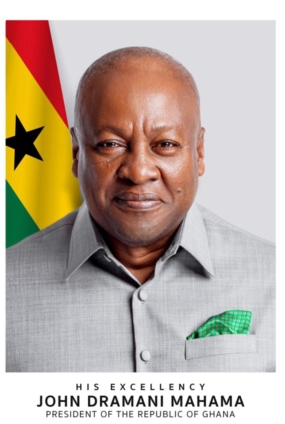
Private sector leaders have commended President John Dramani Mahama for restoring macroeconomic stability, citing the strengthening of the Ghana cedi, which has appreciated by 40.7% against the US dollar in 2025 and is currently trading at GH¢10.9756 per dollar, and the decline in interest rates as critical signals of renewed confidence in the economy.
The commendation was made at an Evening Direct Government–Private Sector Partnership Engagement, a forum promised by the President during the 2024 election campaign to ensure continuous dialogue between government and business leaders on economic reforms and growth priorities.
Participants drawn from finance, agribusiness, manufacturing, construction, retail, and the digital economy described the current economic environment as markedly improved, noting that currency stability and easing borrowing costs are already enhancing business planning, pricing certainty, and investment decision-making. They recalled that in 2024, policy and commercial lending rates peaked at around 47%, severely constraining access to credit and stalling private investment.
According to several industry leaders, prolonged currency volatility and high interest rates in recent years had constrained expansion, raised operational risks, and limited access to affordable credit. They observed that the recent trend reversal is helping and interest rates have sharply declined to about 13% while short-term government securities such as trespassing bills are now trading as low as 6.6%, erasing borrowing costs across the country and improving liquidity conditions for businesses.
They also highlighted the improved performance of the Ghana cedi, which has recorded over 40% gain against the US dollar in 2025.
Finance Minister Dr. Cassiel Ato Forson projects a 4.8% GDP growth for 2026, driven by the government’s focus on stability and growth, with inflation dropping significantly from 23.8% in 2024 to 3.8% in January 2026.
Addressing the gathering, President Mahama stated that Ghana must deliberately position itself as an industrial hub for West Africa and Africa as a whole, anchored on value addition, competitive manufacturing, and export-led growth. He stressed that macroeconomic discipline, stable exchange rates, and affordable financing were essential prerequisites for industrialisation.
He noted that the government’s economic strategy is focused on creating a predictable environment that enables the private sector to invest, scale operations, and compete effectively within regional and continental markets.
Private sector leaders welcomed the industrial hub vision, describing it as a significant opportunity for Ghanaian businesses. They noted that the combination of currency stability, falling interest rates, and structured engagement with government provides a solid foundation for expanding manufacturing capacity, strengthening regional supply chains, and creating jobs.
One manufacturing sector representative said the private sector sees “a much bigger opportunity” under the current economic direction, adding that the alignment between policy stability and industrial ambition is critical for attracting both local and foreign investment.
Participants also praised the institutionalisation of regular government–private sector engagements, describing the forum as a practical mechanism for identifying bottlenecks, tracking reforms, and aligning policy implementation with real-economy needs.
President Mahama reaffirmed his administration’s commitment to private-sector-led growth, assuring businesses that the engagement series would be sustained and used as a feedback platform to refine policies and accelerate implementation.
He indicated that stabilising the cedi and easing interest rates were not isolated outcomes, but part of a broader strategy to restore confidence, crowd in investment, and support Ghana’s long-term industrial transformation. Observers say the renewed collaboration between government and the private sector could play a pivotal role in Ghana’s economic recovery and growth, particularly as the country seeks to expand industrial output, boost exports, and create employment
Latest Stories
-
WIWIK launches new leadership development pathway for Ghanaian university students
15 minutes -
Public basic schools resume today after strike suspension
22 minutes -
Environment Minister calls for transparency in Ghana’s GMO adoption
29 minutes -
Ghana risks 10% to 100% tariffs on exports to US under Trump’s threats as it moves to join BRICS
44 minutes -
US imposes sanctions on ICC hours after former judge wins Nobel Peace Prize
2 hours -
South Africa withdraws asylum directive after anti-migrant violence
2 hours -
Moroccan king says migration cooperation model with Spain hit limit
2 hours -
Libya’s military seizes narcotics after firefight with smugglers
2 hours -
At least 139 migrants dead, including some children, after boat from Djibouti to Yemen capsizes, UN agency says
3 hours -
“US Embassy introduced TRIBE Culture Fest to NSA, GTA” – Kofi Adams
3 hours -
“NSA did not tell us of any embassy arrangement” – Kofi Adams
3 hours -
Kumasi records third commercial fire in three days
4 hours -
Trump faces growing backlash over plans to import diesel from Russia
5 hours -
AI is less regulated than milk, says Microsoft president
5 hours -
Boots sold in £7bn deal to Canadian billionaire family
5 hours