

Audio By Carbonatix
The Communications Minister, Sam George, has issued an ultimatum to Multichoice Ghana, the operators of DStv and GoTV.

He wants DStv subscription prices reduced to reflect the macroeconomic gains Ghana has made, particularly the more than 40 per cent appreciation of the cedi recorded in the first half of the year.
If Multichoice fails to comply by August 7th, the minister has directed the National Communications Authority to suspend the company’s license.
The cedi began 2025 at GH¢14.7 to the dollar. It has since appreciated and remained stable between GH¢10.3 and GH¢10.5 since April. Multichoice has often cited exchange rate pressures as justification for previous price hikes.
Now the government wants that logic applied in reverse.
After a series of engagements, the Ministry directed Multichoice to reduce DStv package prices by 30%. The company has declined, calling the directive untenable.
In response, the Minister has instructed the National Communications Authority (NCA) to suspend Multichoice’s licence by Thursday, August 7, if the company does not comply.
The Minister also points to disparities in pricing across Africa.
DSTV’s premium package costs $29.05 in Nigeria, $38.66 in South Africa, and $82.41 in Ghana.
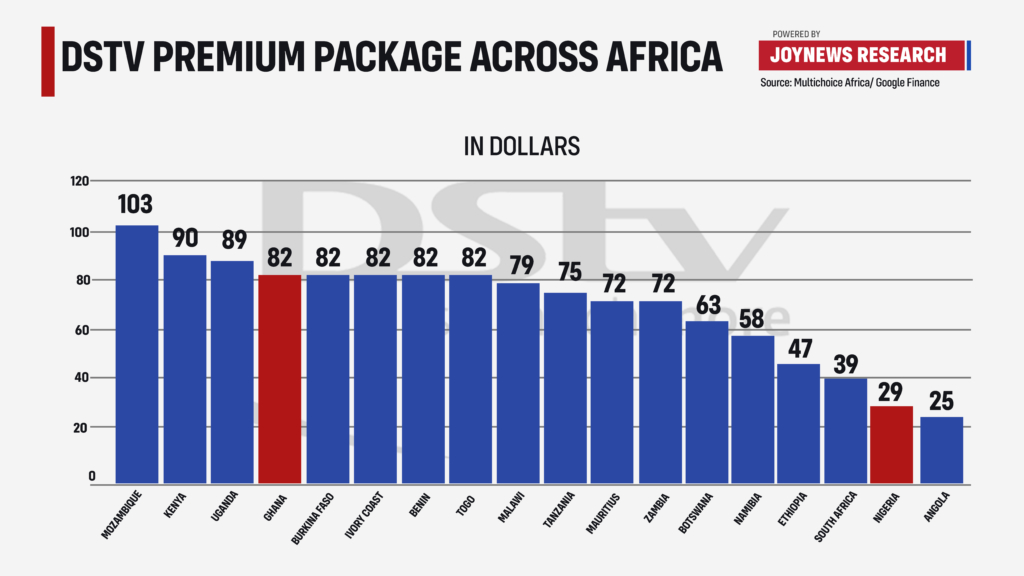
While the difference may seem excessive, pricing across countries depends on more than just exchange rates. Market size, tax policy, content licensing, inflation, and income levels all play a role.
Even so, Ghana’s price stands out.
If the proposed 30 per cent cut is not backed by clear data and evidence of excessive profit margins or pricing insensitivity, the government could open itself up to legal challenges or international arbitration.
So can the NCA suspend DStv’s license?
According to section 13 of the Electronic Communications Act, 2008 (Act 775), the NCA has the legal authority to suspend or revoke a license under certain conditions. These include:
- Failure to comply materially with the Act, Regulations, or licence terms
- Disregard of lawful directions from the Authority
- Default in payment of regulatory fees
- Ceasing operations without notice
- Issues of national security or public interest
- Where a fine is not deemed sufficient to address the breach
Before any action is taken, the NCA must give 30 days’ written notice, outline the grounds, and allow the company to respond or remedy the breach.
But the dispute over DSTV prices may fall more under Section 25, which governs tariffs.
Section 25 states that pricing of electronic communications services should be determined by service providers based on supply and demand. The Authority is, however, allowed to step in and regulate prices only under specific conditions:
- If a single operator dominates the market
- If there’s cross-subsidisation that distorts competition
- Or if there is evidence of anti-competitive pricing
What happens next?
The suspension of Multichoice’s license will have to follow this legal process. Anything short of that opens the government up to litigation.
Update: The National Communications Authority has officially notified Multichoice Ghana of its intention to suspend the company’s operating license.
In a letter dated August 7, 2025, the NCA said it is taking regulatory action because “the company’s pricing model is deemed inimical to the public interest.”
Multichoice Ghana has been given 30 days to respond, in accordance with the Electronic Communications Act.
If the company fails to do so by September 6, its license will be suspended.

Latest Stories
-
Anti-LGBTQ Bill: Forget the rumour mongers, I’m a man of action, and will pass the bill – Speaker
16 minutes -
Women and children among those killed in Sudanese army shelling of wedding celebration
19 minutes -
President Mahama is not sincere with Ghanaians on LGBTQ bill matter – Hassan Tampuli
37 minutes -
Gov’t to establish Prison Industrial Hub to equip inmates with income-generating skills – Prison Service boss
56 minutes -
Alhassan Tampuli donates cement, roofing sheets to support storm victims in Gushegu
56 minutes -
Alhassan Tampuli appeals for urgent support for storm victims in Gushegu
59 minutes -
The hypocrisy must stop; pass Anti-LGBTQ+ Bill now – Alhassan Tampuli to Mahama
1 hour -
Imprisonment should be rehabilitative, not punitive – Ghana Prisons boss at UNGA
1 hour -
Ga Adangbe traditional priests petition Mahama over McDan aviation licence revocation
2 hours -
Anti-LGBTQ Bill: NDC’s arrogance is worrying – Hassan Tampuli
2 hours -
Let’s give OSP time to mature, not to scrap it – Hassan Tampuli
2 hours -
Nigeria convicts 386 Islamist militants in mass trials
2 hours -
Djibouti president wins election with 97.8% of vote, state media says
2 hours -
We don’t have mandate to deduct tax from rent allowance of security services personnel – Interior Ministry clarifies
2 hours -
Ablakwa receives Presidential Special Envoy on Reparations to advance global agenda
3 hours