

Audio By Carbonatix
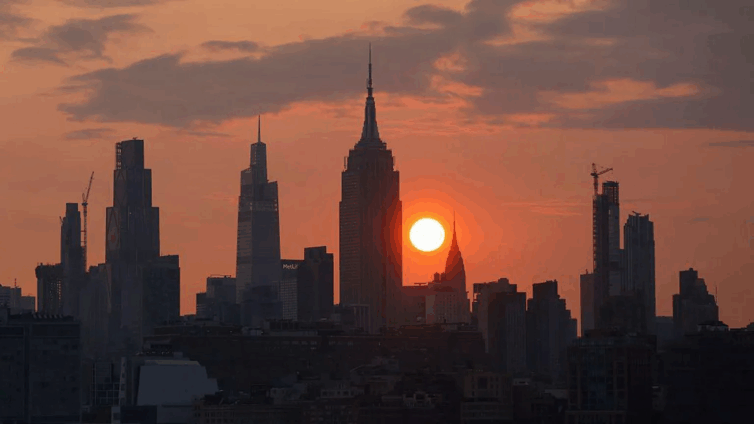
An air quality health advisory has been issued for New York City and its surrounding areas because of smoke from wildfires in Canada.
In a post on X, New York state's Department of Environmental Conservation (DEC) and Department of Health (DOH) issued the advisory for Long Island, New York City Metro, Lower Hudson Valley, Upper Hudson Valley, and the Adirondacks on Saturday.
Authorities are warning air quality in those regions is "unhealthy for sensitive groups".
Wildfires in Canada have forced tens of thousands of people to leave their homes, and the smoke drifting over the border has sparked air quality concerns across the northern United States.
The air quality index (AQI) is predicted to be above 100 in much of New York state on Saturday, and could reach 135. Alerts are also in place for parts of New England.
The AQI measures the severity of pollution in the air and categorises health risks. The higher the number, the more unsafe the air is to breathe.
This is not the first time US authorities have issued air quality alerts because of smoke from the Canadian wildfires.
In mid-July, a similar alert was issued for Chicago, with additional precautions advised for babies and the elderly.
The political implications of the wildfire smoke have also reached Washington.
Earlier in July, six members of Congress wrote to the Canadian ambassador complaining that smoke from wildfires was making it difficult for Americans to enjoy their summer.
There are currently more than 550 active fires in Canada, with the most concentrated in the province of Manitoba, according to authorities. 6.1 million hectares (15 million acres) of land has been burnt across the country in the past year.
May and June were particularly destructive months in western Canada, with roughly 30,000 people forced to evacuate in the provinces of Saskatchewan and Manitoba, where local administrations declared a state of emergency.
Scientists have consistently linked the intensifying wildfire seasons to climate change.
Canada is believed to be warming at twice the global average rate, and its Arctic regions are heating up at nearly three times the global rate, scientists have warned.
Latest Stories
-
When the Gospel Becomes a Weapon: The church, blackmail and the abuse of faith
14 minutes -
JoyNews’ Jacqueline Ansomah Yeboah selected for UK Media Excellence for Emerging Technology Fellowship
31 minutes -
Mental Health Alliance urges government to operationalise Mental Health Fund
46 minutes -
Ghana–Holy See agreement heads to Parliament after Cabinet approval
50 minutes -
Luv FM Corporate Games 2026: Kumasi Central Prisons, Amanfiman Bank win big amid fun
1 hour -
WAFU B U17: Ghana top Group A after win over Togo
2 hours -
Ho Central Mosque reopens amid unresolved leadership dispute that led to closure
3 hours -
Minority caucus questions GH¢16.4m in Ablakwa’s SA evacuation spending, demands independent audit
3 hours -
Gender Ministry meets Nana Akua Addo’s husband over domestic violence after hospital discharge
4 hours -
UG Vice-Chancellor urges swift operationalisation of National Research Fund
4 hours -
Pope Leo to have surgery after lump found in lung
4 hours -
Joseph Cudjoe writes: Ghana must break free from the dangerous mindset that natural resources are the foundation for wealth
5 hours -
Children among 109 dead after boat capsizes off Djibouti, UN says
5 hours -
OmniBSIC Bank’s 11th health walk promotes fitness and business growth
5 hours -
2026 World Maritime Day: Danish Embassy organises “The Gulf of Guinea Speaks”
5 hours