

Audio By Carbonatix
The Ministry of Local Government, Chieftaincy and Religious Affairs has announced plans to develop a Digital Registry System to serve as a central platform for churches to update their operational status annually.
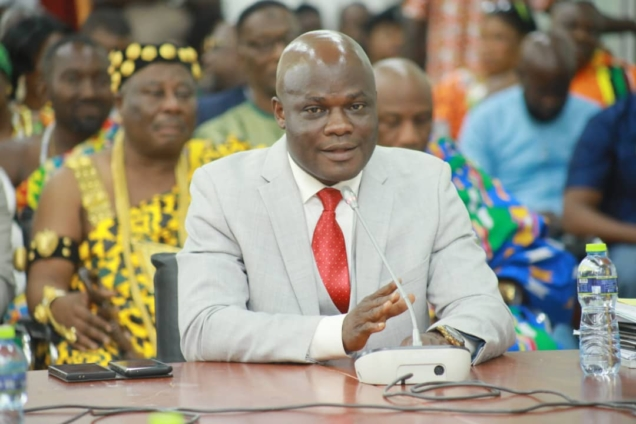
Ahmed Ibrahim, the sector Minister, disclosed this in Parliament on Wednesday in response to a question from Prof. Kingsley Nyarko, Member of Parliament for Kwadaso, regarding the status of registered churches in the country.
He explained that the Ministry would establish a data-sharing agreement with the Office of the Registrar of Companies (ORC) to access records of churches registered as companies limited by guarantee.
The initiative, he said, would be carried out in collaboration with the ORC and the Ministry of Justice.
Additionally, Metropolitan, Municipal, and District Assemblies (MMDAs) would maintain local registers of churches operating within their jurisdictions as part of the local governance structure.
These registers, Mr Ibrahim noted, would eventually be linked to the central digital system to ensure accurate and up-to-date information on churches nationwide.
Responding to questions on the number of churches in the country, Mr Ibrahim said that although the ORC did not publish a single national figure, regional data and surveys revealed thousands of churches across Ghana.
In the Greater Accra Region alone, more than 2,200 churches had been registered, with about 98 per cent owned by individuals.
He recalled that the Religious Bodies (Regulation) Law, 1989 (PNDC Law 221), was originally intended to regulate the establishment of churches and religious bodies but faced opposition from many groups who argued that it infringed on religious freedom and gave government excessive control over religious practice.
“Today, churches are registered as companies limited by guarantee with the Office of the Registrar of Companies. This gives them legal recognition, the ability to own property, and protection under Ghanaian law,” Mr Ibrahim said.
He added that the new digital registry would provide a reliable mechanism for tracking the operational status of churches, thereby enhancing transparency and governance in the religious sector.
Latest Stories
-
Beyond the festivities: Gomoa must turn visibility into development
6 minutes -
DVLA clarifies it is not responsible for Toyota Voxy commercial operations
8 minutes -
Calls for Ofori-Atta’s return a non-issue if trial proceeds in absentia – Pius Hadzide
11 minutes -
France names Ghana first beneficiary of newly established National Health Compact
16 minutes -
US Immigration, extradition outcomes likely to influence each other in Ofori-Atta case – Amanda Clinton
19 minutes -
29-year-old woman rescued after hiding in drain to escape attackers
33 minutes -
Gramps Morgan names Ghanaian business leader Monalisa Effah as Ghana-Jamaica Homecoming Ambassador
1 hour -
CAF President urges faith in African football despite AFCON 2025 issues
1 hour -
AFCON U-17: Black Starlets’ aim is to win trophy – Head Coach Prosper Ogum
1 hour -
ENFA expands access to global capital for Ghanaian SMEs
2 hours -
Beyond security: Why mobile payment fraud has become a customer experience crisis
2 hours -
Former Effia MP demands full disclosure of Truedare AI deal, warns of ‘hidden risks’
2 hours -
Joseph Cudjoe raises alarm over potential revenue loss in Truedare AI Customs deal
2 hours -
Video: Awoshie-Anyaa Highway: Years of fatal crashes caused by faulty traffic lights
2 hours -
No financial transactions with Ghana Card yet, says NIA
2 hours