

Audio By Carbonatix
Rather than benefiting the environment, large-scale tree planting may do the opposite, two new studies have found.
One paper says that financial incentives to plant trees can backfire and reduce biodiversity with little impact on carbon emissions.
A separate project found that the amount of carbon that new forests can absorb may be overestimated.
The key message from both papers is that planting trees is not a simple climate solution.
Over the past few years, the idea of planting trees as a low cost, high impact solution to climate change has really taken hold.
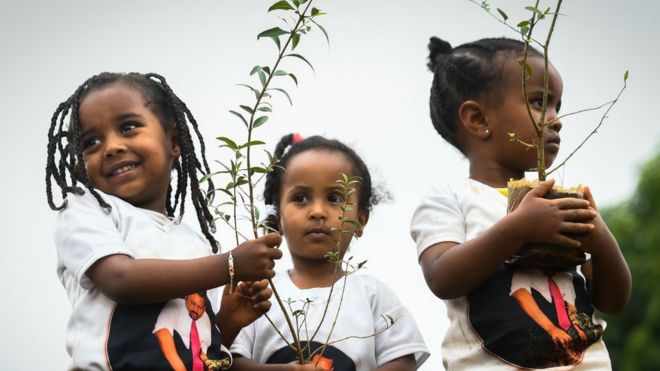
Previous studies have indicated that trees have enormous potential to soak up and store carbon, and many countries have established tree planting campaigns as a key element of their plans to tackle climate change.
In the UK, promises by the political parties to plant ever larger numbers of trees were a feature of last year's general election.
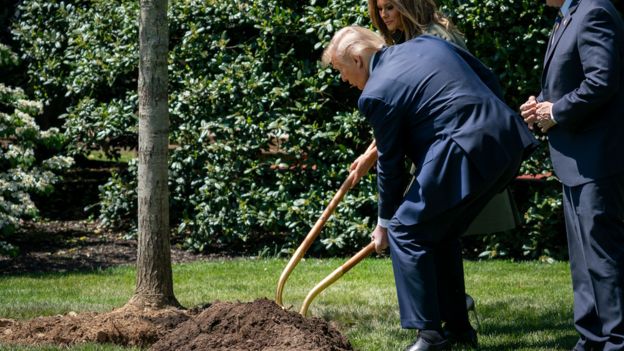
In the US, even President Donald Trump has rowed in behind the Trillion Trees Campaign.
Legislation to support the idea has been introduced into the US Congress.
Another major tree planting initiative is called the Bonn Challenge.
Countries are being urged to restore 350 million hectares of degraded and deforested land by 2030.
So far, around 40 nations have endorsed the idea.
But scientists have urged caution against the headlong rush to plant new forests.
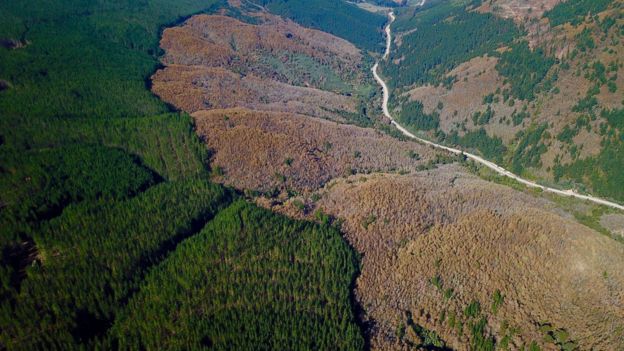
They point to the fact that in the Bonn Challenge nearly 80% of the commitments made to date involve planting monoculture plantations or a limited mix of trees that produce specific products such as fruit or rubber.
The authors of this new study have looked closely at the financial incentives given to private landowners to plant trees.
These payments are seen as a key element of increasing the number of trees significantly.
The study looked at the example of Chile, where a decree subsidising tree planting ran from 1974 to 2012, and was widely seen as a globally influential afforestation policy.
The law subsidised 75% of the costs of planting new forests.
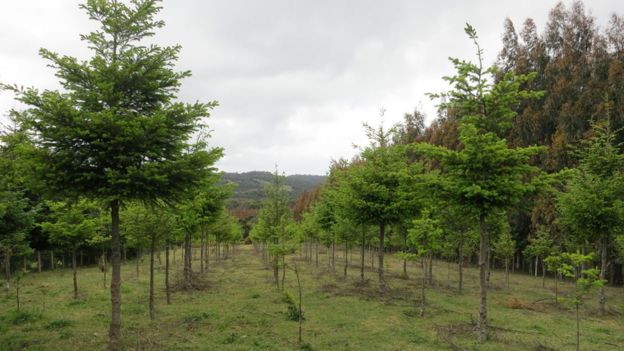
While it was intended not to apply to existing forests, lax enforcement and budgetary limitations meant that some landowners simply replaced native forests with more profitable new tree plantations.
Their study found the subsidy scheme expanded the area covered by trees, but decreased the area of native forest.
The authors point out that since Chile's native forests are rich in biodiversity and store large amounts of carbon, the subsidy scheme failed to increase the carbon stores and accelerated biodiversity loss.
"If policies to incentivise tree plantations are poorly designed or poorly enforced, there is a high risk of not only wasting public money but also releasing more carbon and losing biodiversity," said co-author Prof Eric Lambin, from Stanford University.
"That's the exact opposite of what these policies are aiming for."
A second study set out to examine how much carbon a newly planted forest would be able to absorb from the atmosphere.
Up until now, many scientists have calculated the amount of carbon that trees can pull down from the air using a fixed ratio.
Suspecting that this ratio would depend on local conditions, the researchers looked at northern China, which has seen intensive tree planting by the government because of climate change but also in an effort to reduce dust from the Gobi desert.
Looking at 11,000 soil samples taken from afforested plots, the scientists found that in carbon poor soils, adding new trees did increase the density of organic carbon.
But where soils were already rich in carbon, adding new trees decreased this density.
The authors say that previous assumptions about how much organic carbon can be fixed by planting new trees is likely an overestimate.
"We hope that people can understand that afforestation practices are not one single thing," said Dr Anping Chen, from Colorado State University and a lead author on the study.
"Afforestation involves many technical details and balances of different parts, and it cannot solve all our climate problems."
Latest Stories
-
Power restoration fault suspected in Kumasi Central Market fire
5 hours -
The 7-foot giant of Ngleshie Amanfro: Seven-foot Ghanaian Ephraim Saawa dreams of joining the national basketball team
5 hours -
Government promises support for Kumasi Central Market fire victims
5 hours -
Vibes The Movie: Big Ghun’s Ghanaian film earns five nominations at 2026 REFFA
6 hours -
MamaCare CEO warns unresolved conflicts among health workers could undermine maternal and neonatal care
6 hours -
Health professionals urged to translate medical knowledge into practice to save mothers
6 hours -
Retired judge Justice Francis Korbieh charges 1,568 new lawyers to uphold integrity
8 hours -
Conflicts among care providers linked to maternal, neonatal deaths – Expert
8 hours -
GIS marks 10th TIME conference, champions improved teaching practices
8 hours -
BRICS Or Balance? What Ghana’s bid really means
8 hours -
GPRTU wants full TRAFFITECH-GH implementation to start in 2027
9 hours -
How 10-mile walks for basic education birthed a 50-year legal career for Justice Korbieh
9 hours -
Mahama announces plans to import electric wheelchairs for PWDs
9 hours -
KGL U17 Colts 2026: Western beat Prempeh Elite Academy to set up final final with Greater Accra Region
9 hours -
Late Solanke strike salvages 10-man Spurs draw at Man United
9 hours