

Audio By Carbonatix
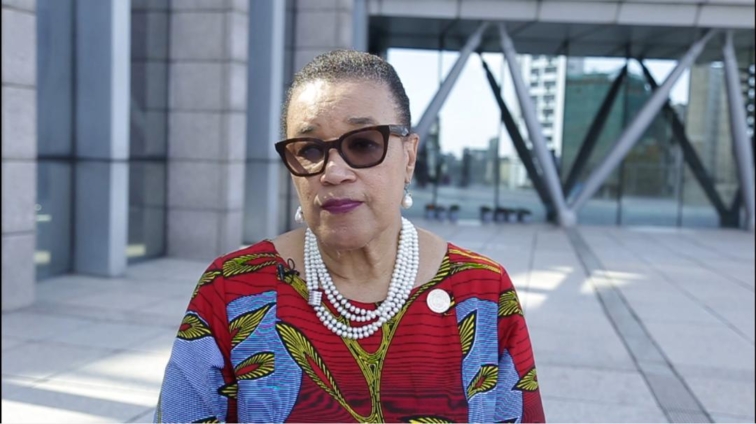
Commonwealth Secretary-General, Patricia Scotland stated that the global financial architecture lacks balance and fails to consider the vulnerability of many African economies in climate adaptation.
This remark was made on the sidelines of the 37th Ordinary Session of the African Union Summit, during a Presidential Dialogue on African Union Financial Institutions.
At the dialogue, attended by many African leaders, calls were made for reforms in the global financial architecture.
President Akufo-Addo, who currently serves as Champion of the African Union Financial Institutions, emphasized the need for a dramatic change in Africa’s development financing.
“We're all in agreement that the way the Global Financial architecture works at the moment it doesn't work in our favor and that there is a need to make some fundamental systemic reforms but making the reforms also requires that we also take some steps that will assist us to have a greater impact in the way in which our economies are financed,” he said while rallying the support of other African leaders and the international community to effect the changes required to achieve this objectives.
Commenting on the push for reforms in the financial architecture, Commonwealth Secretary-General, Patricia Scotland told JoyNews’ Blessed Sogah at the African Union Headquarters in Addis Ababa Ethiopia that similar to President Akufo-Addo’s sentiments the present setup of the global financial architecture “cannot be fair” adding that the commonwealth has been driving this for a long time.
"If you look back to 2018, the Commonwealth was saying that the financial architecture was simply not fit for purpose. If you look at what is happening in so many of our countries when it comes to climate change, and so the structure, the financial structure, which does not take into account that vulnerability, simply doesn't work. And as the president was saying this morning, it cannot be fair".
The Secretary-General stressed that the “Imbalance, unfairness has to be addressed." As part of their remedial proposal she said the Commonwealth came up with the universal vulnerability index adding that the days when people could say, we are all individually responsible for our fiscal health have gone.
“Covid didn't ask any of us before it struck our income. Climate change didn't ask any of us. None of us were the arbiters or the creators of the conflict in Ukraine and Russia, but we were affected in terms of our food security.
"So these exogenous shocks, which are beyond our control, have to be taken into account. So I agreed with absolutely everything that was said. It is absolutely in alignment with what we are doing on the vulnerability index and it's something that we will continue”.
Latest Stories
-
Onion supply to Ghana threatened as trucks held up in transit dispute
6 minutes -
President Mahama to attend One Health Summit in France, hold bilateral talks with Macron
43 minutes -
Mahama endorses ADB at Kwahu Business Summit
2 hours -
Every gram will be tracked – Gold Board unveils traceability push to deal with illegally-mined gold
2 hours -
Analysis: Why the Bank of Ghana sold half its gold reserves
2 hours -
Buy wrong gold, face prosecution – Gold Board CEO cracks down on rogue dealers
2 hours -
Africa pushes integrated health agenda ahead of One Health Summit in Lyon
3 hours -
We own the strategy, its not head office decision – GCB MD positions bank as engine of Ghana’s economy
3 hours -
No more waiting for head office – GCB boss pushes Ghana-first banking
3 hours -
Mahama lauds Julius Debrah for shaping Kwahu Business Forum
4 hours -
Why actors beg in difficulty – Patience Ozokwor on Nollywood financial struggles
4 hours -
Any man who apologises to woman deserves to suffer – Brymo
4 hours -
Nigerian artistes no longer put effort into making music – Omah Lay claims
4 hours -
‘I’m now skeptical about going into politics’ – Davido
4 hours -
Nigeria’s Seplat Energy resumes operations as oil workers halt strike action
5 hours