

Audio By Carbonatix
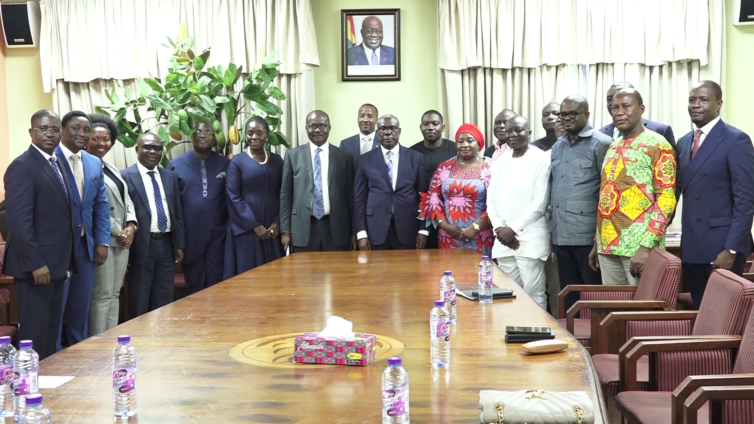
The Ghana Cocoa Board (COCOBOD) has signed a $1.13 billion syndicated loan to finance the purchase of cocoa beans for the 2022/2023 crop season.
The loan, which was secured with over 20 financial institutions attracted an interest rate of 1.75% plus Secured Overnight Finance Rate (SOFA).
Speaking after the signing agreement, the Board Chairman of COCOBOD, Peter Mac Manu, disclosed that COCOBOD is hoping to hit 850,000 metric tonnes after missing this year’s target.
“COCOBOD has been doing very well for this country, and I must say we will continue to do better. This season, we are hoping to hit 850,000 metric tonnes”, he said.
Mr. Manu stated that COCOBOD has put in place measures to support farmers increase yield, while protecting the environment.
“We have replaced old cocoa trees with improved seeds. We have also undertaken pruning exercises and supplied inputs to farmers. We are hopeful we can achieve the target and improve the livelihood of our farmers”, he said.
Mr. Manu, however bemoaned the negative impact of illegal mining, popularly called “galamsey” on cocoa production in the country.
He warned that the act could adversely affect cocoa production output if measures are not put in place to stop illegal mining which leads to destruction of forest reserves and pollution of water bodies.
Meanwhile, the Governor of the Bank of Ghana, Dr. Ernest Addison was hopeful the funds will help strengthen the local currency.
Funds to help stabilise the cedi
The Bank of Ghana is expected to “draw down” the funds from the Ghana International Bank in London, one of the participating banks of the programme.
The Central Bank will take the dollars and give the cedi equivalent to COCOBOD for cocoa purchases for the season.
The inflows will help boost BoG’s reserves – a move that could help in slowing the sharp depreciation of the cedi.
The local currency is said to have depreciated against the dollar by more than 30% since the beginning of 2022.
Details of the Cocoa Syndicated Loan programme
The banks that entered the arrangements are the Standard Chartered Bank, Rabo Bank, Ghana International Bank and French Investment Bank – Natixis.
The rest are Industrial and Commercial Bank of China and one of Japan’s largest bank, MUFG.
The firms are expected to underwrite and lead other banks in securing the funds.
COCOBOD and the Syndicated Loan pogramme
Since the 1992/93 crop season, COCOBOD has consistently and successfully, through the pre-export syndicated finance facility, obtained receivables-backed syndicated loan each year from the international money market to finance its cocoa purchases.
The facility, which is the largest soft commodity deal in sub-Saharan Africa, has help the COCOBOD to finance cocoa purchases and related operational activities in the crop season.
Latest Stories
-
Iran war lands ‘triple blow’ to flood-ravaged Sri Lankans
17 minutes -
Gunmen kill at least 11 people at Afghanistan picnic spot
31 minutes -
Woman, 25, in court for stealing baby at Bogoso
32 minutes -
Trump unveils giant gold-accented victory arch design for US capital
35 minutes -
We spoke to the man making viral Lego-style AI videos for Iran. Experts say it’s powerful propaganda
40 minutes -
Hungarians vote in big numbers on whether to end Orbán rule and elect rival
41 minutes -
At least 30 feared dead in crush at Haitian tourist site
41 minutes -
Boxing: Abdul Ahmed wins WBA Africa Cruiserwight title after dispatching Nigeria’s Eradeye
54 minutes -
Nearly 2,000 displaced, schools damaged as windstorm wreaks havoc in Gushegu
1 hour -
Ghana’s Derrick Kohn to work under Marie-Louise Eta as she becomes first woman to coach men’s Bundesliga team
1 hour -
Accra Open Championships conclude with strong performances ahead of African Championships
1 hour -
Ghana to begin camping with 12 athletes after Accra Open Championships – Bawa Fuseni
2 hours -
Anthony Joshua declines showdown with Tyson Fury but admits they ‘probably’ clash next
2 hours -
Tyson Fury dominates Makhmudov, calls out Joshua next
2 hours -
I have supported highway authority financially to fix roads in my constituency – A Plus
3 hours