

Audio By Carbonatix
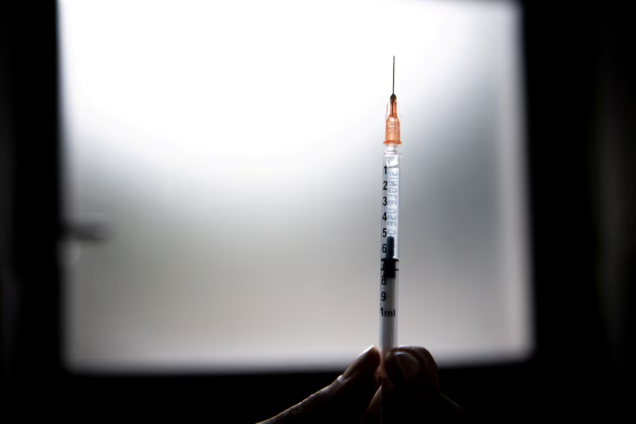
Democratic Republic of Congo, the epicentre of an mpox outbreak that prompted a U.N. declaration of a global public health emergency, said it expects to receive its first delivery of vaccine doses on Thursday and a second delivery on Saturday.
The World Health Organization declared the health emergency last month but efforts to curb the spread of the disease have been hampered by a lack of vaccines.
"We'll receive the first batch on Sept. 5 and a second one on Sept. 7," Cris Kacita, head of Congo's mpox outbreak response chief, told Reuters in a WhatsApp message on Wednesday, without giving further details on the number of doses or the provider.
At a press conference in Geneva later in the day, WHO chief Tedros Adhanom Ghebreyesus confirmed the doses were due to arrive in Congo. They are manufactured by Bavarian Nordic and donated by the European Union.
The vaccine doses' arrival should help address a huge inequity that has left African countries with no access to the two shots used in a 2022 global mpox outbreak, while they were widely available in Europe and the United States.
Washington and Brussels have pledged tens of thousands of doses of a vaccine made by Bavarian Nordic.
The head of country delivery for the global vaccine alliance Gavi, Thabani Maphosa, told Reuters on Wednesday that around 200,000 doses would arrive in the first tranche.
Kacita had said on Monday that Congo hoped to start the first wave of vaccination on Oct. 8, but that this would depend on it receiving vaccines this week.
Health authorities face a steep challenge in launching the vital campaign across a vast equatorial country the size of Western Europe. The doses must be kept at -90 degrees Celsius (-130°F) and communities can be wary of participating.
"The vaccine will not be distributed as soon as it is received," Kacita said, explaining why it would take around a month from delivery to launch the campaign.
COMMUNICATION KEY
"We need to communicate so that the population accepts the vaccination," he said, adding that the six targeted provinces had capacity to store the doses at the required temperature.
The WHO’s acting director of epidemic and pandemic prevention, Maria Van Kerkhove, said this was the agency’s key focus as it supported Congo’s response.
“We have to look at the communication around who will get them (the vaccines) first,” she said, warning that disinformation around the vaccines was “pretty rampant”.
Dose numbers are still limited, she said, so at first vaccinations will be focused on the contacts of known cases.
Children are at high risk from mpox, but Bavarian Nordic's shot is not licensed for children. However, van Kerkhove said the WHO recommends its use in outbreaks for children when the benefits outweigh the risks, and this is currently under discussion in Congo.
Mpox typically causes flu-like symptoms and pus-filled lesions, and can kill. There were 19,710 suspected cases of mpox reported in Congo in the first eight months of this year, according to the health ministry. Of those, 5,041 were confirmed and 655 were fatal.
It spreads through close contact, including sexual contact.
"The greatest loss of human life is in rural areas. These are remote areas where there is no support," said a doctor working in Congo's response who asked not to be identified due to rules against speaking to the media.
The doctor expressed concern that a successful campaign would depend on vaccinating those in the vicinity of confirmed positive cases, but many areas with suspected cases lacked the right resources including clean water and electricity.
The WHO’s Van Kerkhove said some areas in Congo have run out of tests, and called for more resources to support the response there as well as in neighbouring Burundi, which has also seen a recent rise in cases of the new clade Ib strain of mpox.
Latest Stories
-
Today’s Front pages : Tuesday, March 31, 2026
2 minutes -
President Mahama welcomes Zimbabwe’s Mnangagwa for three-day state visit
7 minutes -
Dr Anthony Adjiepong’s Pharmatrust Pharmacy receives top recognition at UG’s White Coat ceremony
21 minutes -
OMCs increase in fuel prices at pumps: GOIL sells petrol at GH¢13.30 and diesel GH¢17.10
37 minutes -
Gender Ministry convenes Equity Committee meeting, commissions secretariat to strengthen coordination
2 hours -
Aggie Asiimwe Konde: Soil is Africa’s hidden growth asset
2 hours -
Fiscal slippage could weigh on Ghana’s credit rating – S&P warns
2 hours -
Gender Ministry reviews Anti-Trafficking Action Plan to strengthen implementation
2 hours -
Fidelity Bank supports UG’s ‘One Student, One Laptop’ initiative
2 hours -
Ellembelle MP donates 1,000 set of furniture to KIMTECK
2 hours -
We’re focused on basic needs, not Anti-LGBTQ Bill – Mahama
2 hours -
Mahama announces April 15 launch for Free Primary Health Care Programme
2 hours -
Government pushes scaled investment in women entrepreneurs at Accra Summit
2 hours -
Gov’t sets 12%–12.5% guidance for 7-year bond as market re-entry gains momentum
2 hours -
Tourism Minister encourages youth to take advantage of theatre for jobs
2 hours