

Audio By Carbonatix
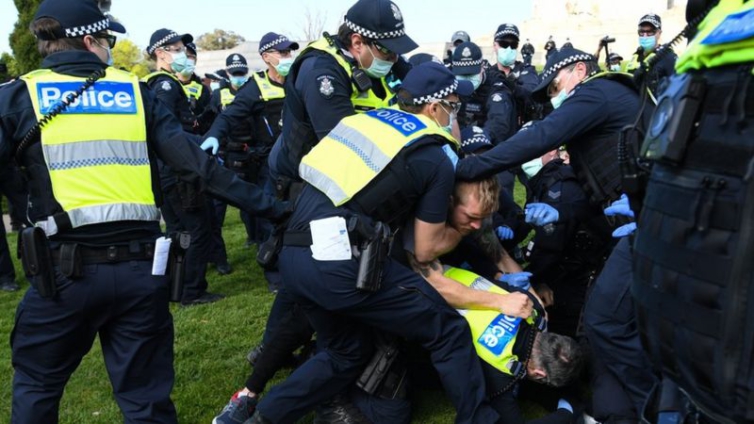
Australian police have made dozens of arrests amid anti-lockdown protests attended by hundreds nationwide.
In Melbourne, the centre of Australia's outbreak, about 300 people marched in defiance of tough measures that have been in place for a month. Other protests took place in Sydney, Brisbane, Adelaide and Perth.
On Friday PM Scott Morrison said seven of the country's eight states and territories had agreed to open their internal borders by December.
He suggested an eventual travel bubble with New Zealand could boost tourism and help revive the economy.
"In the absence of a vaccine, we may have to live this way for years," he warned.
Confirmed virus cases in Australia have more than tripled to over 26,000 over the past two months, with deaths rising to 748 from 104 over the same period.
What happened at the protests?
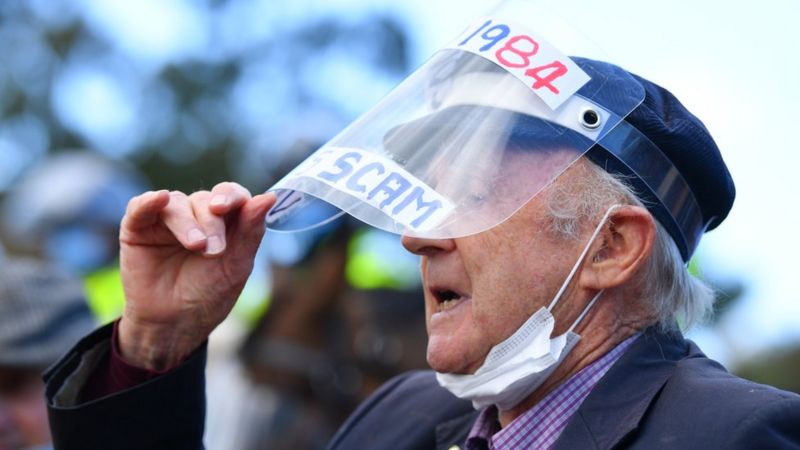
In Melbourne, protesters chanted "freedom" and "human rights matter" amid a heavy police presence. Victoria Premier Daniel Andrews was also singled out.
"We are in a city where the cure from Daniel Andrews is actually worse than what's happening," protester Fiona Kat told AFP.
Police said they had made 15 arrests 14 for breaching lock down rules and one for assaulting a police officer who received lacerations to the head. They also issued more than 150 fines for lock down breaches.
Mr Andrews condemned the event - "It is not safe, it is not smart, it is not lawful.
In fact, it is absolutely selfish for people to be out there protesting," he told reporters.
There were smaller rallies elsewhere, including two in Sydney and one in Byron Bay that turned violent, according to local media.
Police made 14 arrests, including three people suspected of assaulting police officers.
The protests were largely driven by fringe online groups promoting virus-related and anti-vaccination conspiracy theories.
Police had earlier drawn criticism for the arrest of a pregnant woman for promoting the protest online.
On Friday officers broke into the home of a former bodybuilder and conspiracy theorist who had also been calling for people to join the event.
Why does Melbourne have such a strict lockdown?
Victoria has been in a six-week lockdown since July to curb a coronavirus outbreak that has fuelled Australia's second wave.
Authorities have imposed stay-at-home rules and a curfew in Melbourne, the state capital.
The lockdown has closed many businesses and banned gatherings around the state.Victoria accounts for 75% of Australia's total infections and 90% of all deaths.
The state reported 11 deaths on Saturday and more than 70 new infections down from the peak of 725 new infections on 5 August but more than health officials had hoped for five weeks after the restrictions came in.
“Australian police have made dozens of arrests amid anti-lockdown protests attended by hundreds nationwide.
In Melbourne, the centre of Australia's outbreak, about 300 people marched in defiance of tough measures that have been in place for a month”https://t.co/VNFBJnv28K— Nick Mangwana (@nickmangwana) September 5, 2020
On Sunday Mr Andrews is due to announce some easing of restrictions. It follows calls by Australia's federal government and businesses to that end.
The state accounts for about a quarter of the country's economy.However he has urged caution. "Until you fix the health problem, there can be no economic repair," he said.
What about the rest of Australia?
On Saturday there were five new coronavirus infections in New South Wales, one in Queensland and one in South Australia.
Mr Morrison said plans to reopen state borders by December would involve coming up with a way of managing virus hotspots.
However the geographically largest state, Western Australia, has rejected the plan until the other states have the virus under control.
It has not had a local transmission for 129 days and there are no restrictions in place there.
Western Australia Premier Mark McGowan said the long desert border would remain shut to save lives and protect big mining operations.
Speaking after a national cabinet meeting on Friday, Mr Morrison said Australia could apply the hotspot approach to New Zealand as well.
Meanwhile a former prime minister of the Cook Islands, Joseph Williams, has been confirmed to have died of coronavirus in New Zealand. It is the second death there in two days and brings the country's total to 24.
Latest Stories
-
Government reiterates commitment to growth in real estate sector; Prime Accra launched
8 minutes -
Energy Minister engages key stakeholders to boost Ghana’s upstream petroleum sector
13 minutes -
Flood survivors in North East region demand non-partisan action on Pwalugu Dam Project
22 minutes -
“We’re not speaking out of vacuum” – IMANI defends SIC political inference claims
26 minutes -
GH¢20m unexecuted hospital payment exposes systemic failure in public spending – Edem Senanu
48 minutes -
Sampson Tagbor: SIGA’s B2B strategy is proactive and must be commended
49 minutes -
All set for 2026 Kwahu Business Forum
60 minutes -
Photos: Mahama welcomes Zimbabwean President Mnangagwa for 3-day state visit
2 hours -
Four killed in bus crash at Sefwi Asempanaye
2 hours -
Casual staff at Northern Regional Hospital strike over 5 months of unpaid salaries
2 hours -
GCB Bank records GH¢3.2bn profit, sets industry benchmarks in 2025
2 hours -
UK will seek closer ties with EU in light of Iran war, Starmer says
2 hours -
Maxzy’s debut EP ‘Hunter’s Tale’ chronicles pain, loyalty and survival
2 hours -
Volta Region Presiding Members backs Council of State member in EOCO dispute
2 hours -
Explosions at Burundi ammunition depot kill civilians, witnesses say
2 hours