

Audio By Carbonatix
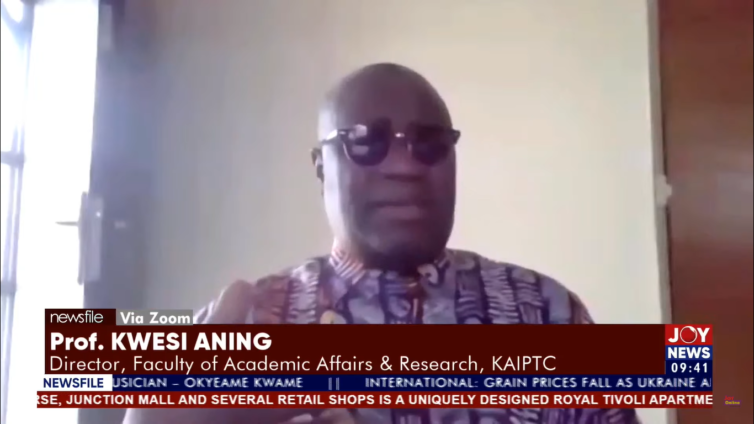
Director of the Faculty of Academic Affairs and Research at the Kofi Annan International Peacekeeping Training Centre (KAIPTC) has likened corruption to a glue that binds the country together.
Prof. Emmanuel Kwesi Aning said without corruption, the "edifice called Ghana Enterprise will collapse."
His comment comes after the Ghana Statistical Service (GSS) unearthed the extent of corruption in the country in its latest survey.
Titled ‘2021 Ghana Integrity of Public Services Survey’, GSS revealed that Ghana lost ¢5 billion in cash through the payment of bribes to both private and public officials in 2021 in order to access basic services.
The latest report also indicated that 26.7% of public sector officials were engaged in bribery acts, whilst 9.1% were officials from the private sector.
Although Prof Aning said he is not surprised by the findings, he decried the extent of the canker.
Speaking on JoyNews’ Newsfile on Saturday, the security analyst noted that corruption creates a serious threat to national security.
"And I think the critical aspect is that this is a problem; we’ve quantified it and we have brought it and we’ve brought it down to developmental terms. How many schools, roads, clinics can we build with this money.
“Also the fact that, this cuts across different shades of individuals and institutions. So yes, Corruption creates insecurity and creates a sense of social injustice. It creates inequality in societies," he noted.
Prof Aning further commended the Statistical Service for providing such a scientific data for reference as far as graft is concerned.
“I think this report quantifies in a very practical commonsensical manner what corruption means and what bribery means. The extent of the problem, the category or categories of individuals and institutions involved.
“So for me, this is one of the few times that a state agent is bold enough to scientifically prove this allegation that people have been engaging in,” he noted.
Prevalence of bribery in Ghana
The report also showed that the prevalence of bribery in Ghana is 26.7%, meaning one out of four people who had contact with a public official in the 12 months prior to the survey, had been asked to pay a bribe by a public official, or asked to pay bribe but refused to do so.
The report also showed that the prevalence of bribery in Ghana is 26.7%, meaning one out of four people who had contact with a public official in the 12 months prior to the survey, had been asked to pay a bribe by a public official, or asked to pay bribe but refused to do so.
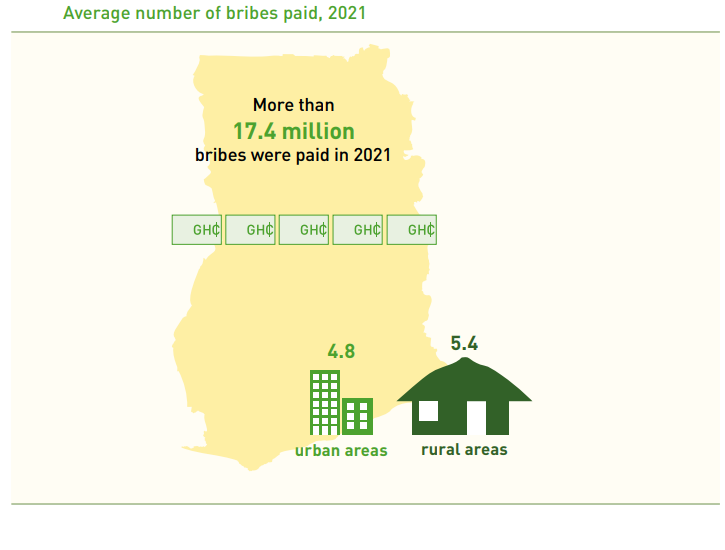
The survey revealed that, on average, there is no difference in the prevalence of bribery in rural and urban areas of Ghana. There are, however, sizable variations across the 16 regions of the country.
On regional basis, the prevalence of bribery in the Bono East, Savannah and Volta regions, for example, were substantially lower than the national rate. The three regions recorded corruption cases of 11.8%, 14.5% and 19.1% respectively.
In the Western North, Ahafo and North East regions, the corrupt cases reported were substantially higher, at 53.4%, 47.0% and 41.9% respectively.
Latest Stories
-
Livestream: Newsfile discusses ‘No-bed syndrome’ and sole-sourcing under the lens
11 minutes -
VAST calls for urgent policy overhaul as air pollution kills thousands in Ghana
2 hours -
Outcome to The Drama: 10 of the best films to watch this April
3 hours -
Britain led the fight to end slavery; we shouldn’t be paying for a crime we helped eradicate – Kemi Badenoch
3 hours -
“Who should compensate whom?” – Afenyo-Markin sparks heated Parliamentary debate over slavery reparations
3 hours -
Iran strikes injure US troops at Saudi base
3 hours -
NPP deploys regional heavyweights to oversee polling station and electoral area polls
4 hours -
Akufo-Addo to lead ECOWAS election observers for Benin’s high-stakes presidential transition
5 hours -
Iran war splits older and younger conservatives – as pressure builds for Trump to find exit ramp
5 hours -
Callistus Mahama writes on slavery reparation: ‘We cannot confuse participation with responsibility’
5 hours -
‘The gravest crime against humanity’: What does the UN vote on slavery mean?
6 hours -
Catholic Bishops back Mahama after US university rescinds honorary degree over LGBTQ stance
7 hours -
Ablakwa expresses disappointment over US ‘no’ vote on the UN Slavery Resolution
7 hours -
Luxury watches and cash theft: Joy Sports Editor Fentuo details what happened at the Black Stars camp before the Austria game
8 hours -
India grants ‘penalty-free’ exit window for overstayed Ghanaian nationals
8 hours