

Audio By Carbonatix
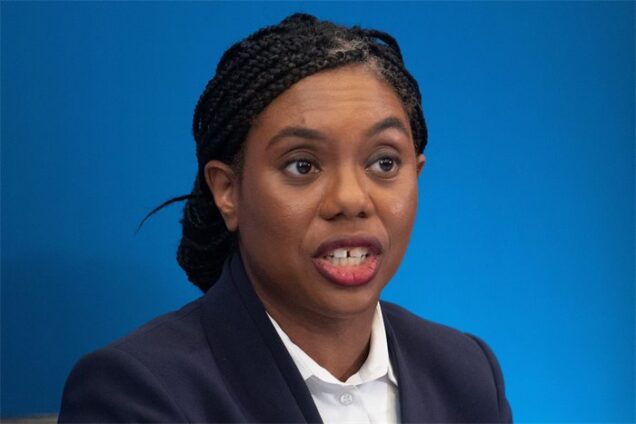
The leader of the UK Conservative Party, Kemi Badenoch, has criticised the Labour government’s foreign policy, accusing Prime Minister Keir Starmer of failing to protect British taxpayers from "trillions in reparations" at the United Nations.
The row erupted after the United Kingdom joined 51 other nations, primarily from the European Union, in abstaining from a landmark UN General Assembly resolution.
The motion, spearheaded by Ghana, officially recognises the Trans-Atlantic Slave Trade as the "gravest crime against humanity" and outlines a formal framework for reparative justice.
While the United States, Israel, and Argentina moved to explicitly vote against the measure, the UK’s decision to remain neutral has ignited a fierce domestic debate over historical accountability and future financial risk.
The "Trillion-Pound" Warning
Taking to social media platform X, Mrs Badenoch suggested that the Labour government’s refusal to vote ‘no’ was a betrayal of Britain’s role as the nation that eventually led the global abolitionist movement.
“Russia, China and Iran vote with others to demand trillions in reparations from UK taxpayers…and the Labour government abstain! Britain led the fight to end slavery. Why didn’t Starmer’s representative vote against this? Ignorance…or cowardice? We shouldn’t be paying for a crime we helped eradicate and still fight today,” the opposition leader wrote.
Russia, China and Iran vote with others to demand trillions in reparations from UK taxpayers…and the Labour government abstain!
— Kemi Badenoch (@KemiBadenoch) March 26, 2026
Britain led the fight to end slavery.
Why didn’t Starmer’s representative vote against this? Ignorance…or cowardice?
We shouldn’t be paying for a… https://t.co/nWlzBxhb5w
The Conservative leader’s concerns mirror those of some economists who warn that, although UN General Assembly resolutions are not legally binding, they create a "moral and political" platform that could be used to pursue heavy litigation against British institutions in international courts.
The Ghanaian Mandate: "Not about money for leaders"
In New York, the architects of the resolution sought to dispel fears that the move was a "shakedown" of Western economies.
Ghana’s Foreign Minister, Samuel Okudzeto Ablakwa, clarified that the demand for compensation is aimed at structural development rather than direct cash transfers to governments.
“We are demanding compensation – and let us be clear, African leaders are not asking for money for themselves. We want justice for the victims and causes to be supported, educational and endowment funds, skills training funds,” Mr Ablakwa emphasised.
He added that Ghana’s mission is to ensure the "enduring scars" of the trade—which saw an estimated 12.5 million Africans forcibly transported across the Atlantic—are documented and addressed through historical truth.
A "Safeguard Against Forgetting"
The resolution passed with a sweeping 123 votes in favour, a victory for the African Union’s reparations committee. President John Dramani Mahama, who has become the global face of the reparatory justice movement, framed the vote as a defining moment for the 21st century.
“Let it be recorded that when history beckoned, we did what was right for the memory of the millions who suffered the indignity of the slave trade and those who continue to suffer racial discrimination. The adoption of this resolution serves as a safeguard against forgetting. It also challenges the enduring scars of slavery,” President Mahama told the assembly.
A Divided Europe
The UK’s abstention placed it alongside 51 other countries that found the resolution’s language on "reparations frameworks" difficult to support, yet were unwilling to join the US in an outright rejection.
Historians estimate that of the millions taken between the 16th and 19th centuries, over two million perished in the "Middle Passage." While the UK was a dominant player in the trade for over two centuries, it also deployed the Royal Navy’s West Africa Squadron to suppress the trade after 1807—a point of pride that Mrs Badenoch argues should have shielded the UK from being lumped in with the "perpetrators" at the UN.
The Starmer government has yet to issue a formal response to Badenoch’s "cowardice" jab, though Whitehall sources suggest the abstention was a calculated move to maintain diplomatic ties with Commonwealth partners while avoiding a definitive legal commitment to payouts.
Latest Stories
-
APL says GoldBod terminated US$1bn Goldstream deal over failure to meet obligations
4 minutes -
Daily Insight for CEOs: Making better decisions under pressure
5 minutes -
Weta rice farmers seek urgent support after floods destroy crops
5 minutes -
Mahama commits GH¢200m in 2027 Budget to complete Police Hospital expansion
9 minutes -
Standard Chartered Bank delivers strong returns and sustainable shareholder value
20 minutes -
Akufo-Addo’s role in the artificial cedi stability is indisputable — Facts do not bend to political convenience
22 minutes -
Breaking Bad actor RJ Mitte dies aged 34
29 minutes -
Wontumi pleads not guilty in GH¢30m Exim Bank loan case
34 minutes -
Beyond the Flyer: Awareness without screening is not enough
40 minutes -
Bekwai MP donates GH¢100,000 to hospital for specialist equipment
48 minutes -
Van Vicker sues Lil Win for defamation, demands GH¢10m
54 minutes -
FIFA/ FIBA agency Pep Sports moves to admit Ghana’s 7-Foot Basketball talent to its Ultra-Modern Sports campus after MyJoyOnline report
56 minutes -
GAUA strike disrupts academic plans at University of Ghana as students, parents express frustration
1 hour -
Dad’s Army/African Polistas crowned champions of 2026 Accra Polo Club Trustees’ Cup
1 hour -
Mahama approves Integrated Basic Education Model, with funding expected in 2027 under GETFund formula
1 hour