

Audio By Carbonatix
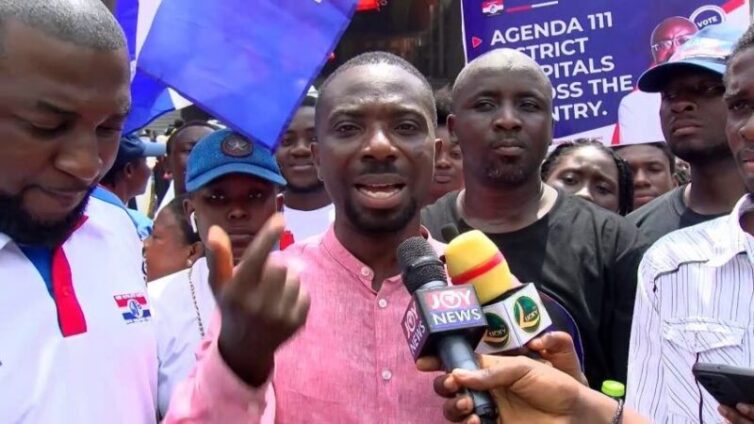
Director of Communications for the Bawumia Campaign, Dennis Miracles Aboagye, has argued that the cost of living for Ghanaians has deteriorated after one year of the National Democratic Congress (NDC) administration, describing the current economic situation as a reversal rather than the promised reset.
Speaking at the People’s Forum, organised to assess the government’s first year in office, Mr Aboagye said that despite improvements in headline indicators such as lower inflation and a stronger cedi, the everyday experiences of households tell a different story.
He maintained that living expenses continue to rise faster than incomes, leaving many families under increasing financial pressure.
According to him, prices of essential goods and services have gone up across the country, deepening the strain on workers and low-income households.
“If this is a reset, then we are in trouble,” he said.
“What we are seeing from the People’s Forum is not a reset but a reverse, and the people are clearly upset.”
Mr Aboagye stressed that there is a clear gap between the economic progress being highlighted by government and the realities faced by ordinary Ghanaians.
He noted that while inflation and the exchange rate have improved on paper, these gains have not translated into meaningful relief at the household level.
“They are upset because inflation and the dollar are dropping, yet the cost of living keeps rising,” he said. “There is a disconnect between the policies the government is touting and the evidence we experience.”
He cited rising utility tariffs and education-related costs as key examples of this disconnect, arguing that modest salary increases are being wiped out by higher expenses.
“If I am a teacher coming from Dodowa and you give me a nine per cent increase, but I am now spending more on electricity, water, school fees and hostel fees, then it becomes a problem,” he stated.
Mr Aboagye also questioned the practical relevance of falling inflation figures in the face of steep utility price hikes.
“When electricity tariffs go up by 28 per cent, it makes nonsense of inflation coming down from 23 per cent to 15 per cent,” he said, urging government to pay closer attention to feedback from market women, drivers and other ordinary citizens.
“The indicators may be true, but they are not reflecting in our lives,” he added.
Latest Stories
-
Imprisonment should be rehabilitative, not punitive – Ghana Prisons boss at UNGA
11 minutes -
Ga Adangbe traditional priests petition Mahama over McDan aviation licence revocation
22 minutes -
Anti-LGBTQ Bill: NDC’s arrogance is worrying – Hassan Tampuli
32 minutes -
Let’s give OSP time to mature, not to scrap it – Hassan Tampuli
36 minutes -
Nigeria convicts 386 Islamist militants in mass trials
41 minutes -
Djibouti president wins election with 97.8% of vote, state media says
46 minutes -
We don’t have mandate to deduct tax from rent allowance of security services personnel – Interior Ministry clarifies
1 hour -
Ablakwa receives Presidential Special Envoy on Reparations to advance global agenda
1 hour -
Christina Koch becomes first woman to travel around the moon on Artemis II
1 hour -
Epstein survivors’ calls to meet King Charles and Queen harder to ignore as US visit approaches
2 hours -
UN Secretary-General names Ghana’s Anita Kiki Gbeho as South Sudan envoy
2 hours -
Mali withdraws recognition of Sahrawi Republic, backs Morocco’s autonomy plan
2 hours -
Gov’t distributes over 8,500 laptops to One Million Coders project
2 hours -
Julius Debrah, ‘man to beat’ as NDC’s James Agbey dismisses Musah Dankwah’s polls
2 hours -
GPRTU in Savannah Region to protest alleged eviction in Damongo
2 hours