

Audio By Carbonatix
A new report from global advocacy organisation Mighty Earth says Africa’s top cocoa-producing nations continue to see huge areas of forest being destroyed since the high-profile launch of the Cocoa and Forests Initiative (CFI),
Mighty Earth said Côte d'Ivoire and Ghana are estimated to have lost 80% to 90% of their forested area over the last few decades, in large part to make way for cocoa farms.
Through a combination of satellite data analysis and on the ground field investigations, the organisation has uncovered evidence of ongoing tropical forest clearance for cocoa.
The new data analysis by Mighty Earth contained in Sweet Nothings Report revealed that, even after the industry published action plans in 2019, Côte d'Ivoire lost 19,421 hectares 74.9 sq. mi. of forest within cocoa growing regions and Ghana lost 39,497 hectares 152.5 sq. mi. This amounts to a combined area equivalent to the size of the cities of Madrid, Seoul, or Chicago.
“This report unwraps the unsavoury side of the cocoa industry and shows the urgent need to break the link between chocolate products and deforestation,” said Glenn Hurowitz, CEO of Mighty Earth, the global advocacy organization working to defend a living planet.
“Chocolate companies like Nestlé, Hershey’s, Mondelez and Mars need to stop making empty promises and start working together with governments in the CFI to establish an open and effective joint deforestation monitoring mechanism this year”.
This includes deforestation in designated protected areas that provide vital habitats for endangered wildlife such as chimpanzees and pygmy hippos. These forests are also critical carbon sinks, vital for slowing both the climate crisis and biodiversity loss.
According to the report “In Ghana, 2020 tree cover loss countrywide was 370 per cent higher since January 2019 than it was between 2001-2010, and 150 per cent higher than the average tree cover loss between 2011 to 2019.
"Average countrywide tree cover loss in Côte d'Ivoire has been 230 per cent higher in the period since January 2019 than it was between 2001 to 2017, and 340 per cent higher than the average loss during the 2000s."
The report noted that deforestation is still found throughout protected areas in Côte d'Ivoire and Ghana, with satellite data analysis and observations from Mighty Earth’s field investigation in Côte d'Ivoire revealing that cocoa expansion is playing a major role in this encroachment.
General Coordinator of the Ivorian Human Rights organizations (RAIDH), Souleymane Fofana said all of this devastation is entirely preventable and should have been addressed long ago.
“Meanwhile, forests continue to disappear, endangered species die, and communities suffer; The cocoa industry has the same tools and far more resources than Mighty Earth to track and prevent deforestation, but limited willpower and lack of transparency and accountability continue to be the biggest roadblocks to progress,” he said.
The ‘Sweet Nothing’s’ report recommended that chocolate companies, cocoa traders, and governments must pool information about cocoa supply chains, and couple this with satellite data imagery to establish an open and transparent joint deforestation monitoring mechanism in 2022.
Such a mechanism would provide the means for collective action to prevent forest encroachment from cocoa expansion and target initiatives aimed at improving livelihoods for smallholder farmers in Ghana and Côte d'Ivoire.
CFI should publicly report progress in reducing deforestation in Ghana and Côte d'Ivoire, with the aim of achieving zero new deforestation for cocoa within two years.
Also, leading chocolate companies and cocoa traders should play an active role in the restoration of degraded forests and biodiversity in Ghana and Côte d'Ivoire.
They should commit to sourcing at least 50 per cent of their cocoa from agroforestry by 2025, and work with cocoa cooperatives and government agencies to help smallholder growers manage the transition from cocoa monocultures to diversified farming systems.
Additional, the Government of Côte d'Ivoire should work to quickly confirm the boundaries of protected areas and stop any new deforestation by involving, in a transparent manner, communities and civil society organizations in their monitoring.
They believe that in Ghana, the Government’s Forestry Commission, together with the Ghana Cocoa Board, need to ensure that the emerging Cocoa Management System (CMS), which is intended to trace the cocoa supply chain, is designed in a transparent manner so that stakeholders will have trust and confidence in the data that it will produce.
The flag up the need for Authorities in the European Union, Japan, and the United States should introduce legislation that requires companies to conduct thorough due diligence checks to prevent cocoa or cocoa-derived products linked to deforestation from being imported into their consumer markets.
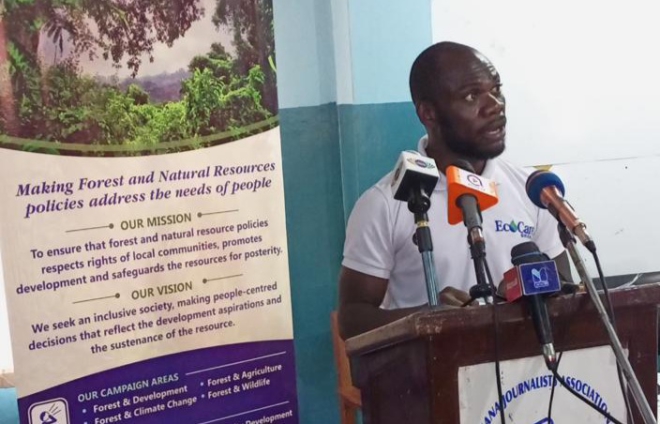
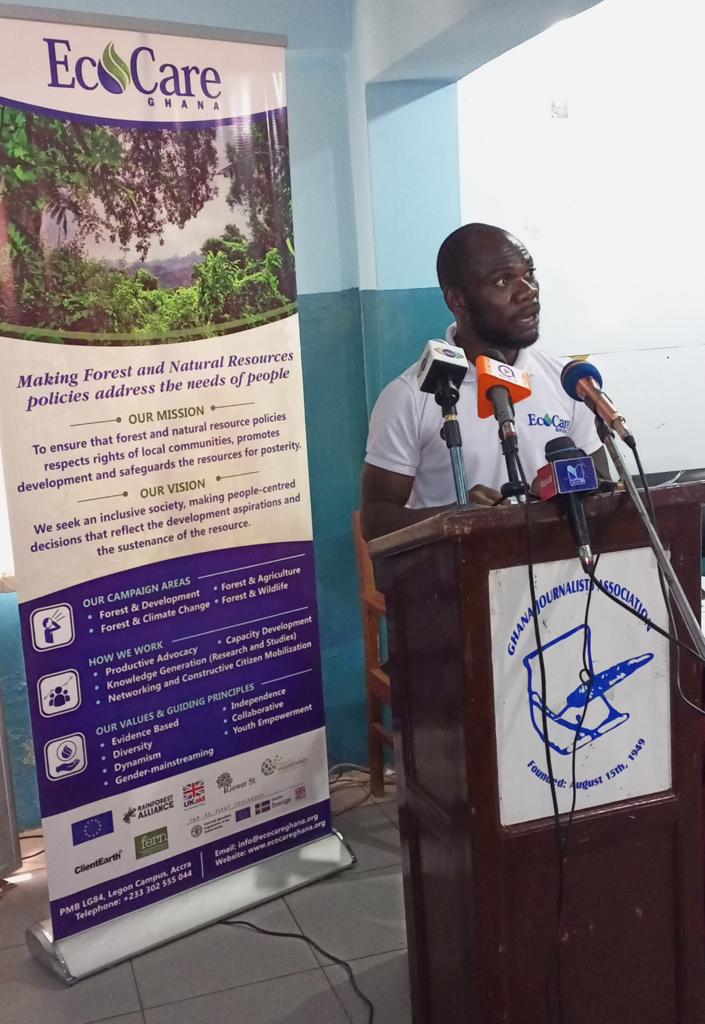
Managing Campaigner at EcoCare Ghana, Obed Owusu-Addai said “The Cocoa and Forests Initiative has lots of potential but currently is not living up to it. It promised so much but is failing to deliver.
"Cocoa and chocolate companies have a duty to protect the environment or risk losing the commodity they depend on forever because the current situation is unsustainable."
Latest Stories
-
US seeks changes to rejected $109m health compact with Ghana – Mahama
2 minutes -
Nine dead in mass shooting at Pennsylvania home
20 minutes -
‘Time for Ukraine to get new president,’ says Trump after Zelensky condemns diesel deal
23 minutes -
Hincapie injury adds to Arsenal issues after Guimaraes rescue act
31 minutes -
Henderson scores twice as Chelsea thumb Bournemouth
41 minutes -
Photos: Mentapulse Africa convenes health and labour summit to address talent retention
53 minutes -
Mahama inspects Nkokɔ Nketenkete plant, eyes Bechem as chicken capital
59 minutes -
Ghana not seeking full BRICS membership, applying as Partner Country – Ablakwa
1 hour -
Woman injures three people in third Poland school knife attack in a week
1 hour -
Ghana should join BRICS as partner, not member – NPP Bono East Regional Secretary
1 hour -
Ghana High Commission warns nationals in South Africa over protests in Johannesburg, Durban
1 hour -
Mahama praises Roads Minister for keeping Big Push contractors on their toes
1 hour -
World Cup Visa Scandal: ‘My client has not collected money for visas’ – Ampofo Ankrah’s lawyer
1 hour -
US immigration officials defend ICE agents who shot man in same car as child
1 hour -
Commentator Katie Zacharia picked as new White House press secretary
2 hours