

Audio By Carbonatix
Acting Head of the Disease Surveillance Department of the Ghana Health Service (GHS), Dennis Laryea says door handles at public places do not necessarily spread Covid-19 infection.
He said some members of the public used their elbows to open doors at public places, insisting that “Don’t worry about touching door handles, what you do after touching the handles is the most important thing.”
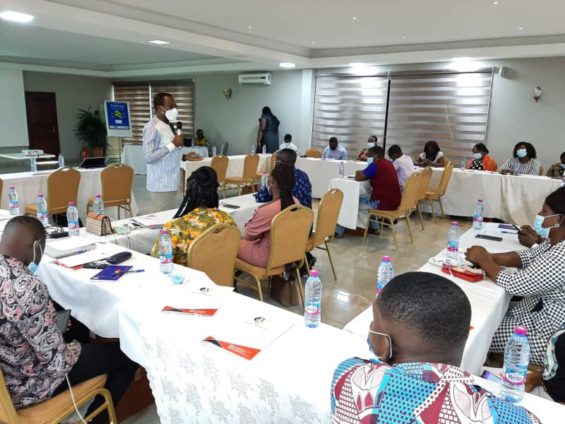
Dr Laryea, who was speaking at the opening of a two-day workshop in Kumasi for some selected journalists across the country, said people could open doors with their hands, but should properly sanitize their hands immediately.
He said most people sanitised their hands, and not their elbows which they inadvertently touched with their hands in the course of the day.
Contrary to some misconception that food could spread Covid-19 infection, the Acting Head of the Disease Surveillance Department emphasized that “There is no evidence that consuming food is associated with Covid-19 infection.
“Sometimes, people focus on the wrong information that when somebody has Covid-19 and sells food to you, you will get Covid-19. Is not eating the food that will give you Covid-19.
“If the person hands over money to you, you take it and don’t sanitise your hands, and touch your face, you might get the infection from that and not eating the food the person gave to you,” Dr Laryea said.
On the use of face masks, he insisted that face masks must be properly worn, and explained that the band on masks, especially the surgical and N95 masks was meant to be shaped around the contour of the nose for proper protection.
On the case count in the country, he said the cumulative cases in the country as of October 21, 2021 stood at 129, 948, discharges were 126, 813 with 1,170 deaths while active cases were 1,965.
Madam Offeibea Baddoo, the Communications Officer of UNICEF said Covid-19 was not peculiar to only adults but also affected children, and encouraged journalists to take interest in child protection issues, especially in the era of Covid-19.
An Official from the Ministry of Information, Mr Kweku Obeng-Adjei who spoke on the impact of Covid-19 pandemic and the role of journalists, reminded them of their responsibility to provide coverage of the pandemic to combat public misconception.
He said “The media must make conscious effort to verify source of information and report objectively the facts rather than opinions.
“Journalists need to collaborate with medical experts to carefully sift through the information to be shared with the public to enable them make informed choices to stay safe,” Mr Obeng-Adjei added.
Latest Stories
-
After more than 14 years at Atletico Madrid, what next for Simeone?
2 hours -
Conquering the World – Building on the foundations laid by Otto Addo
2 hours -
[Watch Live] Obrafour, Kwaw Kese, Tinny, Keche and others thrill fans at Gomoa Easter Carnival
2 hours -
Gomoa Easter Carnival: Experts charge indigenes to own festival to ensure sustainability
3 hours -
Gomoa Easter Carnival: Edem Agbana and Joy Prime fans shower festival with huge endorsements
4 hours -
Gov’t to overhaul free zones into manufacturing hubs for local production – Trade Minister
5 hours -
Ghana losing $2.5bn yearly from raw exports – Trade Minister reveals
6 hours -
Mahama unveils plans for Kwahu Airport, Convention Centre
6 hours -
World’s oldest leader, Paul Biya to get a deputy for first time in 43-year rule
6 hours -
Search for missing US airman continues as Trump threatens ‘hell’ if Iran does not reach deal
6 hours -
US says it has arrested relatives of late Iranian general Qasem Soleimani
6 hours -
La Liga: Real Madrid’s title hopes hang in the balance as Mallorca snatch stoppage-time winner
6 hours -
FA Cup: Haaland hat-trick powers Man City past Liverpool into semi-finals
6 hours -
FA Cup: Chelsea thrash Port Vale to reach Wembley semi-final
6 hours -
Gov’t to boost tourism in coastal communities through infrastructure, sanitation – Vice President
7 hours