


Audio By Carbonatix
Existing vaccines should still protect people who contract the Omicron variant from severe Covid cases, a World Health Organization (WHO) official says.
It comes as the first lab tests of the new variant in South Africa suggest it can partially evade the Pfizer jab.
Researchers say there was a "very large drop" in how well the vaccine's antibodies neutralised the new strain.
But the WHO's Dr. Mike Ryan said there was no sign Omicron would be better at evading vaccines than other variants.
"We have highly effective vaccines that have proved effective against all the variants so far, in terms of severe disease and hospitalisation, and there's no reason to expect that it wouldn't be so" for Omicron, Dr. Ryan, the WHO's emergencies director, told AFP news agency.
He said initial data suggested Omicron did not make people sicker than the Delta and other strains. "If anything, the direction is towards less severity," he said.
The new South African study - which has not yet been peer-reviewed - found the Pfizer/BioNTech vaccine may result in up to 40 times fewer neutralising antibodies against Omicron than against the original Covid strain.
But Omicron's ability to escape vaccine antibodies is "incomplete", said Prof Alex Sigal, a virologist at the Africa Health Research Institute, who led the research.
He said the results, based on blood tests from 12 people, were "better than I expected of Omicron".
Prof Sigal said vaccination, combined with previous infection, could still neutralise against the variant. That suggests boosters may bring a significant benefit.
Scientists believe previous infection, followed by vaccination or a booster, is likely to increase the neutralisation level and will probably protect people against severe disease.
More data on how well the Pfizer jab works against Omicron is expected to be released in the coming days.
There is no significant data yet on how the Moderna, Johnson & Johnson and other jabs hold up against the new variant.
Omicron is the most heavily mutated version of coronavirus found so far.
It was first identified in South Africa, where there is now a surge in the number of people catching Covid multiple times.
UK Prime Minister Boris Johnson's spokesman said early signs suggested Omicron could be more transmissible than the current Delta strain.
But Omicron's ability to cause severe disease is not yet clear.
Dr Anthony Fauci, the top US infectious diseases expert, said early evidence suggests Omicron could be more transmissible but less severe.
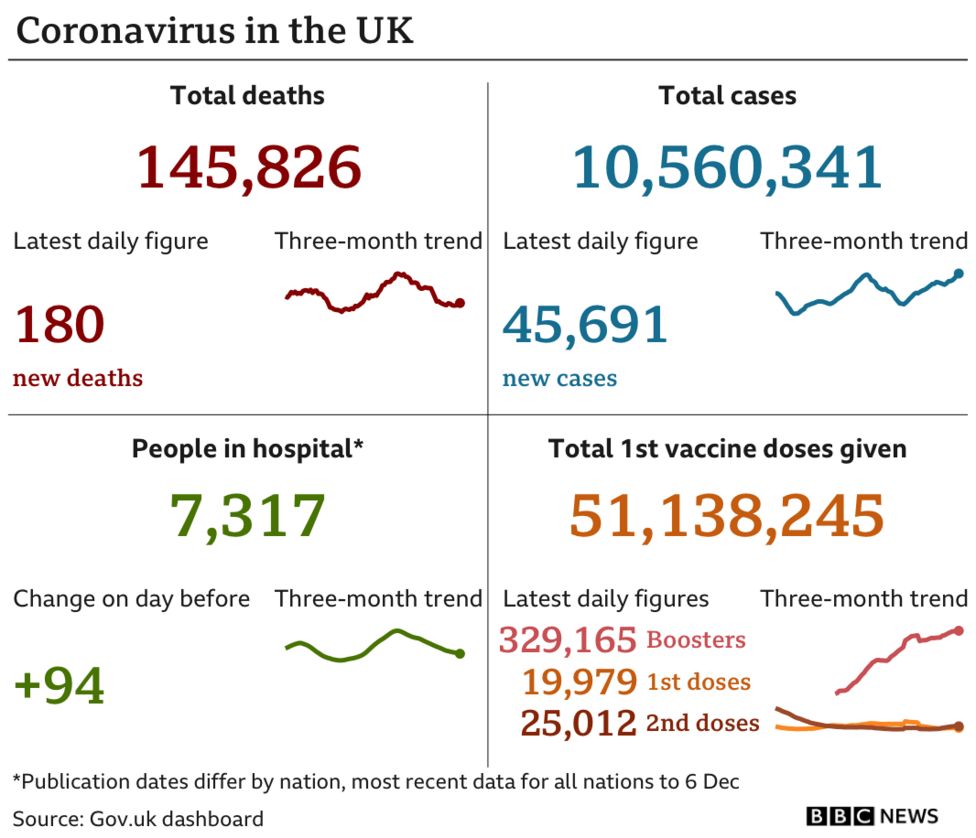
There have been more than 267 million cases and more than five million deaths around the globe since the pandemic started in 2020, according to data from Johns Hopkins University.
Latest Stories
-
GAEC must retain nuclear scientists for Ghana’s nuclear ambitions – Minister
12 minutes -
Man reportedly mistaken for game and shot by hunter dead in forest
14 minutes -
19-year-old mason jailed 15 years for defiling seven-year-old pupil
18 minutes -
Ghana’s banking sector assets rise 20.47% to GH¢500.2bn – BoG Governor
23 minutes -
22 injured as Sprinter bus overturns at Sege after tyre burst
24 minutes -
UN housing expert urges Ghana to strengthen Rent Control Department amid housing affordability concerns
32 minutes -
Delta-BCI partnership reaches 166,000 people with breast cancer education
42 minutes -
Power restoration fault suspected in Kumasi Central Market fire
6 hours -
The 7-foot giant of Ngleshie Amanfro: Seven-foot Ghanaian Ephraim Saawa dreams of joining the national basketball team
7 hours -
Government promises support for Kumasi Central Market fire victims
7 hours -
Vibes The Movie: Big Ghun’s Ghanaian film earns five nominations at 2026 REFFA
7 hours -
‘I’m a fulfilled man’—Justice Korbieh on missing out on Supreme Court despite two nominations
7 hours -
MamaCare CEO warns unresolved conflicts among health workers could undermine maternal and neonatal care
8 hours -
Health professionals urged to translate medical knowledge into practice to save mothers
8 hours -
Retired judge Justice Francis Korbieh charges 1,568 new lawyers to uphold integrity
9 hours