

Audio By Carbonatix
Research shows that Ghana’s agriculture contributed about 11.7 billion dollars to 2023’s Gross Domestic Product. In contrast, agriculture in North Carolina, one of the 50 states of the United States of America, contributed about 111 billion dollars to the country’s GDP in the same year. This difference highlights the impact of continuous investment in innovations and emerging technologies like biotechnology.
The term “biotechnology” was coined by a Hungarian engineer Karl Ereky, in 1919, to refer to the science and methods that permit products to be produced from raw materials with the aid of living organisms. Since then, biotechnology has transformed various industries including producing many biopharmaceuticals and vaccines, helping forensic experts with DNA fingerprinting and profiling, and converting biomass into biofuels, among others.
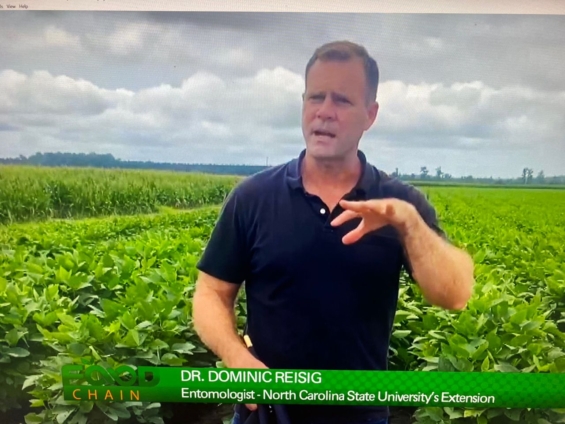
In agriculture, biotechnology aims to introduce sustainable agricultural practices with best yield potential and minimal adverse effects on the environment. A key area of application is pest management, as emphasized by Dr. Dominic Reisig, an Entomologist at North Carolina State University’s Extension.
“In 1996 when BT cotton was commercialized, tobacco budworm was eliminated as a pest in the system. BT cotton for tobacco budworm, I would say arguably, has been the most successful among any pest we’ve tried to control. Because we sprayed cotton less, other insects moved in to fill the niche and those were insects in the piercing and sucking complex hence the traditional way that we have managed both of these insects has been foliar insecticides,” he said.

A third-generation farmer and seed producer at Belhaven in North Carolina, Darren Armstrong grows corn, cotton, soybean, wheat, and oats. He explained that biotechnology has revolutionized his farming practices and improved productivity.
“We started using the technology as soon as it was available somewhere in the mid-1990s. I would say it's been about 28 years now and we could see immediately the difference that it made whether it was the process of what we were doing, tillage techniques we were using, hours we spent on the farm, the equipment or how much diesel we were using. You could see that technology was making these things better,” he stated.
Reacting to backlash on genetically engineered crops, Darren said “certainly, there’s no advantage to me, to produce anything that would negatively affect in any way the consumer because they are the ones who are buying our products at the end of the day.”
Soil and water are critical factors for crop yields, whether using conventional or genetically engineered methods. Professor Ekrem Oslu, a Soil Management Specialist at North Carolina State University, shared insights on best practices for soil management.
“When we talk about tillage as a soil management practice, we can talk about the different intensity and aggressiveness of tillage which goes from the traditional to moldboard plowing systems. There is also cover crop integration in crop rotations. So we do manage soils for corn, cotton, soybean, peanut, and other crops in North Carolina,” he highlighted.
A PhD Candidate in Biological and Agriculture Engineering at North Carolina State University, Dana Mugisa, whose research is being conducted at the Tidewater research station emphasized the importance of water in a climate-changing world.
“I have been looking at the climate resilience of four corn hybrids and four soybean varieties for the last three years. The goal is for us to impose different water stresses on these different corn hybrids and soybean varieties, look at their yield response, their nutrient uptake and the economic implications of the differences in structure and the benefits to the farmer,” she intimated.
Latest Stories
-
MLS bans Yeboah & Jones for betting offences
3 hours -
He called me traitor 50 times – Mourinho sent off after celebrating goal
3 hours -
Eni Aluko wins Joey Barton libel case over X posts
3 hours -
Ten players from Jamaican club denied entry to US
3 hours -
Some banks move to sell assets of PBC over GHC 300 million debt
3 hours -
Uefa fears impact of Premier League spending rules
3 hours -
EU to sign historic defence pact with Ghana in global security pivot
3 hours -
Liverpool lose to Galatasaray in Slot’s 100th game in charge
4 hours -
Iran begins laying mines in Strait of Hormuz, sources say
4 hours -
Joey Barton refused bail after ‘attack at golf club’
4 hours -
GH¢68.7bn gov’t arrears bombshell: Parliament orders probe over suspected fraud
4 hours -
The public display of students’ academic results in basic schools: A case against a damaging practice
4 hours -
GOIL jumps GH¢0.21, MTN Ghana surges past GH¢6.30 in record-breaking GSE session
4 hours -
NAIMOS disrupts illegal mining activities at Gwira Banso-Eshiem
5 hours -
Ashesi hosts Kensei Kai Foundation’s maiden Inter-University Karate Camp
5 hours