

Audio By Carbonatix
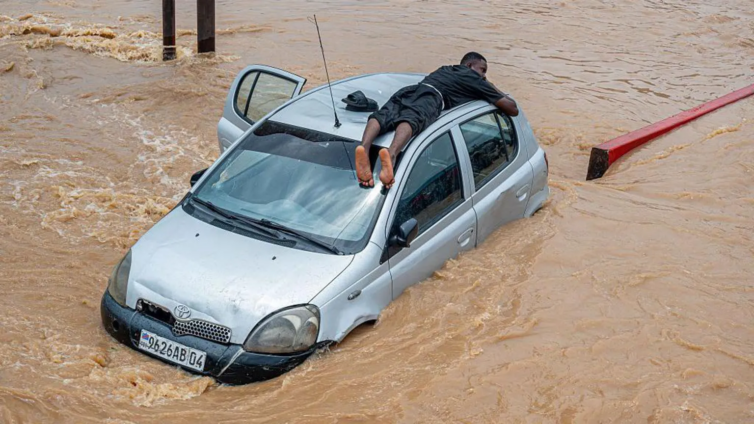
Torrential rains and floods have killed at least 33 people in Kinshasa - the capital of the Democratic Republic of Congo - according to officials.
"The republic will not abandon you," President Félix Tshisekedi promised victims on Monday, saying he had called a government crisis meeting.
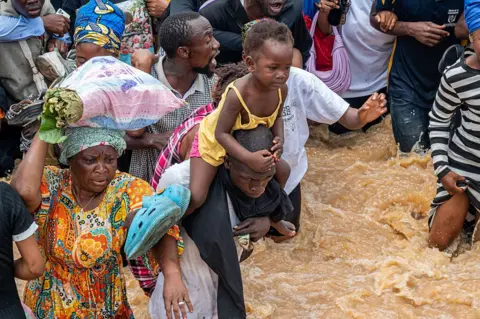
Desperate residents are trying to flee the floodwaters by wading, swimming or paddling to safety in homemade canoes.
The city is home to 17 million people and sits on the Congo river, which is one of the biggest in the world and stretches across the country.
Flooding is common - the river recently reached its highest level in six decades.
Parts of the capital are prone to soil erosion and in recent years the Congolese president has warned that the climate crisis is making flooding worse.
Many homes in west Kinshasa were swept away following flooding overnight from Friday into Saturday.
About half of the city's 26 districts are affected in total, according to the capital's mayor, who says search and rescue teams have been sent out.
Worst affected are the city's outskirts as well as some of its poorest neighbourhoods.
"The water has reached 1.5 metres high. We have just managed to save ourselves, the rest is trapped in our homes," Christophe Bola who lives in the Ndanu area told the AFP news agency.
Other local residents have told reporters they are angry with the authorities, accusing them of being too slow to react and not sending enough help.
The floods have also left people across much of Kinshasa struggling with water shortages, after water treatment pumps in the city were themselves inundated.
The city's busiest road, which connects the centre with the international airport, is impassable, as is some of the motorway that connects the capital to the country's main port, Matadi.
At least one tributary leading off the Congo river - the N'djili river - has burst its banks, trapping many residents there, said Deputy President Jacquemain Shabani in a statement on Sunday.
It is said to be one of the more polluted rivers which Congolese scientists say contains high levels of fecal matter and other waste.
Sewage maintenance is poor in many areas of Kinshasa, and there is little evidence of town planning.
Last year the government announced plans to tackle this long-standing problem.
Further heavy downpours are expected in Kinshasa in the coming weeks, as well as in the eastern city of Goma, which was seized by rebel forces earlier this year.
The national meteorological agency also warns of heavy rains elsewhere, especially in the north and north-east of the country.
Latest Stories
-
Parliament passes Education Regulatory Bodies Amendment Bill, 2026
8 minutes -
Chief Justice declares ADR Week nationwide
9 minutes -
Four million Ghanaians living with silent kidney disease — Experts say
14 minutes -
Jessie Buckley, Michael B Jordan and One Battle After Another reign at Oscars
20 minutes -
African nations tiptoe around recruitment of citizens by Russian networks
32 minutes -
Oscars 2026: Winners list in full
41 minutes -
Madagascar anti-corruption chief Rajaonarison named prime minister
53 minutes -
Indian foreign minister hails talks with Iran to open Strait of Hormuz, FT reports
1 hour -
Africa-bound India-flagged fuel tanker sets sail from east of Hormuz, Indian official says
1 hour -
How Iranians are evading internet blocks to contact family abroad
1 hour -
South Africa’s president authorises deployment of 2,200 troops to help fight crime
2 hours -
Israeli forces kill Palestinian couple and two of their children in occupied West Bank
2 hours -
Two die including uni student in meningitis outbreak
2 hours -
Severe flooding kills 66 in Kenya, as heavy rains continue
2 hours -
Is Dubai’s glossy image under threat? Not everyone thinks so
2 hours