

Audio By Carbonatix
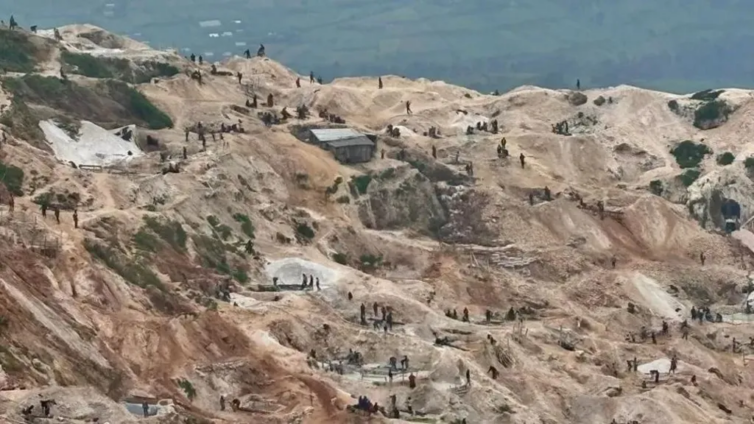
More than 200 people, including 70 children, have been killed after a landslide caused a collapse in a mining area in the east of the Democratic Republic of Congo, the government says.
The landslide struck Rubaya, the country's biggest source of coltan - an ore vital in the electronics industry - in the rebel-controlled east on Tuesday following heavy rains.
In a statement, the mines ministry blamed the tragedy on M23 rebels and said they were allowing illegal mining without proper safety standards.
The M23 are yet to comment but a source in Rubaya told the BBC the collapse was caused by attacks from government forces and only six had died. The government has not responded to the claim.
The mines in Rubaya are thought to hold about 15% of the world's coltan supply and half of the DR Congo's total deposits.
The metallic ore contains tantalum, which is used to produce high-performance capacitors in a range of electronic devices, making it in high demand worldwide.
Since 2024, the M23 have been in control of Rubaya, which lies about 70 km (45 miles) west of Goma, the capital of North Kivu province.
The authorities said rescue efforts after Tuesday's landslide were hampered by dangerous conditions, which they blamed on restrictions imposed by rebels on civilians.
The mines ministry added that the lack of official oversight at the site had left workers without basic safety protections.
"The provisional toll counts more than 200 compatriots who lost their lives, including 70 children and numerous wounded," the ministry said in a statement.
The BBC was unable to independently verify the death toll in the remote area, where humanitarian agencies and major medical facilities have little or no access, and telecommunications are frequently disrupted.
Many of the injured have been evacuated to hospitals in Goma.
The Congolese authorities said they had banned mining in the area last year, even though the rebels had already seized control of the mines by then.
When a BBC team visited the site in July 2025, they observed miners digging manually to source the precious mineral. Conditions at the site are very bad, with dangerous pits dotted around its vast expanse.
Over the past year, the M23 has made rapid advances across the mineral-rich east of DR Congo, taking more areas where coltan is mined.
UN experts say there is evidence that minerals from DR Congo are being exported through Rwanda.
The experts have also accused Rwanda of backing the M23 - an opinion supported by the US government this week which imposed sanctions on the Rwandan army and four of its senior commanders.
Rwanda has rejected these accusations.
The Rubaya mining site was recently added to a shortlist of assets that is being offered to the US by the Congolese government under a minerals cooperation framework, according to the Reuters news agency.
A similar collapse at the site in late January following heavy rainfall killed more than 200 people.
Latest Stories
-
IMF/World Bank Annual Meetings: Africa must help shape global AI rules – BoG Governor
30 seconds -
GMTF targets Volta healthcare gaps with equipment, specialist training and patient support
49 minutes -
Telecel Ghana wins 2 awards at the CCIFG Gala and Awards 2026
1 hour -
Petrol, diesel prices set to fall from Oct. 16 as LPG faces 18.5% hike
1 hour -
Bank of Ghana engages stakeholders in Techiman
2 hours -
PIAC unable to verify GH¢21m petroleum-funded projects in Ayawaso West
2 hours -
Ketu North MP led delegation petitions government over deteriorating Weta Irrigation Scheme
2 hours -
Unpaid contractor delays KATH Mother and Baby Unit as materials deteriorate
2 hours -
Kofi Adams says Ghanaians ignored warnings over World Cup visa payments
2 hours -
Banks to charge 20% VAT on payments for Netflix, Zoom, TikTok and others
2 hours -
Education Minister appeals to GAUA to call off strike, resume work on October 19
2 hours -
Mahama assures Assemblies of God of support for World Congress
2 hours -
Ghana must prioritise home-grown AI solutions to meet national needs – UNDP
2 hours -
Mahama truly cares – Obuobia Darko-Opoku
2 hours -
Fire at GRIDCo Mallam substation disrupts power in parts of Accra
2 hours