

Audio By Carbonatix
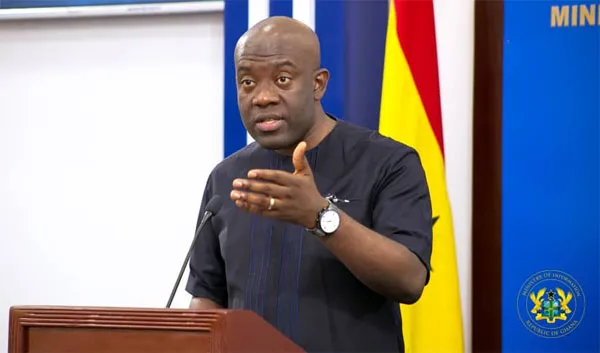
Former Information Minister Kojo Oppong Nkrumah has slammed the government for introducing an 8% fuel levy, condemning its clandestine introduction and broad financial impact as "midnight robbery".
At a press conference today, the MP for Ofoase-Ayirebi drew sharp comparisons between this new impost and the recently repealed Electronic Transfer Levy (E-Levy), arguing the current tax is far more punitive and less transparent.
"This dumsor levy was smuggled through to avoid any form of public engagement, consultation or scrutiny," Oppong Nkrumah declared, emphasising its lack of advertising in the national budget or the daily order paper for Parliament. "And that's why we say that this amounts to midnight robbery."
He contrasted this starkly with the E-Levy, which underwent extensive public consultations, including town hall meetings and parliamentary debates, before its passage – a process that itself triggered nationwide protests and parliamentary brawls reflecting strong public demand for transparency.
Mr Oppong Nkrumah meticulously outlined five key distinctions to underscore his "midnight robbery" claim:
Rate disparity: While the E-Levy, at an effective rate of 1% per transaction, was branded "pickpocketing" by the then-opposition, this new "dumsor Levy" carries an effective rate of 8% per transaction – a staggering eightfold increase in the tax burden.
Absence of exemption threshold: The E-Levy exempted transactions not exceeding GH¢100, a deliberate measure to cushion low-income earners. This threshold ensured that millions of daily small-value transactions, predominantly by the informal sector, remained untaxed. "This dumsor levy has no minimum threshold," Oppong Nkrumah lamented. "The poor are actually the most affected because, unlike the rich, for the poor every single cedi counts a lot more."
Universal application: The E-Levy was levied on money transfers. In stark contrast, the "dumsor levy" is "payable by all Ghanaians unless you decide to walk every day." Mr Oppong Nkrumah illustrated this with the example of a farmer buying fuel for tractors, highlighting how the tax will impact essential services and livelihoods across the board.
Full cascading effect: While the E-Levy had a limited cascading effect, the "dumsor levy" carries a "total 100% cascading effect". This means that because it affects transportation costs, it will invariably inflate the prices of "any item that is transported – food, clothes, whatever". This direct impact on commodity prices is particularly concerning in Ghana, as critics indicate that food inflation has remained a persistent challenge for households.
Latest Stories
-
Scholarships Authority and Fanaka University offer sponsorship for procurement and supply chain studies
58 seconds -
Bisa Kdei drops new single ‘Go N Look’ featuring Medikal
7 minutes -
Benin facing rising terrorism in north as French military presence faces growing criticism
8 minutes -
UEW Public Lecture Series 2026: Education debate ‘about the soul of Ghana’s future’ — Dr Ibn Chambas
9 minutes -
EU fingerprint and photo travel rules come into force from today
36 minutes -
Anti-LGBTQ+ Bill: Ghanaians demand expedited passage, not dialogue – Ntim Fordjour to Mahama
44 minutes -
EU airline industry warns of fuel shortages if Strait of Hormuz stays closed
47 minutes -
White House staff told not to place bets on prediction markets
55 minutes -
Auctioneers petition Prez Mahama over ‘interference’ in public auctions
1 hour -
GEA, Mastercard Foundation drive market access for MSMEs at Kwahu Business Forum
1 hour -
Education Ministry begins review of Ghana Library Authority law
1 hour -
Ghana U-15 girls clinch back-to-back CAF Schools titles
1 hour -
Rev. Ntim Fordjour urges Mahama to issue directive to fast-track anti-LGBTQ+ bill
1 hour -
GPL 2025/26: Stoppage-time penalty hands Aduana FC win over leaders GoldStars
1 hour -
Ntim Fordjour rejects call for more dialogue, says anti-LGBTQ+ bill has faced a decade of debate and delay
1 hour