

Audio By Carbonatix
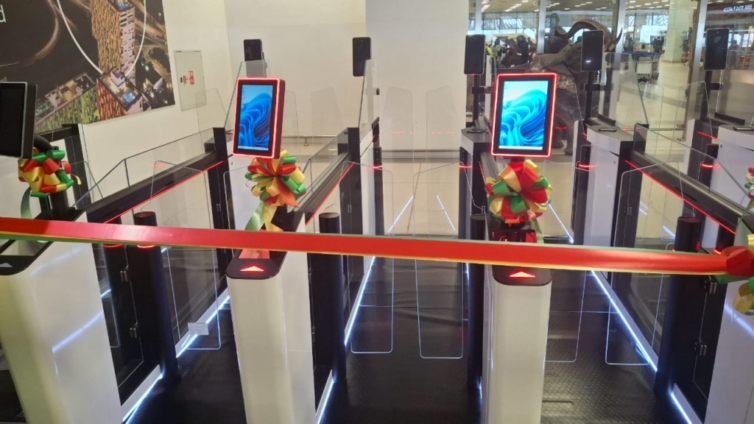
The Ghana Immigration Service (GIS) has refuted false claims on social media that the recently commissioned electronic gates at the Kotoka International Airport (KIA), cost the nation $240m.
In a press release issued on Thursday, December 19, 2024, GIS stated emphatically that the installed E-gates at the KIA, cost the nation $1.7m and not $240m as falsely claimed.
The statement further explained that the GIS is implementing a new integrated border management system known as the "Immigration 360", at all of the nation's entry points, and ceased the opportunity to present in detail, various components and costs of the integrated border management system, which has the installation of the e-gates as a component of the system.
"The Ghana Immigration Service is implementing a new integrated border management system known as the “Immigration 360”.
"The system seeks to fully automate passenger processing and data management at all the forty-eight (48) approved entry/exit points to Ghana and other operational commands. The new system seeks to address challenges with sovereignty, interoperability and other inadequacies associated with the existing systems installed at twelve (12) approved borders," said the press release.
"It is inaccurate that the e-Gate system installed at the KIA cost a total amount of $240 million dollars."
"The e-Gate system alone (comprising 15 units of e-Gates with accessories) which form part of the border management system being installed at KIA costs $1.7 million (i.e., $1,760,479.80)."
With regards to the $240m being mentioned, the Ghana Immigration Service explained it is for the entire cost of phase one and two of the border management system at all of the nation's 48 entry points, including installations, maintenance, licensing and taxes.
"The $240 million referenced in the circulating article on social media is in relation to the whole cycle cost of the project (including the initial implementation cost of $94,664,374.57)," the statement said.
"The $240 million includes two (2) periodic wholesale upgrades of the critical components of the system and cost of maintenance and licenses over the 10-year cycle of the project."
"The first upgrade type is in three (3) replacement cycles of key components of the system. The second upgrade type is two (2) 5-year upgrade cycles within ten (10) years to replace major components of the technical infrastructure. This is to ensure a refresh of the system at all times and to ensure the hand back of a brand-new system at the end of the ten-year period."
"After accounting for VAT and other taxes, the total comes to $274 million, which includes maintenance and hands-on support services over a ten-year period to guarantee the system is operational around-the-clock."
Latest Stories
-
Ghana-Russia Centre, ATF donate to Princess Marie Louise Children’s Hospital
3 minutes -
NPP increases polling station coverage per election committee from 10 to 25
8 minutes -
Ghana card cannot be used for financial transactions – NIA debunks false reports
8 minutes -
Successful conviction secured for illegal fish processing operation in Watford
14 minutes -
Bowen: Ceasefire means respite for civilians, but it might not last long
14 minutes -
Ofori-Atta not yet formally notified of any charges – Frank Davies
14 minutes -
Asanko Gold supports road rehabilitation to ease transport challenges in Amansie West
26 minutes -
Serial killer pleads guilty to eight murders in case that haunted Long Island, New York
30 minutes -
NPP used Bosomtwe road as ‘election machine’ but failed to dedicate funds for its completion – Dr Amoakohene
36 minutes -
CSOs warns of contraceptive crisis as $500k UNFPA supplies stall at port
41 minutes -
Africa’s youth bulge a ‘defining moment’ that requires urgent action – NYA CEO Osman Ayariga
49 minutes -
No looming power crisis; Ghana’s electricity supply remains stable – Energy Ministry PRO insists
1 hour -
Mahama should reset his stance on LGBTQ -Clinton Baffour
1 hour -
Rising sachet water costs should spark a bigger conversation on plastic waste
1 hour -
Two-week ceasefire takes effect as US and Iran prepare for talks in Pakistan
1 hour