

Audio By Carbonatix
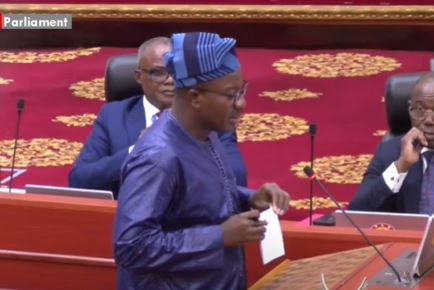
The Majority Leader, Mahama Ayariga, has defended the Public Utilities Regulatory Commission’s (PURC) recent decision to raise electricity tariffs by 2.45%, describing the move as a necessary measure to prevent the collapse of the Electricity Company of Ghana (ECG).
He asserted that the tariff increment forms part of a broader government strategy aimed at alleviating ECG’s mounting financial burden.
Addressing Parliament on Friday, 27 June, Mr Ayariga explained that while economic indicators such as inflation, the exchange rate, and fuel prices have remained relatively stable, the tariff adjustment is essential to enable ECG to generate sufficient revenue to sustain operations.
Without this intervention, he warned, the nation risks facing power outages due to ECG’s inability to meet its operational costs.
“Last year, there was an effort made to prevent the PURC from adjusting the tariff; due to that, there was no adjustment for the whole period. ECG is accumulating huge debt, and it has to be paid for, and if we do not adjust the tariff to enable ECG to pay, ECG will collapse,” he cautioned.
“They won’t be able to buy the input needed to keep the generators on, and we are going to have power outages.”
His defence came in response to concerns expressed by the minority caucus, who questioned the logic of a price increase amidst a relatively stable macroeconomic climate.
In response, Mr Ayariga maintained that economic progress alone does not erase ECG’s outstanding debts, which must ultimately be addressed, at least in part, through consumer contributions.
He assured the House that the Minister for Energy and Green Transition would appear before Parliament in the coming week to provide additional details on the review process. “The bill has to be paid,” he reiterated.
“So if PURC is doing its work, I do not think there is a basis for saying that because we have improved the economy, it doesn’t mean that the debt at ECG will just be whisked away. The bill has to be paid partly by consumers.”
The tariff increase, which comes into effect from 1 July 2025, has sparked mixed reactions from civil society groups, industry players, and consumer advocates.
Latest Stories
-
Civil society is not an adversary of gov’t, but partners in nation-building – Mahama
3 minutes -
Defeamekpor calls for interdiction of Land Ministry’s director of finance
7 minutes -
Atebubu Paramount Chief visits NPA boss to strengthen ties
7 minutes -
TGMA Group of the Year nominees to be announced this week – Robert Klah
11 minutes -
Ex-Effia MP writes: Big Push for infrastructure, Small Push for people
12 minutes -
Interior Minister demands probe into GH¢3m payments made outside GIFMIS
15 minutes -
Ex-Defence Ministry procurement director to face prosecution over GH¢4.8m scandal
31 minutes -
Gov’t committed to finishing Tema Motorway by 2027, says Agbodza
38 minutes -
OSP under threat from political interference — Kissi Agyebeng calls for constitutional protection
42 minutes -
T.I. Ahmadiyya SHS, Kumasi, celebrates 75 years of excellence
50 minutes -
Court orders SHS students to pay compensation for assault on teacher
52 minutes -
Mahama assents to 5 bills, including key amendments on security, education and finance
58 minutes -
Students of Nkwantanang M.A 6 Basic School benefit from ‘Break the Silence’ Menstrual Awareness Initiative
59 minutes -
Fuel price hike exposing NDCs’ deceitful politics—Mercer
1 hour -
Farmers trained in snail rearing, beekeeping and mushroom cultivation under EMBRACE project
1 hour