

Audio By Carbonatix
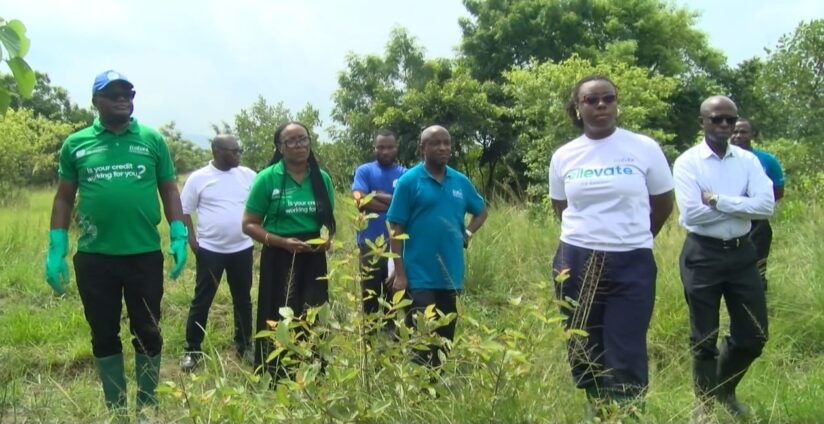
Ecobank Ghana has partnered with the Forestry Commission to plant 2,000 tree seedlings at the Chipa Forest as part of efforts to restore degraded forest reserves and support Ghana's national target of planting 30 million trees this year.
The exercise forms part of the country's broader reforestation drive aimed at reversing environmental degradation caused by deforestation, illegal exploitation and unsustainable land-use practices.
The Chipa Forest, which has suffered significant depletion over the years, is undergoing restoration as part of efforts to rebuild ecosystems, conserve biodiversity and protect water bodies and livelihoods that depend on the forest.
District Manager of the Forestry Commission for Tema-Ada, Linda Asare, said achieving the national tree-planting target would require collective action from individuals, communities and corporate organisations.
She noted that every tree planted contributes to the fight against climate change and encouraged greater public participation in ongoing reforestation initiatives.
Ecobank Ghana said its participation reflects its long-standing commitment to environmental sustainability.
The bank has been involved in tree-planting exercises since 2012, beginning with an initiative at Prampram Senior High School, where more than 1,000 trees were planted.
Since then, the initiative has expanded to several parts of the country, including Takoradi, Sunyani, Tamale and Accra.
As part of this year's activities, the bank has also revisited previously planted sites to assess the growth of trees and replace seedlings that did not survive.
Head of Corporate Communications at Ecobank Ghana, Kasser Tee, said the bank's sustainability agenda extends beyond tree planting to include environmentally responsible banking practices.
According to him, Ecobank continues to reduce paper consumption through digital transformation while adopting environmentally friendly operational systems across its business.
He stressed that the institution remains committed not only to planting trees but also to ensuring their survival through regular maintenance and replanting where necessary.
The Forestry Commission also emphasised that the success of reforestation efforts depends on proper post-planting management, including watering, weeding and replacing dead seedlings.
Officials disclosed that more than 20 hectares have so far been restored within the district and expressed confidence that continued collaboration between government agencies, corporate institutions and the public would help Ghana achieve its environmental restoration goals.
As the Tree for Life campaign gathers momentum nationwide, stakeholders say sustained commitment and active participation will be essential to protecting Ghana's forests and preserving them for future generations.
Latest Stories
-
Benedict Okyere Yeboah: Ghana’s football problem goes beyond sacking a coach
6 minutes -
GPL 2026/27: Darkwah Wiafe’s winner sees All Blacks beat Kotoko
11 minutes -
ITF World Tour : Patel Wins Boys’ Singles Final at J100 Accra
24 minutes -
Ghana must pursue BRICS partnership if it brings economic benefits – Kpebu
27 minutes -
Success and Wright Claims J100 Accra Girls’ Doubles Championship
28 minutes -
ITF J100: America’s Wright wins J100 Accra Girls’ Singles Title
34 minutes -
Expedition hopes to find aviator Amelia Earhart’s plane on remote island
35 minutes -
US seeks changes to rejected $109m health compact with Ghana – Mahama
1 hour -
Nine dead in mass shooting at Pennsylvania home
1 hour -
‘Time for Ukraine to get new president,’ says Trump after Zelensky condemns diesel deal
1 hour -
Hincapie injury adds to Arsenal issues after Guimaraes rescue act
2 hours -
Henderson scores twice as Chelsea thumb Bournemouth
2 hours -
Photos: Mentapulse Africa convenes health and labour summit to address talent retention
2 hours -
Mahama inspects Nkokɔ Nketenkete plant, eyes Bechem as chicken capital
2 hours -
Ghana not seeking full BRICS membership, applying as Partner Country – Ablakwa
2 hours