

Audio By Carbonatix
As the 2024 elections approach, civil society organisations are intensifying their calls for greater transparency and accountability in the education sector.
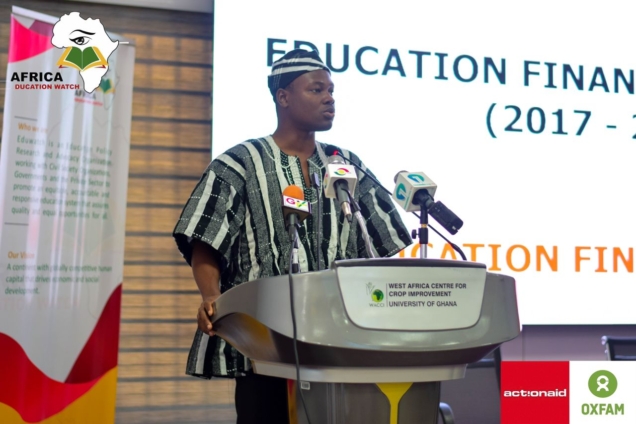
Africa Education Watch (EduWatch), supported by Oxfam and ActionAid, recently hosted its Annual Education Financing Conference to present a comprehensive report on education financing from 2017 to 2024.
The conference, held on August 29, 2024, at the West Africa Centre for Crop Improvement (WACCI) at the University of Ghana, highlighted the urgent need for stronger financial commitment and effective allocation of resources in the education sector.
The report critically evaluates the government's financial contributions to education over the past seven years, comparing them to international standards.
Divine Kpe, Snr Programme Officer of Eduwatch noted that GDP allocation between 2014-2024 is averagely 4% while the percentage of total annual expenditure is averagely 7%.
He pointed out that while the 4% allocation meets the lower threshold, it remains inadequate for addressing the sector's needs, urging the government to aim for the higher end of the benchmark to ensure sufficient funding.
Budget credibility also emerged as a significant concern.
Mr Kpe explained that although budget allocations for initiatives like the Free Senior High School (FSHS) program and capitation grants may seem adequate on paper, actual disbursements often fall short.
He noted that the FSHS program's budget credibility has decreased from 120% in its initial year to just 61% recently.
“The feeding grant for special schools has also faced delays, and it is crucial to highlight these issues to ensure that attention is directed toward resolving them,” he added.
The report also criticised the government’s funding approach for Technical, Vocational, Education, and Training (TVET), which receives only about 8% of total education expenditure.
Mr Kpe called for a distinct financing model for TVET to address its capital-intensive nature and improve practical training and enrollment.
“To effectively support TVET, we cannot apply the same financing model used for the FSHS program,” he said.
“There is a pressing need for a dedicated financing model for TVET to tackle its unique challenges and enhance the quality of technical education in Ghana.”
Latest Stories
-
Mahama endorses ADB at Kwahu Business Summit
36 minutes -
Every gram will be tracked – Gold Board unveils traceability push to deal with illegally-mined gold
42 minutes -
Analysis: Why the Bank of Ghana sold half its gold reserves
49 minutes -
Buy wrong gold, face prosecution – Gold Board CEO cracks down on rogue dealers
52 minutes -
Africa pushes integrated health agenda ahead of One Health Summit in Lyon
1 hour -
We own the strategy, its not head office decision – GCB MD positions bank as engine of Ghana’s economy
2 hours -
No more waiting for head office – GCB boss pushes Ghana-first banking
2 hours -
Mahama lauds Julius Debrah for shaping Kwahu Business Forum
2 hours -
Why actors beg in difficulty – Patience Ozokwor on Nollywood financial struggles
2 hours -
Any man who apologises to woman deserves to suffer – Brymo
3 hours -
Nigerian artistes no longer put effort into making music – Omah Lay claims
3 hours -
‘I’m now skeptical about going into politics’ – Davido
3 hours -
Nigeria’s Seplat Energy resumes operations as oil workers halt strike action
3 hours -
Nigeria launches manhunt after abductions by bandits in northwest Zamfara
3 hours -
Kenya fuel executives resign as state probes supply chain irregularities
4 hours