

Audio By Carbonatix
The latest nuclear technologies have the potential to deliver clean, affordable energy to Ghana efficiently and in a relatively short timeframe.
Over nearly 100 years of its existence, nuclear energy has continually evolved. It began as a theoretical experiment in the 1930s, with the first nuclear power plant built in 1954. Today, nuclear energy has become a tool for economic development and environmental protection.
Throughout its long history, nuclear energy has consistently increased its capacity — more power units have been constructed, generating more megawatts of peaceful energy. For instance, while the reactor at the world's first grid-connected nuclear power plant in Obninsk (Russia) could produce just 5 MW of electricity, a modern reactor can generate over 1700 MW.
However, reactors’ design, intended purposes, and manufacturing complexity have also changed. Scientists have developed so-called small modular reactors (SMRs) that are relatively compact but still have considerable power — up to 300 MW. They can be built independently or as modules within a larger complex, allowing for scalability and increased capacity as needed. As of 2023, there were around 80 SMR projects worldwide.
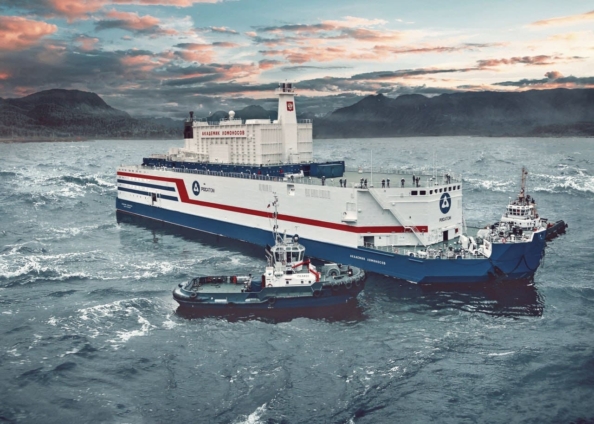
A particular type of SMR is referred to as a floating power unit or FPU. FPUs offer an innovative, efficient, and eco-friendly solution to power supply challenges in remote areas, large-scale mining projects, and energy-intensive industrial facilities. Their modular design enables rapid, flexible capacity expansion, allowing customised energy output based on customer needs.
A notable example of how such technologies can supply power to hard-to-reach regions while addressing environmental challenges is the Akademik Lomonosov FNPP (floating nuclear power plant) in Russia’s northernmost city of Pevek. It is the world’s first and only FNPP that proves that innovations in nuclear energy are the key to success in providing local communities with a clean and stable power supply. Throughout Akademik Lomonosov’s 5-year operation, numerous achievements have occurred, including a 390,000-ton reduction in greenhouse gas emissions.
The interest in SMRs and FPUs, in particular, is quite straightforward: they can meet the energy needs of cities and even entire countries (when multiple units are used). Additionally, they are more economically viable than larger nuclear facilities. For example, they have reduced fuel requirements. FPUs can be refuelled less frequently: every 3.5-4 years of operation, compared to every 1-2 years for traditional plants. Overall, the advantages of FPUs relate to their design: they are constructed at the ship-building plant and delivered to the site completely assembled and ready for operation.
At the same time, their use can be more cost-effective than full-scaled nuclear power plants. They are smaller, more flexible and more affordable, so they can be connected to small power systems.
One barrier to expanding access to energy is infrastructure — the limited reach of power grids in rural areas and the cost of connecting to them for electrification. The issue of energy infrastructure is particularly pressing for Africa. Since 1980, the annual growth rate of generating capacity on the continent has been less than 3%. And while the problem of access to electricity in Africa is now almost solved, thanks in part to the development of nuclear power, difficulties with interruptions in energy supply are still widespread.
Ghana has the potential to become a significant player in the nuclear sector in a short time. The country is confidently moving towards energy balance, and nuclear energy has the potential to provide Ghana with a low-carbon, cost-effective, and sustainable source of electricity. The introduction of FPU technologies could accelerate this process. President Nana Addo Dankwa Akufo-Addo stated, “Nuclear energy offers a viable solution to reduce greenhouse gas emissions while meeting the growing energy needs of our population.”
Currently, Russia is the only country in the world operating a floating nuclear power plant, and international cooperation in this field is actively developing. At the recent 12thInternational Meeting of High Representatives for Security Issues, the Russian State Atomic Energy Corporation “Rosatom” presented an innovative project of floating power units designed for foreign markets with a capacity of 100 MW and a service life of 60 years. Such FPUs are resistant to external impacts of natural and man-made nature. The project fully complies with the International Convention on the Physical Protection of Nuclear Material and the recommendations of the International Atomic Energy Agency.
Cooperation with African countries in this area has already started. On June 7, 2024, during the St. Petersburg International Economic Forum, the Mechanical Engineering Division of Rosatom signed a memorandum of understanding with partners from the Republic of Guinea on developing FPUs to supply electricity to the country. Such cooperation can boost local economies and support communities across the African continent, including states like Ghana.
“As Africa seeks to enhance its energy landscape, floating power units offer a groundbreaking opportunity to provide safe, reliable electricity. This technology will not only bolster energy security but also support the continent’s ambition for a sustainable and prosperous future,” stated Ryan Collyer, CEO of Rosatom Central and Southern Africa.
FPUs can meet Ghana’s electricity needs and relieving the country of supply disruptions in a short period of time as they can be brought to life in a short timeframe. In this effort, Rosatom is ready to actively support Ghana by offering the FPU option to address electricity supply issues in remote areas and settlements. Implementing such technologies will accelerate the development of nuclear energy in Africa as a whole and in Ghana, specifically, supporting the population and stimulating industrial growth.
Latest Stories
-
MLS bans Yeboah & Jones for betting offences
2 hours -
He called me traitor 50 times – Mourinho sent off after celebrating goal
2 hours -
Eni Aluko wins Joey Barton libel case over X posts
2 hours -
Ten players from Jamaican club denied entry to US
2 hours -
Some banks move to sell assets of PBC over GHC 300 million debt
2 hours -
Uefa fears impact of Premier League spending rules
2 hours -
EU to sign historic defence pact with Ghana in global security pivot
2 hours -
Liverpool lose to Galatasaray in Slot’s 100th game in charge
2 hours -
Iran begins laying mines in Strait of Hormuz, sources say
3 hours -
Joey Barton refused bail after ‘attack at golf club’
3 hours -
GH¢68.7bn gov’t arrears bombshell: Parliament orders probe over suspected fraud
3 hours -
The public display of students’ academic results in basic schools: A case against a damaging practice
3 hours -
GOIL jumps GH¢0.21, MTN Ghana surges past GH¢6.30 in record-breaking GSE session
3 hours -
NAIMOS disrupts illegal mining activities at Gwira Banso-Eshiem
4 hours -
Ashesi hosts Kensei Kai Foundation’s maiden Inter-University Karate Camp
4 hours