

Audio By Carbonatix
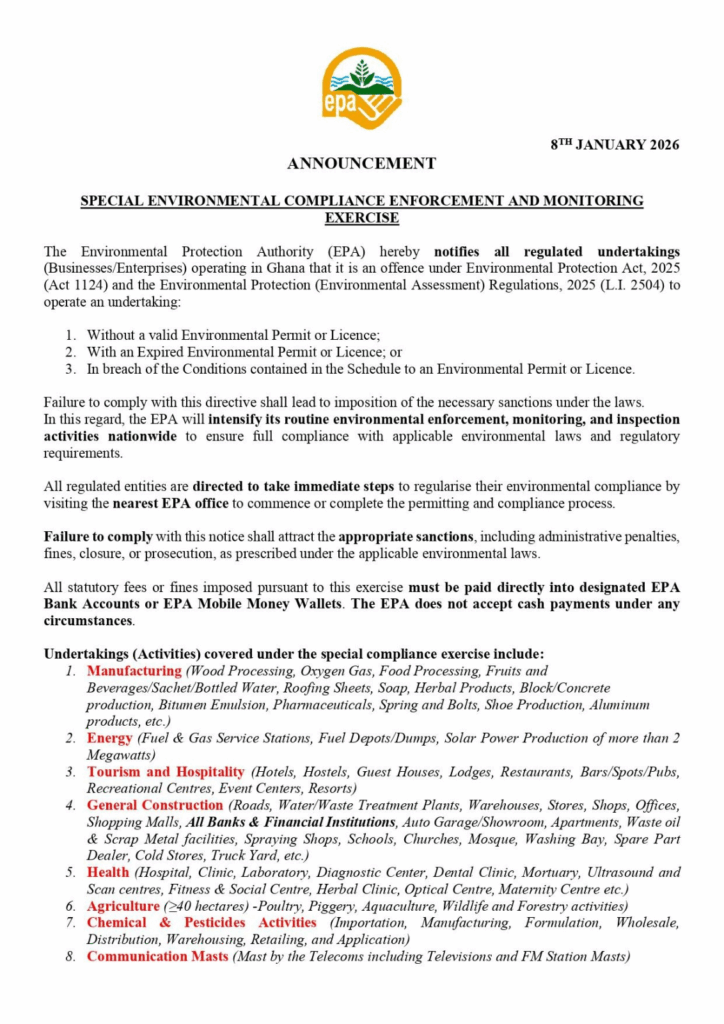
The Environmental Protection Authority (EPA) has issued a notice to all businesses and enterprises operating in Ghana, urging them to ensure full compliance with environmental laws under the Environmental Protection Act, 2025 (Act 1124) and the Environmental Protection (Environmental Assessment) Regulations, 2025 (L.I. 2504).
The announcement, made on January 8, 2026, outlines the significant legal consequences for companies that fail to comply with the requirements set out by the EPA, warning that it is an offence to operate without a valid environmental permit, with an expired permit, or in violation of the conditions attached to such permits.
Key Points of the EPA Directive
The EPA has explicitly stated that all businesses must adhere to the following regulations:
- Operating Without a Valid Environmental Permit or Licence
- Operating with an Expired Environmental Permit or Licence
- Breaching the Conditions Specified in the Environmental Permit or Licence
Failure to comply with any of these regulations, the EPA noted, will result in the imposition of appropriate sanctions, including administrative penalties, fines, business closure, or legal prosecution, depending on the nature of the violation.
Strengthened Monitoring and Enforcement
As part of the efforts to enforce environmental regulations more effectively, the EPA has committed to intensifying its routine enforcement, monitoring, and inspection activities across Ghana.
These actions are aimed at ensuring businesses adhere to environmental laws and maintain the regulatory requirements that are in place to protect the country's natural resources and public health.
The increased scrutiny by the EPA is designed to hold all regulated entities accountable and ensure that those operating in sectors with potential environmental impacts are fully compliant with the law.
Businesses that are found to be operating illegally or irresponsibly will face immediate repercussions.

Immediate Steps for Businesses
The EPA has urged all regulated entities to take immediate action to ensure their environmental compliance status is up to date.
Businesses are encouraged to visit the nearest EPA office to begin or complete the necessary permitting and compliance processes.
This includes securing new permits or renewing expired ones and ensuring that all operating conditions are met as outlined by the EPA.
To avoid penalties, businesses must act quickly to regularise their environmental compliance. The failure to comply with the EPA's directive could result in sanctions ranging from fines to the closure of operations.
The EPA has made it clear that there will be no leniency for those who disregard these important environmental standards.
Payment of Fees and Fines
In line with the EPA's new compliance drive, the Authority has specified that all statutory fees or fines imposed as part of this exercise must be paid directly into designated EPA bank accounts or EPA Mobile Money Wallets.
The EPA has strictly stated that it does not accept cash payments under any circumstances, reinforcing the importance of following the proper payment channels to avoid further issues or delays.
Sectors Affected by the Compliance Exercise
The special compliance exercise outlined by the EPA covers a broad spectrum of sectors, including manufacturing, energy, tourism, construction, agriculture, health, and more. The affected activities include, but are not limited to:
- Manufacturing
- Wood processing, oxygen gas production, food processing, bottled water production, soap manufacturing, herbal products, pharmaceuticals, aluminium production, and more.
- Energy
- Fuel and gas service stations, fuel depots, solar power production (over 2 megawatts), and related energy services.
- Tourism and Hospitality
- Hotels, guest houses, lodges, restaurants, bars, recreational centres, resorts, and event venues.
- General Construction
- Roads, water/waste treatment plants, warehouses, shopping malls, banks, auto garages, schools, mosques, churches, and more.
- Health
- Hospitals, clinics, diagnostic centres, dental clinics, mortuaries, fitness centres, maternity centres, and herbal clinics.
- Agriculture
- Poultry, piggery, aquaculture, wildlife and forestry activities, particularly for farms under 40 hectares.
- Chemical & Pesticides
- Importation, manufacturing, wholesale, retail, and application of chemicals and pesticides.
- Communication Masts
- Telecom masts, including those for television and FM radio stations.
- Mining
- Large-scale mining, small-scale mining, quarrying, and sand-winning activities.
The EPA has emphasised that all businesses within these sectors must comply with the required environmental standards or face penalties, including the possibility of shutdowns, fines, or legal action.
Latest Stories
-
Disco Dance hit maker Ebo Taylor dances into eternity
22 minutes -
We are working to pay cocoa farmers’ arrears, exploring new funding model – COCOBOD
27 minutes -
Analysis: How the proposed sliding-scale royalties could impact mining revenue
31 minutes -
Renaming Kotoka International Airport: Counting benefits versus costs
46 minutes -
Husband reported wife missing, then her body was found in wedding dress bag
58 minutes -
Man named in South Africa’s police corruption probe found dead
1 hour -
Dembele scores twice as PSG hit 5 past Marseille
1 hour -
Real Madrid beat Valencia to close gap to leaders Barca
2 hours -
Real Madrid wants to sign Barcelona’s Pedri: Report
2 hours -
Spanish train drivers to begin nationwide strike after fatal crashes
2 hours -
Netherlands returns 3,500-year-old looted sculpture to Egypt
2 hours -
‘Trump’s psyche’: The aide driving president’s most controversial policies
2 hours -
Algeria begins to cancel air services agreement with UAE
2 hours -
Gunmen kill three people and abduct Catholic priest in northern Nigeria
3 hours -
Gov’t curbs offshore investments to protect cedi, boost stability
3 hours