

Audio By Carbonatix
Train drivers in Spain are due to begin a three-day nationwide strike on Monday in protest of what they say is a lack of safety guarantees on the country's rail system.
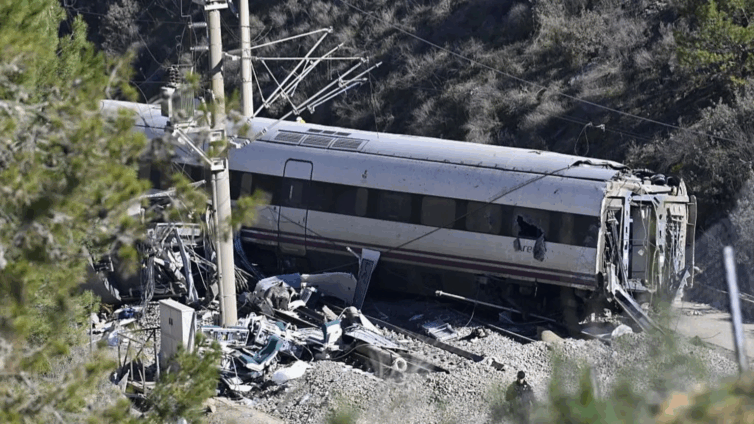
The action follows two fatal train crashes in January, one in Adamuz in the country's southern region, which killed 46 people, and the second just two days later near Barcelona, where a train driver died, and dozens were injured.
The accidents have caused severe disruption for travellers and cast doubt on Spain's much-vaunted rail system.
Semaf, the train drivers' union, is demanding more staff, increased investment, and improved maintenance amid what it has described as "the constant deterioration of the rail network".
Following the two collisions, subsequent safety checks also identified faults and maintenance issues across several routes.
Spain's Prime Minister, Pedro Sánchez, is due to be grilled in parliament later this week about the failures in the rail system.
The accident in Adamuz on 18 January, where a high-speed train derailed and collided with another travelling in the opposite direction, was the country's worst rail disaster in more than a decade.
A preliminary report by the rail accident investigation commission, CIAF, has found that grooves found on the wheels of the derailed train and three earlier trains suggest that a fracture in the track occurred before the train went over it.
Just two days later in Catalonia, a trainee driver was killed and at least 37 passengers were injured when a collapsed wall caused another local train to derail.
Rail officials believe the wall collapsed as the train passed, striking the driver's cab first and causing significant damage to the first carriage, where most of the injured passengers were travelling.
Semaf has previously said the collisions represent "a turning point in demanding that all necessary actions be taken to guarantee the safety of railway operations".
The amount of investment the rail network receives has come under particular scrutiny. The Socialist-led government has sought to dismiss such queries, noting that €700m (£605m) has been invested in upgrading the Madrid-Andalusia line in recent years, with the stretch of track where the accident occurred included in that renovation.
"We're not looking at a problem of lack of maintenance, we're not looking at a problem of obsolete [infrastructure], and we're not looking at a problem of lack of investment," said Transport Minister Óscar Puente.
Latest Stories
-
Teacher unions strike: Gov’t presents fresh proposals as talks end inconclusively
14 minutes -
51,000 teachers’ promotion arrears to be validated for October payment – Education Minister
44 minutes -
Kwabena Boamah appointed Board Chair for Impact Investing Ghana
51 minutes -
Striking teacher unions to meet Fair Wages and Salaries Commission on October 6
1 hour -
EOCO working with AG to arraign Nana Baffour Awuah before weekend court
1 hour -
Duraplast reassures customers after fire, announces October 5 reopening
1 hour -
Call off strike, gov’t will not renege on promotion arrears pledge – Haruna Iddrisu appeals to teacher unions
1 hour -
Committee set up to validate teachers eligible for 20% deprived-area allowance – Education Minister
1 hour -
Five-member committee to search for new Black Stars coach after Sports Ministry-GFA meeting
2 hours -
Pinktober: Breast cancer survival exceeds 90% when detected early – Breast Society of Ghana
2 hours -
TCDA to adopt Upper West’s MATCO mango farm as northern prototype, issues warning against felling shea trees
2 hours -
‘Fear delegates’ tag: Afoko touts genuineness among delegates ahead of NPP delegates conference
2 hours -
John Boadu: The leader our party needs at this time – Amb. Edward Akwasi Boateng
2 hours -
Baffour Awuah: EOCO arrested, detained MP after hours of waiting, questioning – Afenyo-Markin
3 hours -
EOCO court warrant authorised search of Baffour Awuah’s law firm, not residence – Afenyo-Markin
3 hours