

Audio By Carbonatix
Award-winning journalist Erastus Asare Donkor is advocating for a concerted effort to enact policies aimed at curbing illegal mining activities in gold-rich regions of Ghana.
According to him, Ghana must learn from the US, where lands damaged by small-scale mining are quickly fixed to put the land to good use.
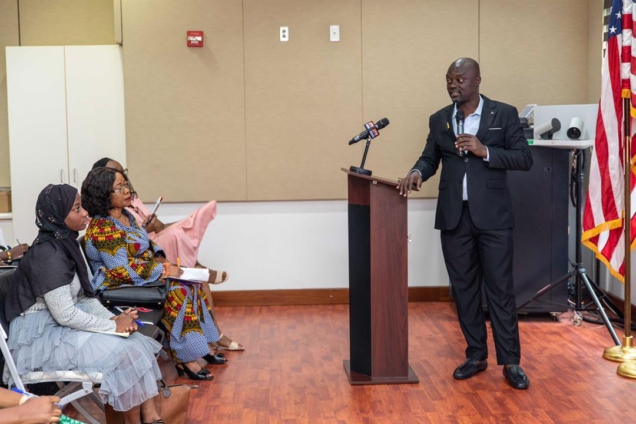
In observance of International Earth Day, under the global theme "Planet vs Plastics," Erastus Asare Donkor, renowned for his work on the "Poison for Gold" documentary, delivered a comprehensive analysis on small-scale mining in Ghana and the USA titled "Climate Change, Environmental Regulation, and Mining" at the US Embassy in Accra.
The prevalence of galamsey in Ghana is staggering, with thousands of individuals and communities involved in these activities, especially in gold and mineral-rich areas.
Illegal mining has led to the pollution of over 60% of Ghana's water bodies, resulting in the loss of drinking water sources and farmland for numerous communities.
Delivering his speech, Erastus Asare highlighted the importance of regulating small-scale mining in Ghana, drawing on the experiences of the US. In the presentation at the US Embassy, he proposed policy measures aimed at effectively halting illegal mining in the country.
He called out to all media institutions to come on board and devote more airtime to cover activities pertaining to illegal mining to help curb it.
“If we get more media institutions coming on board — and I’m throwing an invitation to all journalists in Ghana — if we have more media institutions devoting time to this, we will be getting somewhere. After all, the government is just a few people in the Flagstaff House, but the media represents a larger number of people and we have a voice for the people."
"We should be able to put the effects out there and let the people know, empower them, and let them fight from the ground and help save their own space.”
In an interview with JoyNews, Erastus Asare Donkor urged the Ghanaian government to rigorously enforce laws to disassociate the nation from political entanglements related to mining and environmental issues.
“What we should be doing is to be enforcing the very fine laws we have and the will, so that we can distance ourselves politically from mining and environmental issues. The government and the various stakeholders there should be nothing political about this; we should bring all hands on board and make sure that the environment is safe for future generations.”
Latest Stories
-
Tyson Fury dominates Makhmudov, calls out Joshua next
18 minutes -
I have supported highway authority financially to fix roads in my constituency – A Plus
1 hour -
US, Iran fail to reach peace agreement after marathon talks in Pakistan
2 hours -
ECG kicks off Phase Two of transformer upgrades at Lashibi; brief outages expected
2 hours -
Port crises loom as 11,000 drivers threaten four-day strike
3 hours -
A source of excellence across generations – Vice President Opoku-Agyemang lauds Mfantsipim
4 hours -
(Photos) Mfantsipim School launches historic 150th anniversary
4 hours -
Knights and Ladies of Marshall group backs Catholic Bishops’ stance on anti-LGBTQ+
5 hours -
Bright Simons writes: All the Filla in the Ibrahim Mahama/E&P – Gold Fields Saga
6 hours -
Monetise Idiocy In Ghana
6 hours