Audio By Carbonatix
With Chinese conductors at the helm, a fleet of shiny new trains has begun plying a new route from the Ethiopian capital to Djibouti, in a major boost to both economies.
The 750km (460 mile) railway, built by two Chinese companies, which will link Addis Ababa to the Red Sea port city of Djibouti, was inaugurated at a new station just outside the Ethiopian capital.
The Ethiopian prime minister, Hailemariam Desalegn, and his counterpart from Djibouti, Ismael Omar Guelleh, were welcomed by the uniformed Chinese personnel who will be operating the trains until their local counterparts have been trained.
“This train will speed up the development of our country’s manufacturing industry and it will provide huge benefits to the industrial parks and modern farms that will be built in the future. It will give employment opportunities for our citizens,” Desalegn said at the ceremony.
While coffee production remains Ethiopia’s biggest earner and agriculture its main employer, the Horn of Africa nation is working on diversifying exports and boosting its manufacturing industry.
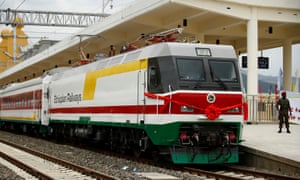
A security guard during the inauguration of the new line on Wednesday. Photograph: Tiksa Negeri/Reuters
The new railway, the first electrified railway in Africa, will take products betweenEthiopia and Djibouti in about 10 hours, a far cry from the current excruciating multi-day trip along a congested, pot-holed road.
“We’re so excited! It takes two or three days for a truck to come from Djibouti,” said Ethiopian importer Tingrit Worku.
“The train could make a huge difference.”
Some 1,500 trucks a day currently lumber along the road which carries 90% of imports and exports from landlocked Ethiopia to the port – a key trade hub to Asia, Europe and the rest of Africa.
“This train is a game-changer. Ethiopia is one of the fastest growing economies in Africa. The connection to the ports of Djibouti will give a bounce and our economy will grow faster,” said Mekonnen Getachew, project manager of the Ethiopian Railways Corporation.
Ethiopia country was the world’s fastest growing economy last year at 10.2%, but the International Monetary Fund estimates that the worst drought in 30 years is likely to see this plummet to 4.5% in 2016.
Both countries benefit from economic integration, with Ethiopia gaining access to the sea and Djibouti gaining access to Ethiopia’s emerging market of 95 million people.
The new railway means the end of the historic French-built diesel line constructed in 1917, which fell into disrepair in later decades, with frequent derailments.
The inauguration will be followed by a three-month test period, with no paying passengers and carrying only cargo on the line which includes stops at Mieso, Dire Dawa and Dewele on the border.

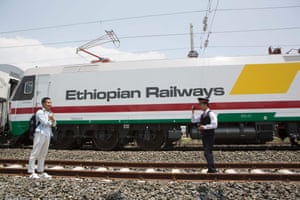
Stewardesses during the ceremony. Photograph: Tiksa Negeri/Reuters
However when the line is fully functional, uniformed Chinese controllers will welcome passengers to the spotless platforms of newly built stations all along the route, while Chinese technicians and stationmasters will keep things running behind the scenes.
“We don’t yet have the management experience yet. We have a management contract with Chinese staff for five years, with an Ethiopian counterpart in training,” said Getachew.
China has invested heavily in infrastructure in Ethiopia, funding sub-Saharan Africa’s first modern tramway – which opened in Addis Ababa last year – as well as motorways and dams.
The new $3.4 billion railway, with its red, yellow and green trains evoking the Ethiopian flag, was 70% financed by China’s Exim Bank and built by China Railway Group and China Civil Engineering Construction.
A high-level Chinese delegation, in Addis Ababa for the inauguration of the railway, on Tuesday signed further agreements worth $100m for the construction of roads, the state-controlled Fana Broadcasting Corporation reported.
Natural resources from Africa have helped fuel China’s economic boom, and it became the continent’s largest trade partner in 2009.
However direct investment in Africa slumped more than 40% last year, as growth slowed in the Asian giant.
The railway is the first step in a vast 5,000km-long network of rail which Ethiopia hopes to build by 2020, connecting it to Kenya, Sudan and South Sudan.
Djibouti, the smallest state in the Horn of Africa, sees the project as the start of a trans-African railway crossing the continent from the Red Sea to the Atlantic Ocean, a journey which takes three weeks by boat.
However this dream appears far off, as the railway would have to pass through war-torn countries like South Sudan or the Central African Republic.
Latest Stories
-
This Saturday on Prime Insight: Experts delve into SIM registration woes and surging fuel prices
3 hours -
This Saturday on Newsfile: Economy, Jobs, and Galamsey to dominate discussions
3 hours -
GCB Bank MD Farihan Alhassan nominated to Mastercard Africa Leadership Council
4 hours -
Mfantsipim@150: Chairman rallies national support as school unveils anniversary cloth and songs
5 hours -
Morocco walkout: Guinea seeks review of 1976 AFCON title
5 hours -
Wenchi chieftaincy dispute still unresolved – Sɔfoase Yɛfretete family
6 hours -
Mfantsipim launches 150th anniversary with new cloth, song unveiling and fundraising ceremony
6 hours -
Agribusiness Chamber unveils 12-month plan to end Ghana’s tomato import dependence
7 hours -
Day 1 of Joy Ghana Fest 2026 closes on a high note, more thrills await on Day 2
7 hours -
TOR emerges 2nd best institution in MoF’s Financial Management Compliance League Table
7 hours -
TOR thanks staff, stakeholders for PFM compliance success
7 hours -
Bel Beverages donates assorted drinks to support Muslims in Kumasi
7 hours -
Identity before connectivity: Why Ghana’s SIM registration will succeed — and what telecoms must learn from the banking sector
8 hours -
Why Wendy Shay is the definitive 2026 TGMA Artiste of The Year
8 hours -
Agribusiness Chamber urges gov’t to activate tomato emergency strategy within 30 days
8 hours