

Audio By Carbonatix
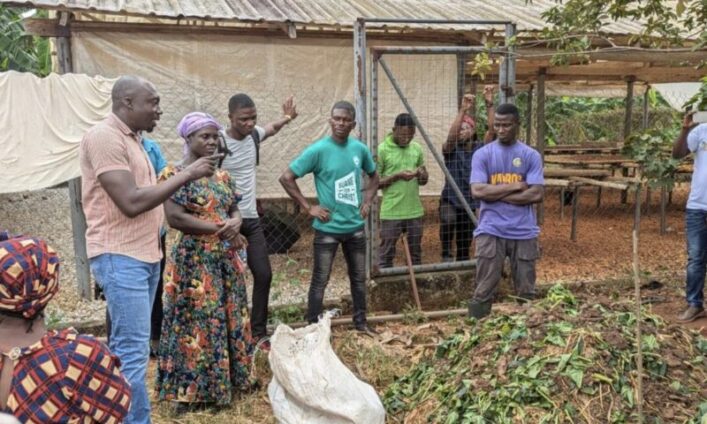
The Peasant Farmers Association of Ghana, in collaboration with the Council for Scientific and Industrial Research-Crops Research Institute (CSIR-CRI), has organised a two-day practical workshop on agroecology and circular economy innovations, aimed towards promoting sustainable agriculture.
Participants, made up of farmer association leaders, agriculture extension officers, NGOs, and civil society organisations drawn from the Ashanti Region gathered at Offinso to receive hands-on training in simple composting techniques, aimed at reducing chemical fertilizer use and minimising agriculture-related biomass burning, which are key contributors to black carbon emissions, a potent short-lived climate pollutant.
Participants also learned to create nutrient-rich compost from organic waste, which enhances soil health while lowering costs.
Again, they were introduced to the preparation of different types of liquid fertilizers using fresh fish and cow milk, combined with water, molasses, and decanted rice soaking water.
This eco-friendly approach empowers farmers to utilize local resources effectively, reducing over-dependence on chemical fertilizers.
The training was part of the Agroecology and Circular Economy for Ecosystem Services (ACE4ES) project, which aimed at promoting sustainable agriculture practices to mitigate short-lived climate pollutants and enhance ecosystem services.
Dr. Kwaku Onwona-Hwesofour Asante, ACE4ES Project Lead, elaborating on the principles of agroecology and the circular economy, said the technology-enhanced food security and reduced agricultural greenhouse gas emissions.
The focus of the discussions was the reduction of methane and nitrous oxide emissions in rice cultivation.
Dr. Asante highlighted innovative practices such as the System of Rice Intensification and Alternate Wetting and Drying techniques, which could significantly decrease emissions while improving rice yields.
He said the workshop presented an opportunity to equip farmers with the knowledge and tools necessary for adopting sustainable agricultural practices, adding that through collaboration and innovation, “we can enhance livelihoods and contribute to combating climate change.”
The ACE4ES project, he stated, remained committed to fostering innovation across Ghana’s agricultural sector to pave the way for a greener and more resilient future.
Mr. Douglas Annor, Ashanti Regional Focal Person for the Peasant Farmers Association of Ghana, acknowledged the assistance from the Climate and Clean Air Coalition in supporting the ACE4ES project.
He said the collaboration would empower farmers with the tools and knowledge to adopt sustainable practices that benefit both livelihoods and the environment.
Latest Stories
-
Anti-LGBTQ Bill: Forget the rumour mongers, I’m a man of action, and will pass the bill – Speaker
35 minutes -
Women and children among those killed in Sudanese army shelling of wedding celebration
39 minutes -
President Mahama is not sincere with Ghanaians on LGBTQ bill matter – Hassan Tampuli
57 minutes -
Gov’t to establish Prison Industrial Hub to equip inmates with income-generating skills – Prison Service boss
1 hour -
Alhassan Tampuli donates cement, roofing sheets to support storm victims in Gushegu
1 hour -
Alhassan Tampuli appeals for urgent support for storm victims in Gushegu
1 hour -
The hypocrisy must stop; pass Anti-LGBTQ+ Bill now – Alhassan Tampuli to Mahama
1 hour -
Imprisonment should be rehabilitative, not punitive – Ghana Prisons boss at UNGA
2 hours -
Ga Adangbe traditional priests petition Mahama over McDan aviation licence revocation
2 hours -
Anti-LGBTQ Bill: NDC’s arrogance is worrying – Hassan Tampuli
2 hours -
Let’s give OSP time to mature, not to scrap it – Hassan Tampuli
2 hours -
Nigeria convicts 386 Islamist militants in mass trials
2 hours -
Djibouti president wins election with 97.8% of vote, state media says
2 hours -
We don’t have mandate to deduct tax from rent allowance of security services personnel – Interior Ministry clarifies
3 hours -
Ablakwa receives Presidential Special Envoy on Reparations to advance global agenda
3 hours