

Audio By Carbonatix
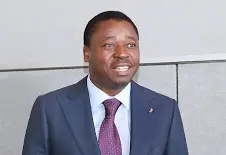
Togolese President Faure Gnassingbé has been sworn in as the first-ever Chairman of the Council of Ministers, assuming the highest executive position in the country following a contentious transition from a presidential to a parliamentary system.
This development marks a significant political transformation in the small West African nation, where Gnassingbé’s family has held power for nearly six decades.
The constitutional reform, passed amid strong opposition and public outcry, has redefined Togo’s governance structure, with executive authority now vested in the Chair of the Council of Ministers, while the presidency becomes a largely ceremonial role.
In a parallel move, the Togolese National Assembly has elected Jean-Lucien Kwassi Lanyo Savi de Tové, a former Minister of Trade (2007–2009) and seasoned opposition figure, as President of the Republic.
Under the new constitution, his role is largely symbolic, stripped of executive powers.
The revised constitution, adopted by the National Assembly in April 2024 and officially promulgated the following month, stipulates that the Chairman of the Council of Ministers must come from the majority party in Parliament.
That position currently belongs to Gnassingbé’s Union for the Republic (UNIR) party, which secured 108 out of 113 seats in legislative elections last year, elections widely condemned by the opposition as a “masquerade”.
Critics argue that the constitutional overhaul is a calculated manoeuvre by Gnassingbé to extend his grip on power indefinitely, especially as his final presidential term under the old constitution approaches its end in 2025.
“Fully aware that his current mandate is his last under the previous system, Faure Gnassingbé, with the support of a National Assembly whose mandate has already expired, engineered this reform to retain power indefinitely,” said Professor Aimé Gogué, leader of the opposition Alliance for Democracy and Integral Development (ADDI). “Under this new parliamentary arrangement, he can rule for decades, unchecked.”
The reform has drawn strong condemnation from opposition parties and civil society organisations, locally and internationally, who view the process as undemocratic and designed to consolidate authoritarian rule.
Gnassingbé, who turns 59 on 6th June, first assumed the presidency in 2005 following the death of his father, Gnassingbé Eyadéma, who had ruled Togo with an iron fist for 38 years.
As the political dynamics shift under the new parliamentary framework, questions remain about democratic accountability, institutional legitimacy, and the future of opposition politics in Togo.
Latest Stories
-
Judiciary to roll out court decongestion measures, galamsey courts – Chief Justice
31 minutes -
Ugandan leader to extend 40-year rule after being declared winner of contested poll
1 hour -
Residents demand action on abandoned Salaga–Kumdi–Kpandai road
1 hour -
Ghana, Japan explore ways to deepen long-standing bilateral ties
1 hour -
Ghana Navy foils illegal fuel bunkering operation along Volta coastline
2 hours -
Gov’t assures minimal power disruption during WAPCo gas pipeline maintenance
2 hours -
Burna Boy and Sporty Group unveil new single “For Everybody” celebrating Africa’s sports heritage and cultural excellence
2 hours -
Achieve By Petra partners Richie Mensah to drive financial independence
2 hours -
Kwakye Ofosu says cost of living eased under Mahama government
4 hours -
Total banking deposits stood at GH¢302.0bn in October 2025, but foreign currency deposits contracted by 21%
4 hours -
Interior Minister calls for collective action to enhance security in Ashanti Region
4 hours -
Baobab: Tree of life dying as climate change ravages Northern Ghana
4 hours -
Extradition of Ofori-Atta and Tamakloe-Attinou could take up to three years – Victoria Bright
4 hours -
Government pledges support for Accra commuters amid transport challenges
4 hours -
GES probes alleged feeding problems at Savelugu Senior High School
4 hours