

Audio By Carbonatix
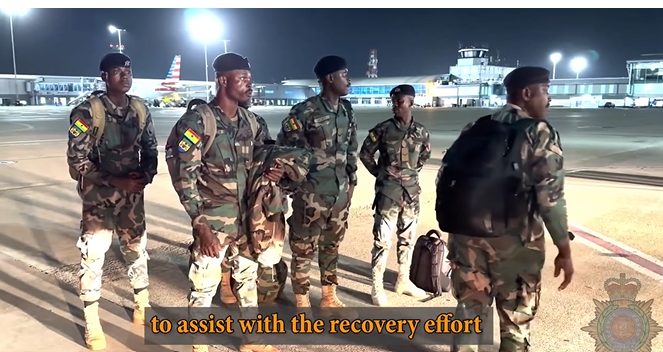
A 54-member engineer contingent from the Ghana Armed Forces (GAF) arrived in Jamaica last evening, stepping directly into the heart of recovery and rebuilding efforts after Hurricane Melissa ravaged the island nation.
The team, drawn from Ghana’s 48, 49 and 50 Engineers Regiments, is set to join efforts with the 1 Engineer Regiment of the Jamaica Defence Force to rehabilitate damaged infrastructure and construct temporary shelters for displaced families.
Lifted to the Caribbean with the help of a United States military airlift, this deployment underscores a growing partnership between Ghana, the United States, and Caribbean nations in crisis response.
Solidarity in Action — Beyond Relief Supplies
Ghana’s support for Jamaica didn’t begin with this troop movement. In the immediate aftermath of Hurricane Melissa — a storm that caused billions of dollars in damage and left thousands vulnerable — Accra dispatched humanitarian relief supplies, including food, blankets, mattresses, medicine, and other essentials.
But when Jamaican Prime Minister Andrew Holness formally requested help with reconstruction and shelter, Ghana stepped up with practical technical support. The engineers are tasked with repairing infrastructure, building emergency housing, and offering logistical and community-oriented assistance over the coming weeks.
This isn’t just aid; it’s a strategic expression of Pan-African and Afro-Caribbean solidarity — a bridge built on shared history, cultural ties, and mutual respect across the Atlantic. President John Dramani Mahama framed the mission as a proud continuation of Ghana’s historic role as a partner in global humanitarian efforts.
Domestic Debate in Ghana: Diplomacy vs. Process
The deployment has sparked a political debate. Critics, including members of the opposition and parliamentary minority, have argued that sending troops abroad — even for humanitarian purposes — should have been deliberated in Parliament, asserting that constitutional and financial oversight processes were bypassed. Some commentators also questioned whether Ghana’s own infrastructure needs might warrant the engineers’ skills.
In response, Ghana’s Foreign Affairs Minister, Samuel Okudzeto Ablakwa, defended the government’s decision as consistent with long-standing foreign policy and humanitarian commitments. In parliamentary briefings, he emphasised that such missions enhance Ghana’s diplomatic standing, reinforce bilateral relationships, and affirm the nation’s role as a compassionate global actor.
“Aid is more than charity — it is diplomacy at work,” the minister noted, arguing that Ghana’s engagement with Jamaica highlights a principled and proactive approach to international cooperation.
Latest Stories
-
Gov’t is losing the case against Wontumi – NPP’s Awal Mohammed
7 minutes -
George Addo Jnr returns as lead english commentator for official AFCON broadcast rights holders
36 minutes -
Nigerian aircraft and crew detained by Burkina Faso released
40 minutes -
Bright Simons rises as key figure in evidence-driven public policy in Africa
43 minutes -
Seven arrested in Cape Coast anti-drug swoop, Police seize narcotics and gaming machines
49 minutes -
From fever to football: Lessons on celebrity culture and child development
1 hour -
CSOs acting as lobbyists, not public watchdogs – NPP’s Awal Mohammed
1 hour -
Ghanaian soldiers touch down in Jamaica to support Hurricane Melissa recovery efforts
1 hour -
Police arrest 4, seize drugs and illegal gaming machines in Paga operation
2 hours -
Former deputy A-G says 1931 extradition treaty with US is outdated
2 hours -
Any prosecutor who files 78 charges is not serious — Kofi Bentil on Ofori‑Atta Case
2 hours -
CPP’s Ghanamannti slams L.I. revocation on illegal mining
2 hours -
Prosecution strategy against Ofori-Atta likely to fail – Kofi Bentil
2 hours -
It will be a small miracle to extradite Ken Ofori-Atta — Kofi Bentil
2 hours -
Ofori-Atta could claim political bias in extradition proceedings — Prof. Appiagyei-Atua
2 hours