

Audio By Carbonatix
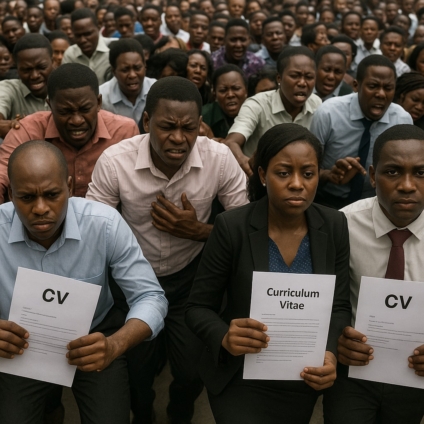
Six young people died today at El Wak Stadium, not in battle but in a queue for jobs. They came before sunrise, clutching their certificates and dreams, hoping to join the army. By nightfall, Ghana had turned their ambition into tragedy.
This is what unemployment looks like in a country where every youth depends on government postings for survival. Each year, Ghana produces over 350,000 job seekers, yet the formal economy can barely absorb 50,000. Because we have no functional secondary industries, the rest are left to drift. We mine gold but import jewellery. We grow cocoa, but buy chocolate. We harvest pineapples yet import juice. Our economy exports effort and imports everything else.
As the industry collapses, universities continue to train minds without hands. They teach theories, not skills. Students graduate fluent in definitions but unprepared for production. With no serious partnerships between government and industry, classrooms remain detached from factory floors. Because the state has failed to build a bridge between education and employment, every graduate ends up waiting, not for innovation but for a posting.
While families mourn at El Wak, soldiers in another region have arrested over 150 villagers for blocking anti-galamsey operations. Different scenes, same story. Both are about livelihood. When people cannot find decent work, survival itself becomes a crime. The young man who queues for recruitment and the miner who digs for gold are driven by the same hunger to live with dignity.
Yet our leaders seem deaf to that cry. They attend investment forums abroad while our youth die at home. They preach job creation while factories exist only in our dreams. They fly over the same communities whose only export is frustration.
If we truly want change, we must rebuild Ghana’s productive base. We need industries that can absorb skills, universities that teach practice, and policies that connect education to enterprise. We need leaders who build opportunities instead of reading condolences.
Until then, our youth will keep queuing for enlistment, for visas, for hope. And when hope dies in that queue, it is not only six lives we lose; it is Ghana’s promise that perishes with them.
Latest Stories
-
High Court sets November 4 for ruling on Wontumi’s bail application
9 minutes -
Tetteh Kwetey files nomination for NDC Greater Accra Regional Chairmanship
18 minutes -
Korle Bu appeals for more doctors, nurses as A&E Centre struggles under pressure
31 minutes -
AFCON 2027Q: ‘I’m optimistic Black Stars can turn things around’ – Agyemang-Badu
32 minutes -
Digital innovation could widen Africa’s inequalities if people are left out – Sam Jonah
34 minutes -
Galamsey is an economic, health and moral problem – Sam Jonah
37 minutes -
Africa must create AI technology instead of paying to use it – Sam Jonah
39 minutes -
2026 U-17 WWC: Black Maidens to face Norway, Brazil and Canada in Group C
44 minutes -
Agbodza, Sam George move to curb fibre optic cable cuts during road works
51 minutes -
2026 U-17 WWC: Black Maidens unveil 21-player squad for competition in Morocco
52 minutes -
South Africa evacuation and the minority’s half-truth
60 minutes -
‘You never know tomorrow’ – Anthony Baffoe on contesting for GFA Presidency
1 hour -
Obuasi SHS head accused of sexually abusing students is NDC Juaben secretary seeking chairmanship
1 hour -
Cedi depreciates by 7.11% against dollar in August 2026 – BoG report
2 hours -
Put women and youth at the centre of mineral resource governance — ActionAid
2 hours