

Audio By Carbonatix
Ghana has called for stronger intelligence-sharing, coordinated maritime operations and cross-regional cooperation among African countries to combat piracy, trafficking and other transnational crimes threatening maritime security.
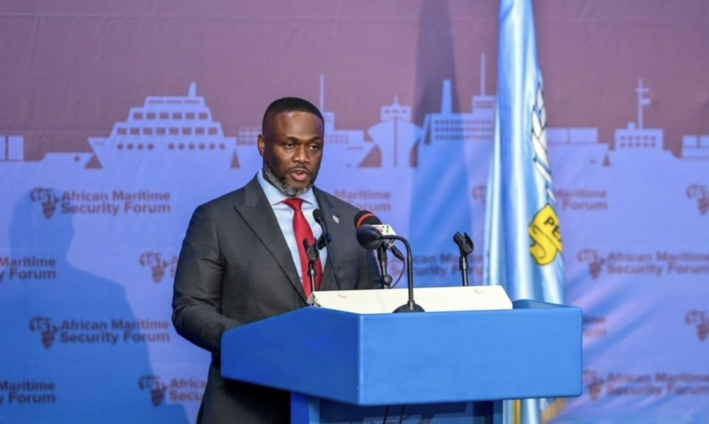
The call comes as the country hosts the maiden African Maritime Security Forum in Accra, bringing together naval leaders, security experts and policymakers to discuss emerging maritime threats and strengthen cooperation across the continent.
The two-day forum, being held from October 14 to 15 at the Kofi Annan International Peacekeeping Training Centre (KAIPTC), was organised by the KAIPTC, the Royal Danish Defence College (RDDC) and the Security Institute for Governance and Leadership in Africa (SIGLA) at Stellenbosch University in South Africa.
The forum builds on annual maritime security conferences organised by the three institutions since 2022, which primarily focused on the Gulf of Guinea.
Its expansion into a continent-wide platform reflects growing concerns that geopolitical tensions and conflicts beyond Africa are disrupting international shipping routes, changing maritime traffic patterns and placing additional pressure on coastal states’ security capabilities.
Although piracy and armed robbery at sea in the Gulf of Guinea have declined significantly through regional cooperation and sustained patrols, underlying drivers of maritime insecurity persist.
These include limited naval capabilities, weak coastal governance, youth unemployment, environmental degradation, smuggling, trafficking and illegal, unreported and unregulated fishing.
Participants are expected to explore practical measures to improve maritime surveillance, strengthen cross-regional cooperation and develop policy recommendations to address evolving threats.
Mr Kenneth Gilbert Adjel, Minister of Defence, who opened the forum on Wednesday, said maritime insecurity could not be addressed by individual countries acting alone because criminal networks exploited connections between the sea, land and air to extend their activities across national borders.
He said Ghana recognised the sea not merely as a boundary or passage for commerce, but as a source of livelihoods, a strategic avenue for trade and a shared resource whose security was essential to national and regional prosperity.
“Maritime safety and security are not the responsibility of navies alone,” he said, stressing the need for cooperation among governments, industry, regional bodies and international partners.
The Minister said effective maritime security required countries to share information, strengthen operational cooperation, uphold the rule of law and build the capacity of institutions responsible for protecting their waters.
He said Ghana had national legislation, institutional policies and international conventions to regulate shipping, secure maritime boundaries, manage ports, protect the marine environment and oversee commercial activities.
However, he said those frameworks could achieve their intended objectives only when backed by capable personnel, effective coordination and a firm commitment to implementation.
Mr Adjel said Ghana valued its longstanding partnership with Denmark, which had provided military, financial and training support for maritime security in the Gulf of Guinea, as well as capacity-building support for special operations within the Ghana Armed Forces.
He cited support through the Danish Gulf of Guinea Maritime Security Programme, including a maritime simulation centre and the container-based Ship-in-a-Box training facility for anti-piracy tactics.
The provision of vehicles, equipment and tactical training for the Ghana Navy’s Special Boat Squadron and the Army Special Operations Brigade also reflected the partnership’s alignment with Ghana’s National Integrated Maritime Strategy, he said.
The Minister commended the KAIPTC for its contribution to maritime security policy, training, research and governance over the past decade, with support from the Danish Government.
He urged participants to produce practical recommendations that could be translated into policy and action, saying the forum’s success should be measured by strengthened partnerships, progress on commitments and improvements in the security of people who depended on maritime resources.
Air Vice Marshal David Anetey Akrong, Commandant of the KAIPTC, said the forum represented an important step towards a continent-wide approach to maritime governance.
He said the decision to establish the forum reflected the recognition that contemporary maritime threats extended beyond regional boundaries, requiring a platform linking developments in the Gulf of Guinea, Southern African sea routes and the Western Indian Ocean.
He said piracy in the Gulf of Guinea had declined significantly through regional frameworks and initiatives, including the Yaoundé Architecture, which had strengthened cooperation and coordination for sustained patrols.
However, the underlying drivers of maritime insecurity remained, including limited naval capabilities, weak coastal governance, youth unemployment, environmental degradation and maritime pollution, he said.
Air Vice Marshal Akrong also drew attention to the growing use of the Cape sea route by international shipping seeking to avoid instability around the Red Sea and other strategic passages.
He said the resulting changes in shipping patterns demonstrated how crises beyond African waters could have direct security, economic and operational consequences for countries along the continent’s coast.
The forum’s discussions would therefore examine geopolitical developments, maritime security governance, emerging technologies and practical measures to strengthen cooperation across regions.
Danish Ambassador to Ghana, Mr Jakob Linulf, said Denmark’s partnership with African institutions had contributed to reducing piracy and strengthening the capabilities of maritime security personnel.
He said more than 1,000 military and civilian security officers had been trained through Denmark-supported initiatives to improve maritime security capabilities across Africa.
Mr Linulf said Denmark had also supported the establishment of specialised training facilities in Ghana and Nigeria, where maritime law enforcement personnel could practise crime interdiction and investigations.
He said the changing security environment, particularly geopolitical tensions in the Middle East, was disrupting major maritime trade corridors and increasing pressure on African coastal states as vessels diverted around the Cape of Good Hope.
The Ambassador called for stronger national ownership, regional cooperation and coordination among maritime stakeholders to safeguard freedom of navigation.
He said the forum provided an opportunity to exchange experiences and develop Africa-led solutions to maritime security challenges.
The organisers expect the forum to strengthen professional networks among maritime stakeholders in West, Southern and East Africa and develop a shared understanding of how geopolitical developments and emerging technologies are reshaping maritime threats.
They also plan to issue an official communiqué and one or two policy briefs for national and regional decision-makers, alongside identifying further research activities.
Latest Stories
-
Fire at GRIDCo’s Mallam Substation cuts power to parts of Accra
49 seconds -
Stephen Amoah criticises 20% digital services tax as excessive
2 minutes -
Ghana secures $3.5bn investment commitments to revive oil and gas sector – Jinapor
7 minutes -
Court to hear Wontumi’s bail application today
7 minutes -
DPC flags six companies for data protection breaches
13 minutes -
Chief Justice appointment from outside Supreme Court possible but unlikely – Bentil
14 minutes -
NEDCo replaces faulty transformer at Saasigli
17 minutes -
Dr Seidu Jasaw urges climate financiers to align funding with farmers’ planting seasons
21 minutes -
Bank of Ghana urges public to uphold dignity of local currency
22 minutes -
Global Chairman of World Assemblies of God Fellowship lauds Mahama’s sterling leadership
27 minutes -
Global economy’s resilience nearing limits – IMF
34 minutes -
Trust-building is crucial for sustaining confidence with communities – Police Commander
39 minutes -
Government to redevelop Aboabo Market in Tamale – Mahama Ayariga
45 minutes -
We haven’t handed over our forex role to Goldbod – BoG Governor Asiama
49 minutes -
AG urges Legal Aid Commission to expand services to districts
50 minutes