

Audio By Carbonatix
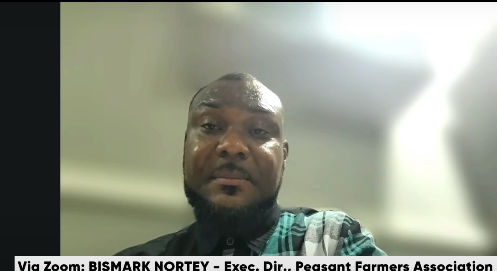
The Executive Director of the Peasant Farmers Association, Bismark Nortey, has raised concerns about the worsening impact of illegal mining (galamsey) on farmlands and livelihoods.
Speaking on JoyNews’ AM Show, he said the galamsey situation is not getting any better, and it is making a lot of farmers very frustrated and disturbed about the situation.
Mr. Nortey explained that his outfit has started working with farmers to collect data from selected areas that are galamsey hotspots in order to understand the extent of farmland destruction and the disruption of livelihoods.
According to him, in the Ashanti Region alone, information gathered from about three or four districts revealed not less than 3,488 acres of farmland destroyed. These include cocoa, plantain, cocoyam, and other farms.
He added that this has directly affected more than 5,491 farmers, many of whom have had to abandon farming because they no longer have land to work on.
“The saddest thing is that the farmers are in fear of victimisation. They are even afraid to speak out because they know who the kingpins of the galamsey are. But for fear of being attacked, they just have to keep quiet and suffer the consequences. That is the danger that we are facing,” he said.
Mr. Nortey further noted that the menace is also destroying irrigation facilities and water sources. He cited the Shama District in the Western Region, where rice farmers who used to rely on irrigation to farm all year have now been forced to switch to one-season farming because of polluted water.
He also raised concerns about food quality. He said some farmers are now forced to farm on degraded land or use contaminated water to irrigate their crops, which poses serious risks to food safety.
“For us as farmers, we don’t think that the situation is getting really better,” Mr. Nortey stressed.
He warned that the government’s Feed Ghana programme, which has the goal of reducing food imports, increasing food productivity, and producing for industry, risks failure if illegal mining is not addressed.
“How can you increase your production when your farmlands and water bodies that the farmers are going to use are being destroyed?” he asked.
Latest Stories
-
US Court backs extradiction of former MASLOC CEO Sedina Tamakloe-Attionu’s to Ghana
14 minutes -
Seven arrested as NAIMOS dismantles illegal mining camp, seizes firearms at Boin River
16 minutes -
Fire erupts at Madina Ritz Junction, destroys multiple wooden structures and containers
30 minutes -
Daniel-Kofi Kyereh returns from long-term injury, registers assist for Freiburg U23
43 minutes -
Knifeman calling himself ‘Lucifer’ slashes three at NYC’s Grand Central
58 minutes -
Brands are built from within to without
58 minutes -
Matriculants urged to pursue excellence as gov’t reaffirms support for Maritime education
1 hour -
See the areas that will be affected by ECG’s planned maintenance on Monday, April 13, 2026
1 hour -
GPL 2025/26: Salim Adams double fires Medeama back to summit after Kotoko rout
1 hour -
Two robbery suspects convicted following violent gold dealer attack in Obuasi
1 hour -
Supreme Court @150: Fanfare meets reflection as nationwide activities roll out
1 hour -
Padel for Parkinson’s cycling event promotes awareness at University of Ghana
2 hours -
GPL 2025/26: Samuel Tetteh brace fires Nations FC past Basake Holy Stars
2 hours -
Ghana’s oil trade position close to net neutral in near term – Fitch
2 hours -
IMANI Africa President urges greater awareness and support for Parkinson’s Disease patients
2 hours