

Audio By Carbonatix
In early June 2026, a group of illegal miners did something that should alarm every Ghanaian.
They went live on TikTok. Not through anonymous accounts. Not through leaked footage. Not through secretly recorded videos. They livestreamed their activities in broad daylight, seemingly unbothered by the possibility that law enforcement agencies, journalists, environmental activists, or ordinary citizens might be watching.
A month before that, another individual took to Facebook to boast about making GH₵2,000 a week from galamsey. In a tone that was quite triumphant, he compared his earnings to those of some PhD holders in Ghana, presenting illegal mining as a lucrative career path rather than a criminal offence. That should concern us.
When people begin to publicly celebrate illegal activity, it suggests more than economic desperation. It suggests a growing belief that the law is either absent, unwilling, or unable to act.
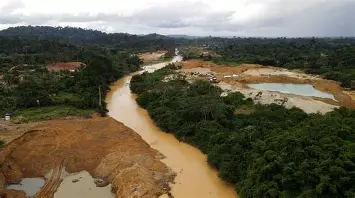
June 22 was World Rainforest Day. Around the world, conversations were centred on preserving forests and protecting ecosystems that sustain life. In Ghana, however, today arrives against the backdrop of a crisis that has become painfully familiar: the continued destruction of forests and water bodies by illegal mining.
There was a massive flood at Samreboi in the Western region yesterday. The Western Regional Minister Joseph Nelson suggested that years of illegal mining activities along the River Tano and River Samre may have exacerbated the recent flooding in Samreboi and surrounding communities, arguing that protecting river bodies is critical to preventing future disasters.
Ghana’s anti-galamsey movement has been driven by activists and civil society groups, including Awula Serwah, The Multimedia Group’s Erastus Asare Donkor, Oliver Barker-Vormawor, Eco-Conscious Citizens, Democracy Hub, the Fix The Country Movement and the Ghana Youth Environmental Movement (GYEM), all of whom have played significant roles in raising awareness and demanding stronger action against illegal mining.
Yet the problem remains stubbornly persistent. Perhaps the most troubling development is not that galamsey continues. It is that some perpetrators appear increasingly comfortable displaying it publicly.
Traditionally, criminals attempt to conceal evidence of wrongdoing. They avoid surveillance. They minimise exposure. They operate in secrecy.
But what are we to make of a situation where individuals can livestream illegal mining activities or boast about them online without any visible fear of repercussions? The answer may lie in the perception of enforcement.
A law loses part of its deterrent power when people no longer believe there are consequences for breaking it. The more visible the offence becomes without visible accountability, the stronger the message that enforcement is selective, inconsistent, or ineffective.
This is not merely an environmental issue. It is a rule-of-law issue. If social media users can identify alleged acts of illegal mining from videos circulating online, why should state institutions with investigative powers be unable to do the same? If evidence is being voluntarily uploaded to public platforms, why does it appear easier for citizens to find it than for authorities to act on it?
These questions become even more pressing in light of efforts to strengthen investigative capabilities. Law enforcement agencies continue to acquire new technologies and surveillance tools designed to assist in tracking criminal activity and gathering digital evidence. Such investments are welcome. However, technology alone cannot solve a problem if there is insufficient urgency to deploy it.
Our forests are disappearing. Our rivers continue to suffer contamination. Communities are bearing the consequences. And increasingly, some of those contributing to the destruction appear comfortable enough to showcase it online.
That should worry all of us. With World Rainforest Day, the question is no longer whether galamsey exists. The question is whether Ghana is prepared to respond with the consistency and seriousness that the crisis demands.
If illegal mining can be livestreamed in real time and celebrated on social media without consequence, then the issue is no longer just environmental degradation. It is the dangerous normalisation of lawlessness.
Latest Stories
-
Ho Central Mosque reopens amid unresolved leadership dispute that led to closure
32 minutes -
Minority caucus questions GH¢16.4m in Ablakwa’s SA evacuation spending, demands independent audit
41 minutes -
Gender Ministry meets Nana Akua Addo’s husband over domestic violence after hospital discharge
2 hours -
UG Vice-Chancellor urges swift operationalisation of National Research Fund
2 hours -
Pope Leo to have surgery after lump found in lung
2 hours -
Joseph Cudjoe writes: Ghana must break free from the dangerous mindset that natural resources are the foundation for wealth
2 hours -
Children among 109 dead after boat capsizes off Djibouti, UN says
2 hours -
OmniBSIC Bank’s 11th health walk promotes fitness and business growth
3 hours -
2026 World Maritime Day: Danish Embassy organises “The Gulf of Guinea Speaks”
3 hours -
New Economy will tackle unemployment and restore hope – Ato Forson
3 hours -
IMMILAC president recounts personal losses as security women lead breast cancer awareness campaign in Wa
3 hours -
University of Ghana postpones October 12 reopening as GAUA strike persists
3 hours -
Bahass Foundation launches vocational skills training to support mental health recovery in Wa
4 hours -
NPP orders parliamentary aspirants and their supporters to suspend campaign activities
5 hours -
Techiman unites against child marriage: Joy Impact Makers Awardee leads charge on International Day of the Girl Child
5 hours