

Audio By Carbonatix
The Chief Economist and Head of the Economic Research Department at Development Bank Ghana (DBG) says the Ghana Commodity Exchange (GCX) needs a massive reform to ensure food security in the country.
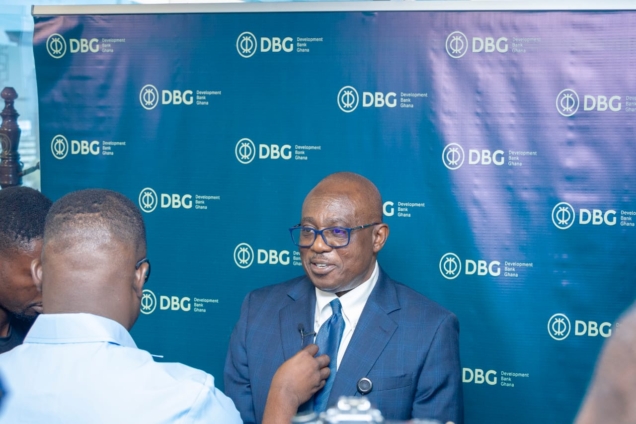
Dr Kwabena Opuni-Frimpong when presenting the findings of the Bank’s multi-stakeholder value chain workshops held across a number of regions in the country, recommended a six-point plan which he believed is the paradigm shift Ghana needs in its agriculture sector.
According to him, the GCX needs to become an aggregator in the agricultural sector to not only provide inputs and materials necessary to facilitate the farmer's work but to collect all produce during harvest and store them.
This move, he said, would solve Ghana’s food insecurity since there will always be food in store for consumption.
“So we recommended that they set up a warehouse commodity which is called MCCL which will become a subsidiary of GCX.
“And that Subsidiary company will be the one that will interact with the farmers at the point of giving them the inputs, at the point of taking the harvest to the point of storage and GCX itself will do the trading [of the produce],” he said on Monday.
Acknowledging that the GCX is currently under-equipped to perform the task, Dr Opuni-Frimpong noted that GCX needed an overall rehabilitation including the construction of new warehouses and the renovation of the existing ones to make them conducive to storing the produce.
He also estimated that an amount of $200 million would be needed to make GCX capable to perform this task.
“What we had from our estimate as well as speaking with GCX is that we may require about $200 million in seed capital if we really want this to go ahead. Remember that they have to buy stock from the farmers, they have to store and do a lot of other things too
“DBG cannot provide that amount of money but I believe that DBG can work with other equitable funders in Ghana who may be willing to do that. Government may want to take a stake into it because I think this is a national security issue,” he said.
The economist also called for GCX to be given the same mandate as the Ghana Cocoa Board so that individuals do not export the food that “we need to survive on when we don’t have enough in stock.”
“A lot of the maize that we get in the lean season are produce that is grown in Ghana, sent to Burkina Faso and dried and kept in warehouses and in the lean season they bring it back to us at a higher price,” he indicated.
Speaking on when these recommendations would ever materialise, Dr Opuni-Frimpong said that relevant stakeholders including the Ministry of Food and Agriculture have been engaged on the issue.
He was therefore optimistic that this recommendation, along with the others the Bank has proposed, will be implemented in due course.
Latest Stories
-
Imagination Africa, Mentors Chess Academy to host second African Genius Chess Championship at Ghud Park
2 hours -
Techiman South MP ends decades of water struggle in Asutia
3 hours -
Three things we’ve learnt about the UK economy from the IMF
3 hours -
Nana B passport claims a diversionary tactic — Abu Jinapor
3 hours -
Pope Leo diagnosed with cancer as doctors remove lobe of lung, Vatican says
3 hours -
Legal Aid Commission takes free legal services to Techiman main lorry terminal
3 hours -
Nana B denies seeking passport favour, accuses Ablakwa of failing to account for GH¢16.4m
3 hours -
Young girls demand climate action, stronger protection against child marriage
4 hours -
Ex-gang boss sentenced to 40 years for orchestrating Tupac Shakur’s murder
4 hours -
From near-deferral to three awards: UMaT graduate’s academic journey
4 hours -
Atta Akyea denies seeking presidential pardon for Wontumi in galamsey case
4 hours -
Sasaabi scam centre busted: 19 arrested, 117 trafficking victims identified in global crackdown
4 hours -
Photos: Mahama commissions 85-bed Police Hospital ward, donates two ambulances
4 hours -
GTEC directs Ghana’s public universities to reopen by October 16 and begin lectures on October 19
4 hours -
Star Oil donates GH¢1million towards construction of new CID facility
5 hours