

Audio By Carbonatix
Agriculture Minister Bryan Acheampong has assured Ghanaians of the capacity of his outfit to handle the food security needs of the country.
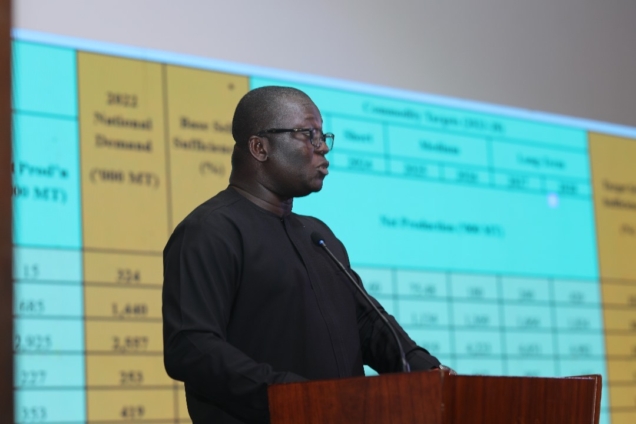
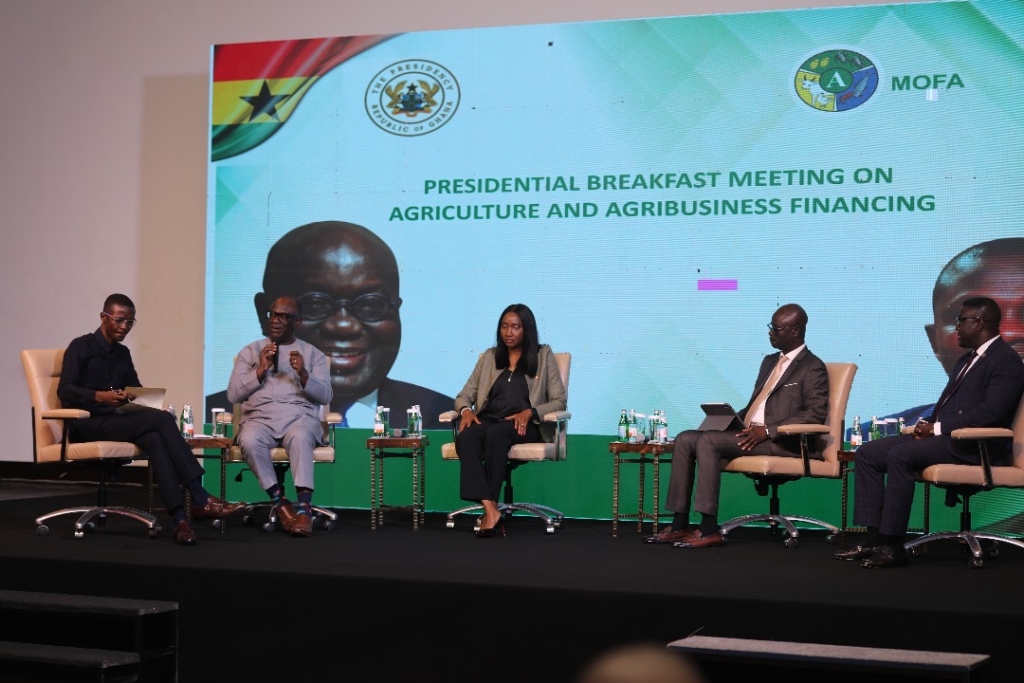
Dr. Bryan said this when he addressed farmers and financial institutions at a Presidential Breakfast Meeting on Agriculture and Agribusiness Financing in Accra.
The Minister indicated that Ghana can boldly say and boast that it will be food-secured and resilient in five years.

He, however, lamented the embarrassing narratives, like importing onions and tomatoes from the Sahelian regions, He affirmed his commitment to reverse the trend as soon as possible.
The enormity of leading the charge to transform Ghana’s agriculture through the new strategy has never been lost on me, right from the inception of my stewardship,” he added.
He expressed positivism of the existing potential of the agriculture sector, which should easily change the fortunes of Ghana if fully tapped.
They include; abundant arable land for crop production, especially the virgin valleys suitable for rice production, good soils for the production of a variety of crops, across the country, water resources for irrigation, favourable weather, and a diversity of food commodities that provide numerous avenues for job creation along the agriculture value chain, to mention a few.

The Minister also indicated how PFJ 2.0 will work as an intervention on a sound footing. According to Dr. Bryan statistics have it that, for poultry, Ghana consumes a total of 324,000 MT, and is only able to produce just about 15,000 MT, implying a woeful self-sufficiency of under 5%.
In the five-year plan of PFJ 2.0, Ghana is expected to move its self-sufficiency from 5% to 7% by the end of 2023, and to 13% in 2024, and progressively attain full self-sufficiency of 110.6% by 2028. Specific steps have been taken in this regard.
In this conclusion, Dr Bryan announced that, in the immediate term (October to December 2023), MoFA is supplying 4.5-million-day-old chicks, vaccines, and starter-pack feed to anchor farmers and their out-growers.
This intervention will result in the production of an additional 13,200 MT of poultry meat by the end of this year, which will increase Ghana’s self-sufficiency to 7%.
In 2024, he said the ministry will ramp the poultry sector up with support to 18 million day-old chicks, vaccines, and starter-pack feed, which will lead to the production of 42,600 MT of meat and increase our self-sufficiency to 13%. This trajectory will continue until we reach full self-sufficiency.
Plans are also advanced to revive the poultry industry this year through the rehabilitation of 300 outgrown poultry farms across the country over the next 12 months.
Each of these farms can be scaled to produce 200,000 birds within each poultry cycle of 4 months.
Latest Stories
-
GAEC must retain nuclear scientists for Ghana’s nuclear ambitions – Minister
23 minutes -
Man reportedly mistaken for game and shot by hunter dead in forest
25 minutes -
19-year-old mason jailed 15 years for defiling seven-year-old pupil
29 minutes -
Ghana’s banking sector assets rise 20.47% to GH¢500.2bn – BoG Governor
33 minutes -
22 injured as Sprinter bus overturns at Sege after tyre burst
35 minutes -
UN housing expert urges Ghana to strengthen Rent Control Department amid housing affordability concerns
43 minutes -
Delta-BCI partnership reaches 166,000 people with breast cancer education
53 minutes -
Power restoration fault suspected in Kumasi Central Market fire
6 hours -
The 7-foot giant of Ngleshie Amanfro: Seven-foot Ghanaian Ephraim Saawa dreams of joining the national basketball team
7 hours -
Government promises support for Kumasi Central Market fire victims
7 hours -
Vibes The Movie: Big Ghun’s Ghanaian film earns five nominations at 2026 REFFA
7 hours -
‘I’m a fulfilled man’—Justice Korbieh on missing out on Supreme Court despite two nominations
7 hours -
MamaCare CEO warns unresolved conflicts among health workers could undermine maternal and neonatal care
8 hours -
Health professionals urged to translate medical knowledge into practice to save mothers
8 hours -
Retired judge Justice Francis Korbieh charges 1,568 new lawyers to uphold integrity
9 hours