

Audio By Carbonatix
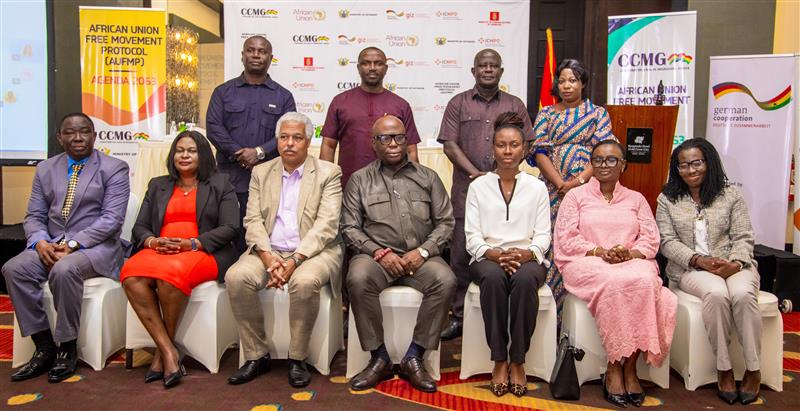
Ghana has taken a bold step toward accelerating the ratification of the African Union’s Free Movement of Persons (AU FMP) Protocol by hosting a two-day National Dialogue in Accra. The dialogue was convened by the Ministry of the Interior in partnership with the Coalition of CSOs in Migration, Ghana (CCMG), with support from the German Development Cooperation and the International Centre for Migration Policy Development (ICMPD).
The event united key stakeholders such as the African Union (AU), Ministry of the Interior, GIZ Ghana, ICMPD, IOM Ghana, members of the CSOs Coalition on Migration Ghana, and various government institutions to deepen collaboration and fast-track regional momentum on the ratification and implementation of the AU’s Free Movement of Persons Protocol.

In his keynote address, the Deputy Minister for the Interior, Hon. Ebenezer Okletey Terlabi, reaffirmed Ghana’s commitment to regional integration and effective migration governance under the AU’s Agenda 2063. He stated that “The dialogue presented an important opportunity to align national perspectives and stimulate informed debate towards accelerating the ratification process as part of Ghana’s broader role in fostering African unity and economic development.”
Speaking on behalf of the AU, Dr. Olamuyiwa Oluwafemi Solomon, Free Movement Protocol Officer, Department of Health, Humanitarian Affairs and Social Development of the African Union Commission, underscored the AU Free Movement Protocol’s pivotal role in facilitating trade across Africa. “The African Continental Free Trade Area (AfCFTA) and the Single African Air Transport Market (SAATM) remove barriers to goods and services and enable the movement of people, essential for business and investment.”
Mr. David Robert, Head of Project, Digital Transformation Centre, GIZ Ghana, spoke on behalf of the German Development Cooperation and highlighted the importance of free movement in driving economic development, regional integration, and migration management. “Free movement is not just a humanitarian or social issue, but a strategic economic opportunity—a business case for Africa and partner regions such as Europe, including Germany and Ghana.”

Speaking for the CSOs Coalition on Migration, Mr. Eric Peasah stressed Africa’s rich history of mobility and trade, contrasting it with today’s restrictive visa regimes and fragmented migration policies that hinder integration and development.
The dialogue also drew valuable lessons from Rwanda’s experience, where the removal of visa restrictions has significantly fueled economic growth—especially in the tourism and hospitality sectors-doubling revenues between 2020 and 2024.
At the close of the event, a communiqué was adopted, affirming commitments from members of the national coordination mechanism-including ministries, departments, agencies, and civil society organisations intensify efforts toward Ghana’s ratification of the AU FMP Protocol. Among other things, the communiqué recognised the critical role of parliament in championing the AU FMP and called for enhanced advocacy, policy coherence, and collective stakeholder engagement to achieve ratification by December 2027.
About Programme “Shaping Development-Oriented Migration” MEG
The Global Programme “Shaping Development-oriented Migration” (MEG), which is closely aligned with the Global Compact for Safe, Orderly and Regular Migration (GCM), supports partner countries to make gender-responsive contributions to the GCM, focusing on regular migration, diaspora cooperation, mitigating precarious situations, and fostering global partnerships with a whole-of-Government and whole-of-Society approach.
About GIZ
As a provider of international cooperation services for sustainable development and international education work, GIZ is dedicated to building a future worth living around the world. GIZ has over 50 years of experience in a wide variety of areas, including economic development and employment, energy and the environment, and peace and security. We work with businesses, civil society actors, and research institutions, fostering successful interaction between development policy and other policy fields and areas of activity. The German Federal Ministry for Economic Cooperation and Development (BMZ) is our main commissioning party.
Currently, GIZ promotes sustainable development in Ghana via about 50 programmes and projects. Our activities currently cover three priority areas: Energy and Climate, with a concentration on renewable energy and energy efficiency; Training and Sustainable Growth for Decent Jobs; and Peaceful and Inclusive Societies, which looks at good governance. For more information, please visit www.giz.de/ghana.
Latest Stories
-
Hussein Mohammed: Hearts midfielder hit with three match ban for attempting to slap referee
11 minutes -
Ukraine ceasefire talks continue as US says ‘progress was made’
12 minutes -
Airbnb fined £56m by Spain for advertising unlicensed properties
12 minutes -
Uncle Ebo Whyte wraps ‘Order for Four’, blends politics, love, and music in festive stage hit
14 minutes -
Asokore Mampong: 2 suspected robbers arrested for killing 28-year-old woman, stealing iPhone 11
16 minutes -
Three Americans killed by IS gunman in Syria, US military says
16 minutes -
Shock and grief after director Rob Reiner and wife Michele found dead
17 minutes -
We’re ready for Kpandai rerun – Electoral Commission
26 minutes -
GACL opens overflow car park at Kotoka airport ahead of Christmas rush
28 minutes -
Cool off this festive season at Joy FM’s family party in the park this boxing day
34 minutes -
Atiwa East DCE fined GH₵12,000 for contempt in galamsey case
1 hour -
Ghana must industrialise or perish: The urgent case for economic self-reliance
1 hour -
Bawumia was a driver’s mate and could not overrule the driver – Adwoa Safo mounts strong defence
1 hour -
Ofori-Atta’s 20% killer tax destroying 24-Hour industralisation
1 hour -
Former Black Galaxies and Great Olympics coach Annor Walker to be laid to rest in January
2 hours