

Audio By Carbonatix
Talks between Ukraine and the US aimed at reaching a peace deal with Russia are continuing in Berlin for a second day.
Zelensky and his chief negotiator Rustem Umerov met US envoy Steve Witkoff and Donald Trump's son-in-law Jared Kushner for five hours on Sunday, joined by German Chancellor Friedrich Merz.
"A lot of progress was made," a US readout said. The same team resumed talks on Monday morning.
Ahead of the start of the meeting, Volodymyr Zelensky signalled he would give up ambitions to join Nato in exchange for security guarantees.
Recognising that "some partners from the US and Europe" did not support Ukraine's bid for Nato membership, Zelensky said he was instead seeking strong security guarantees modelled on Nato's Article 5 clause of mutual protection.
"And this is already a compromise on our part," he said on Sunday.
Witkoff has travelled to Moscow to hold talks with Vladimir Putin on several occasions, but Sunday's meeting at the chancellery in Berlin was the first time he met Zelensky. Nato Supreme Allied Commander Europe General Alexus Grynkewich was also present at the talks.
Several European leaders as well as European Commission President Ursula von der Leyen are expected to join further talks with the Ukrainian and US delegations on Monday evening.
At the core of the discussions in Berlin is the 20-point peace plan proposal presented to the US by Ukraine last week to counter an initial American plan which was seen as heavily favouring Russia.
Details haven't been shared, but last week Zelensky said the points should be seen as a "foundation" on which to build provisions for the reconstruction of Ukraine and security guarantees.
For Russia, Kyiv's membership of Nato is a red line, and Moscow has repeatedly demanded that any ambitions for Ukraine to join the alliance are shelved forever. "This issue is one of the cornerstones and requires special discussion," said the Kremlin on Monday.
The US too has repeatedly stated it does not want Ukraine to be part of Nato. But Kyiv fears that a peace deal without watertight security guarantees would fail to detract Russia from attacking again.
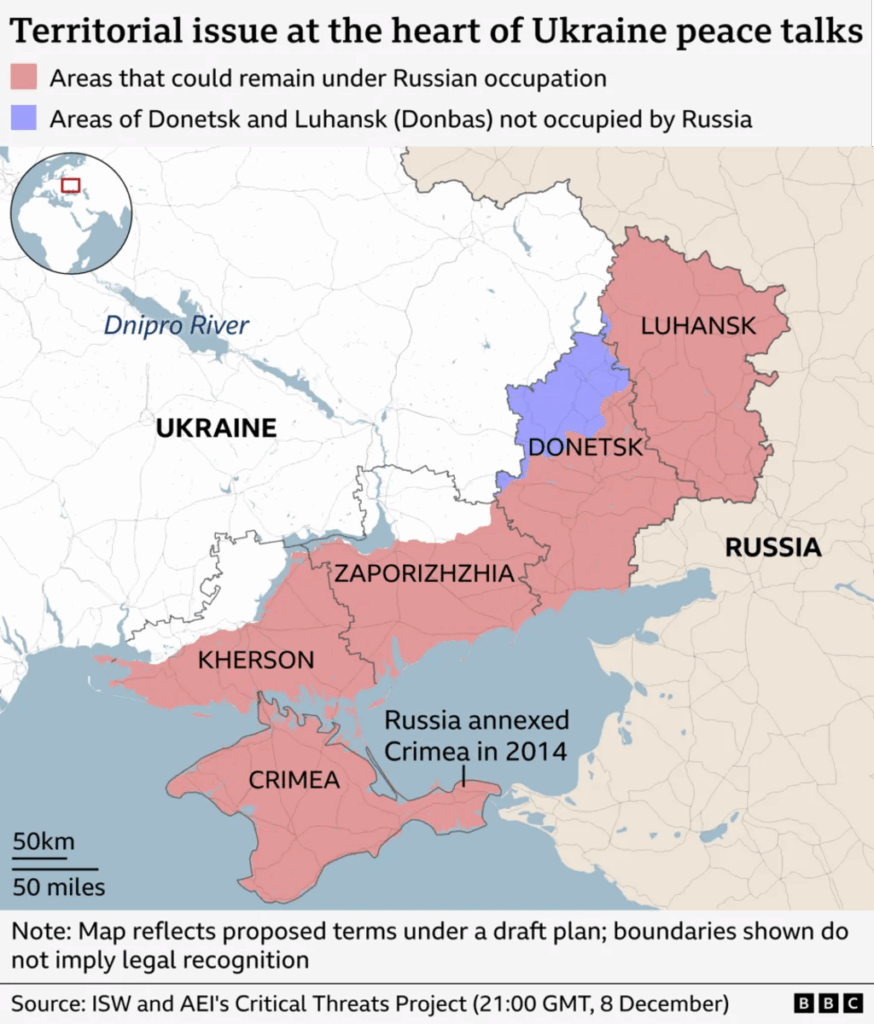
Before the talks began, Zelensky also addressed the thorny issue of sovereignty over the eastern region of the Donbas, which Russia mostly occupies and which it wants Kyiv to hand over in their entirety.
The Ukrainian president said that while he was open to freezing the conflict along the current front line he was not prepared to have his troops withdraw from the percentage of the Donbas they still hold - unless Russian forces did the same in the areas they control.
For it to be a fair arrangement Russia would have to withdraw the same distance, Zelensky said. This matter was "extremely sensitive and heated," he added.
Any proposal hashed out by the Ukrainian, American and European side will still have to be presented to Moscow – although Zelensky said that the US delegation "so to speak present the Russian side's perspective, because they relay Russia's signals, demands, steps, and indications of readiness or lack thereof."
The Kremlin said it expected the US to provide us with the "concept" discussed on Monday.
The talks in Berlin come at a crucial time for Ukraine, which is enduring its fourth winter of war amid sustained power cuts caused by Russia's attacks on its energy facilities. Over the weekend more than a million households in Ukraine were left without electricity following a barrage of strikes.
Later this week, EU countries will be voting on a plan to send €90bn (£78.6bn) worth of frozen Russian assets held in a Belgium-based financial institution to prop up Ukraine's economy.
On Friday, EU governments agreed to immobilise the Russian assets indefinitely - but there is no consensus yet on whether they can be sent to Ukraine. Belgium has been resisting the legally contentious proposal, and in recent days other countries, including Italy, have said "alternative options" should be put forward.
EU foreign policy chief Kaja Kallas acknowledged the discussions were "increasingly difficult".
"But we're doing the work, and we still have some days," she added.
Latest Stories
-
Fire destroys belongings in Akweteyman apartment
7 minutes -
Baffour Awuah to turn himself in to EOCO today – JoyNews sources
12 minutes -
Government identifies payment discrepancy holding up teachers’ strike resolution
30 minutes -
BoG signals no FX intermediation for October as GoldBod plans $1bn support for banks
34 minutes -
When share ownership becomes personal: The African mindset of the Dangote IPO
44 minutes -
Why MFWA Legal Fund matters to Ghana’s democracy
44 minutes -
Fuel prices to rise from October 1; diesel could hit GH¢19.60 – COMAC
45 minutes -
Parliament must investigate how 3.9 tonnes of cocaine left Ghana undetected – Samuel Jinapor
45 minutes -
Government pledges to pay striking teachers as payment dispute is resolved
59 minutes -
Government cannot investigate drug exports under its own watch – Abu Jinapor
1 hour -
Government extends GH¢2 diesel subsidy for two more months
1 hour -
GTEC flags over 100 tertiary institutions as unrecognised
1 hour -
Agric Committee chair commends NAFCO for turnaround from GH¢20m debt to GH¢96m profit
1 hour -
NPP: Judicial office requires judges to surrender some personal freedoms
1 hour -
Senyo Hosi: Ghana missed its chance to end galamsey under Akufo-Addo
1 hour